

Last Updated on August 4, 2025 by The Official Game Rules Team
Mistborn is a narrative-driven tabletop roleplaying game (TTRPG) set in Brandon Sanderson’s Mistborn universe. Players assume the roles of heroes—or scoundrels—who live in the Final Empire or Scadrial, trying to change the world or survive its brutal systems. The game is story-first and emphasizes creativity, teamwork, and character development.
- System: Custom ruleset focused on Traits and Action Dice Pools
- Players: 2–6 recommended
- One player is the Narrator (Game Master equivalent)
- Play Style: Collaborative storytelling with cinematic action and optional dice mechanics

This post contains affiliate links. For more information, see our disclosures here.
How to Play Mistborn
Welcome to Brandon Sanderson’s Mistborn®!
Set in the scarred world of Scadrial, Mistborn: The Deckbuilding Game™ throws powerful Mistborn against one another in fierce battles across Luthadel — a city shrouded in ash and mist, ruled by the enigmatic Lord Ruler and his deadly Steel Inquisitors.
You take on the role of a Mistborn, consuming and Burning metals to unlock devastating superpowers. Burn Steel to launch bullet-like coins at your enemies, Pewter to gain superhuman strength, Tin to sharpen your senses, and much more. Each game offers the chance to explore unique strategies: will you focus on Steel and Iron to deal heavy damage, specialize in Bronze and Copper to evade opponents and gain advantages in the Market, or mix a variety of metals to keep your enemies guessing?
Victory can come in many forms — complete a series of challenging Missions or eliminate all rival players directly. And once you’ve mastered dueling each other, join forces in cooperative or solo mode to take on the Lord Ruler and his minions, using the special Lord Ruler deck included in the game.
Click here to watch the video tutorial
Components
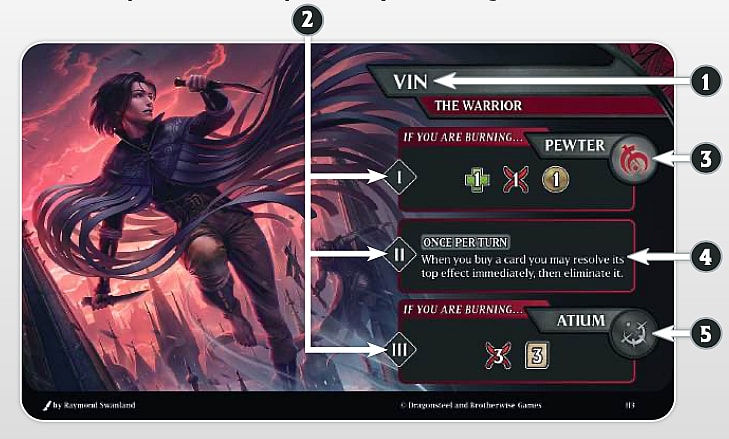
- 4 Character Cards
- 4 Starter Decks (10 cards each)
- 82 Market Cards
- 8 Mission Cards
- 36 Lord Ruler Challenge Cards
- Lord Ruler Card and Dominance Track Card
- 16 Atium Tokens
- 4 Player Training Tracks
- 4 Health Dials with Matching Tracking Cubes
- 4 Sets of 8 Metal Tokens (32 total)
- 14 Boxing Tokens
- Target Standee
- Lord Ruler Dial and 8 Tracking Cubes
Setup
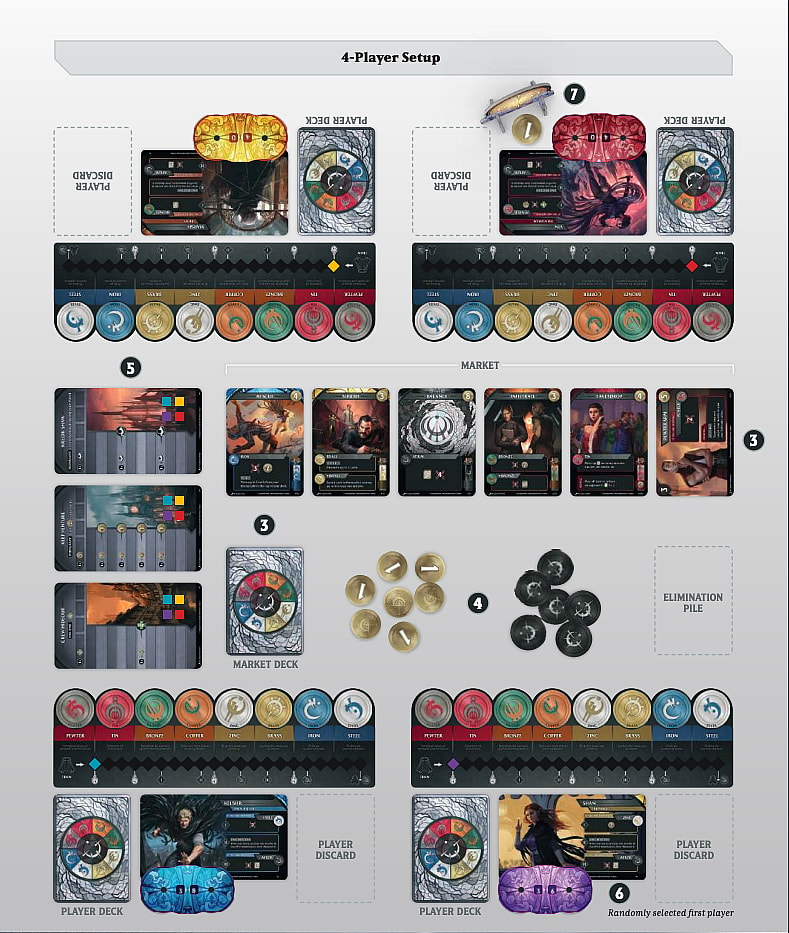
Draw starting hands:
Each player draws 5 cards from their deck to form their starting hand.
Distribute to each player:
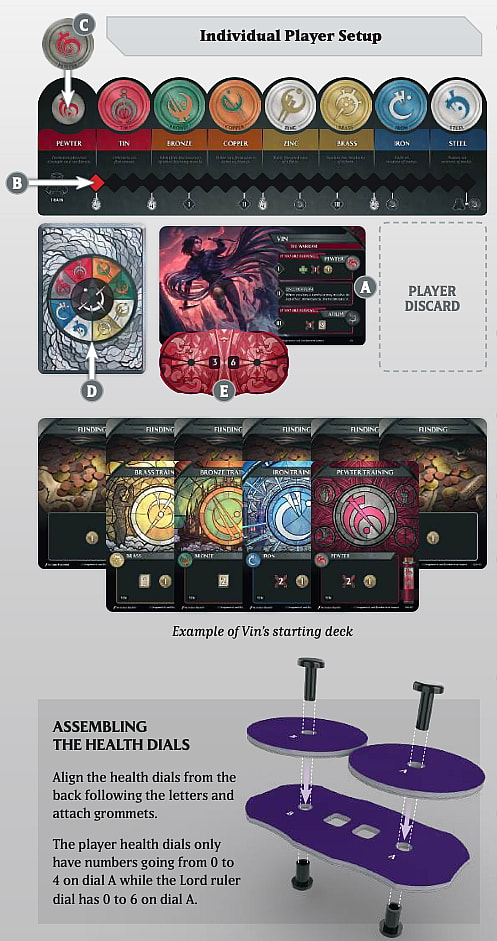
- One randomly selected Character Card.
- A Training Track and a tracking cube in their color, placed on the first step of the track.
- A set of 8 metal tokens placed on the designated spots above the Training Track.
- Their starting deck, made by shuffling 4 character-specific starting cards with 6 Funding cards.
- A health dial set to 36 health points.
If fewer than 4 players:
Remove all components belonging to unused players, including their starting cards and Funding cards.
Prepare the Market:
Shuffle the Market deck and reveal the top 6 cards in a row.
Place tokens:
Place all Boxing and Atium tokens near the Market, accessible to all players.
Missions:
Shuffle the Mission deck and reveal 3 Mission cards. The rest are set aside. Place one tracking cube from each player on each Mission card’s right-side image.
Determine first player:
Choose a player to start.
Adjust starting health:
- The player to the first player’s left (second player) receives 2 extra health.
- The third player (if present) receives 4 extra health.
- The fourth player (if present) receives 4 extra health and one Boxing token.
Target token:
If playing with more than 2 players, the Target token is given to the last player (counting clockwise).
Game Overview & Core Concepts
Mistborn: The Deckbuilding Game™ is a deckbuilder, meaning you begin with a modest deck and improve it throughout the game by acquiring new cards and removing weaker ones. Here are some essential deckbuilding rules:
- Each player maintains:
- A hand of 5 cards (A)
- A facedown deck (B)
- A faceup discard pile (C)
- Cards currently in play (D)
- Players can freely view their hand and discard pile at any time but cannot look through their facedown deck.
- On their turn, players may play cards in any order, placing them faceup in their play area until the turn ends.
- When gaining cards, unless otherwise stated, they go immediately to the discard pile faceup.
- At turn’s end, all cards in play (except Allies) and any remaining cards in hand are discarded to the discard pile.
- Players then draw 5 new cards to form their next hand.
- If a player needs to draw but their deck is empty, they shuffle their discard pile to form a new deck.
- Eliminated cards are removed from the game and placed in a shared eliminated pile visible to all players.
Strategy Overview
Your deck evolves continually during the game. Winning usually requires building the most effective deck aligned with your chosen strategy. You might:
- Create a lean deck with 5 powerful cards, playable every turn.
- Build a diverse deck to keep opponents guessing.
- Specialize in metals for strong combos, or diversify metals to cover many effects.
- Focus on direct combat, Mission points, or a balance of both.
- Pursue Atium for powerful, flexible plays.
Choose your strategy based on your character and the Market’s offerings.
Metals & Their Use
The source of a Mistborn’s powers is the metals they Burn. This is represented by the 8 metal tokens each player controls. Metals are used in several key ways:
Burning Metals
Most Action card abilities require you to “Burn” a metal.
- At game start, you can Burn only 1 metal token per turn.
- Moving up the Training Track or completing Missions unlocks the ability to Burn more metals each turn.
- To Burn a metal token, move it from its spot on the Training Track onto the card you want to power.
- At turn end, return Burned metals to their spots.
- You must Burn the metal the card requires (e.g., Pewter card requires Pewter metal).
- Cards themselves can also be used as metals by playing them sideways beneath a card needing that metal (e.g., a card that provides Steel can power a Steel card). This does not count against your limited metal tokens Burned, letting you power more cards each turn.
Flaring Metals
If you want to Burn more metals than your current limit, you can Flare metals.
- To Flare, flip an unused metal token face up and place it on a card or empty space.
- Flared metals count as Burned but remain flipped after the turn ends and can’t be used again until refreshed.
- You can Flare any number of metals per turn.
Refreshing Metals
- To refresh a Flared metal, discard a card from your hand.
- The discarded card must match one of the metals shown on the card’s bottom right vial.
- Refreshing does not count as Burning for abilities.
- Some cards and Missions allow refreshing any Flared metal without discarding a card.
- You may refresh a metal you Flared this turn and use it once again, but you cannot Flare, refresh, and reuse a metal multiple times in one turn.
Atium
Atium is the most powerful metal and is not available at game start.
- You acquire Atium tokens from the Training Track and Missions.
- Atium tokens can power Atium cards or substitute for any other metal.
- When used as a substitute, Atium counts as both Atium and the metal it replaces for Ally and character abilities.
- Atium tokens are single-use; return them to the supply at turn’s end.
- Atium cannot be Flared; you must have enough Burn actions left to use it.
- Atium cards can power any card or refresh any Flared metal (when discarded or played sideways).
- If Atium tokens run out, use placeholders to represent more.
Metals and Their Effects
| Metal | Primary Effect | Special Ability |
|---|---|---|
| Pewter | Provides Combat and Healing | Defender: Pewter Allies protect you and other non-Defender allies from damage. |
| Tin | Focus on Mission Points and Coins | Sense: Limits opponents’ Mission Track advances. |
| Bronze | Grants Mission Points; market abilities | Seek: Use the top effect of any Market Action card (not Ally). |
| Copper | Various effects, including healing and blocking damage | Cloud: Reduces damage to players or allies, may prevent passing the Target token. |
| Zinc | Primarily grants Coins; activates Allies without Burning metals | Riot: Activate any Ally’s top effect once per turn without Burning metals. |
| Brass | Mission Points, Coins, card elimination | Soothe: Eliminate cards from hand, discard, or play. Effects still apply this turn. |
| Iron | Combat focus; prepares for future turns | Pull: Move cards from discard pile to top of deck. |
| Steel | Combat, Coins, Market manipulation | Push: Eliminate any Market card immediately, replacing it. |
| Atium | Powerful Mission and Combat Points | Used to power any card or refresh metals (see above). |
Cards Overview
Each card includes:
- Name: The card’s name.
- Cost: How many coins needed to acquire it from the Market.
- Metal Requirement: The metal token or card needed to activate its main ability.
- Primary Effect: What happens when the metal is Burned.
- Secondary Effects: Some cards unlock extra abilities when additional metals are Burned (e.g., a second Iron).
- Metal Pairing: Cards belong to a metal pair (e.g., Steel/Iron), enabling flexibility in powering or refreshing metals.
- Savant Abilities: Triggered when the card is used as a metal instead of as an Action.
- Off-turn Effects: Some cards have discardable effects usable outside your turn.
Strategy Tip on Eliminating Cards
Cards with Soothe ability and certain Missions let you eliminate weaker cards from your deck. Removing less powerful cards increases the chances of drawing stronger cards each turn. You may eliminate cards from your hand, discard pile, or played cards (activated this turn). Place eliminated cards in a shared eliminated pile.
Ally Cards
Ally cards differ from Action cards:
- Played horizontally above your Character Card.
- Stay in play until defeated by another player, then discarded.
- Provide ongoing benefits while alive.
- Cannot be used as metals or to refresh metals.
- Are not powered directly by Burning metals but may have effects triggered when you Burn certain metals anywhere.
Ally card features include:
- Name and cost.
- Defense rating.
- Associated metal(s) that trigger benefits when burned.
- Some have additional effects requiring multiple metals.
- Some Allies have continuous effects active regardless of metals.
Funding Cards
- Only present in starting decks.
- Provide 1 coin for buying Market cards or Boxings.
- Do not require metals to activate.
Characters & Training Track
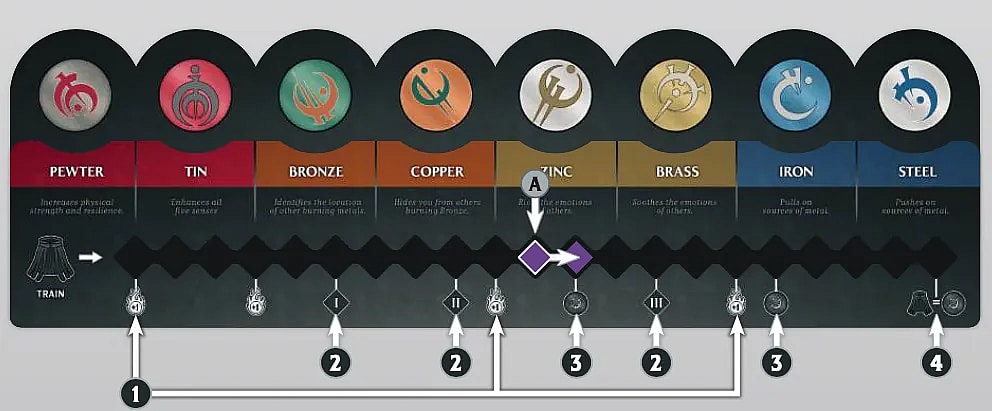
Each player controls a Character Card and a Training Track which improves throughout the game.
- At the start of each turn, move your tracker cube one step up your Training Track.
- Moving up the track may unlock new abilities immediately.
- You may also move up the track through card or Mission effects marked with the training symbol.
Training Track Rewards
There are four types of rewards unlocked along the track:
- Extra Metals Burned ( ): Permanently increase how many metals you can Burn per turn (up to 4).
- Character Abilities ( ): Permanently unlock unique character powers.
- Atium Tokens ( ): Gain single-use Atium tokens.
- Continuous Atium ( = ): After reaching this point, each Mission Track advancement (including start of turn) grants an additional Atium token.
Example
The purple player starts their turn by moving their cube one space on their Training Track and immediately receives an Atium token. At this point, they can Burn three metals per turn and have unlocked their first character ability.
Missions
Each game uses 3 of the 8 available Mission cards. One of the three ways to win is to be the first to reach the top of all three Mission tracks.
Moving Up Mission Tracks
- You advance on Mission Tracks by gaining Mission points ( ) from card effects or other abilities.
- You may distribute Mission points freely among one or more Mission Tracks during your turn.
Features of a Mission Card
- Mission Name: Title of the Mission.
- Starting Area: Where each player’s cube begins (this is off the main track and not counted as progress).
- Mission Track: The numbered track where cubes move from bottom to top, requiring 12 points to reach the summit.
- Mid-Track Rewards: Some points on the track provide immediate one-time rewards upon reaching them.
- Mid-Track First Player Rewards: Additional bonuses granted to the first player who reaches these points.
- Placement Spots: Spaces at the top of the track where players are placed in finishing order (left to right).
- Top First-Player Reward: The first player to reach the top gains a one-time extra reward.
- Top Reward: All players who reach the top get this reward, which may be one-time or permanent.
Strategy Tip: Highest and Lowest on Mission Tracks
- Cubes positioned in the starting area (off the track) do not count as being on the Mission Track.
- If only one cube is on the track, it is considered the highest but not the lowest.
- When multiple players are on the track, ties count as highest or lowest accordingly.
- The first player to complete the Mission track permanently holds the highest spot on that track.
Strategy Tip: When to Advance Mission Tracks
- You may advance on Mission Tracks at any point during your turn.
- This can unlock resources or abilities to help you continue your turn effectively.
Combat
Health and Elimination
- Each player starts with a health pool of 36 points (or more depending on your character).
- If your health reaches 0, you are eliminated from the game.
- When eliminated, your cards remain in your deck and discard pile, and your cubes stay on the Mission tracks, but you no longer take turns.
Dealing Damage
- Damage points are represented by the symbol ( ).
- You may only use your damage at the end of your turn.
- You may distribute damage among other players and their Allies as you choose.
Allies and Defense
- Allies have a Defense value indicating their health.
- They cannot take partial damage — damage must be equal to or exceed their Defense to kill them in a single attack.
- When an Ally is killed, it is sent immediately to its owner’s discard pile.
- Some Allies have the DEFENDER ability, which forces attackers to kill them before targeting their player or other non-Defender Allies.
- If you do not have enough damage to kill a Defender Ally, you cannot damage the player or their other Allies this turn.
Target Mechanic (3-4 Player Games)
- The player who currently holds the Target must be attacked with damage at the end of other players’ turns.
- The last player before you clockwise starts with the Target.
- After taking damage, the player with the Target may pass it to another player.
- Damage to Allies is separate and can be targeted freely.
- If a player with the Target is eliminated, the attacker chooses a new Target and applies any leftover damage.
- If only two players remain, the Target is removed from the game.
2-Player Games
- At the end of your turn, you may choose to direct all your damage at your opponent and their Allies.
- If that damage reduces their health to 0 or below, you immediately win.
Strategy Tips for Combat
- You don’t have to use all your damage points each turn.
- Holding the Target can be risky since it makes you the focus of attacks. Only keep it if you have a powerful damage turn ahead.
- Using damage that affects all other players is strong, but be prepared for retaliation.
Regaining Health
- Some effects allow you to regain health ( ).
- Increase your health dial by that amount, but your health can never exceed 40.
Boxings
- Boxings are a special resource purchasable near the Market.
- Cost: 2 coins to buy.
- At any later time, you can discard a Boxing to gain 1 coin.
- Boxings do not expire and can be reused infinitely.
- If you run out, use tokens or placeholders to represent additional Boxings.
Market
- Market cards can be bought and added immediately to your discard pile.
- Your available coins to spend come from funding cards, activated effects, Savant abilities, Allies, character abilities, Missions, and spent Boxings.
- You may buy any number of Market cards during your turn as long as you can afford them.
- After buying a Market card, immediately replace it with a new card from the Market deck.
- Coins do not carry over to future turns.
Example:
You have 6 coins from all your effects this turn. You purchase two cards costing a total of 4 coins and use the remaining 2 coins to buy a Boxing.
Turn Structure Summary
Each player’s turn proceeds as follows:
- Move one space to the right on your Training Track.
- In any order, and as many times as you want during your turn:
- Play cards from your hand.
- Burn or Flare metals on cards.
- Use cards as metals.
- Discard cards to refresh Flared metals.
- Activate Ally and character abilities.
- Advance on Mission Tracks.
- Buy Market cards and Boxings.
- Attack Allies.
- Attack players (damage their health).
- Pass the Target if applicable.
- Discard all cards in play (except Allies) and any remaining cards in hand.
- Draw 5 new cards from your deck.
How to Win
There are three ways to win in competitive play:
- Be the first player to reach the top of all three Mission tracks.
- Be the last player alive after eliminating all others.
- Play 4 Atium tokens on the card Confrontation.
Card Icons Reference
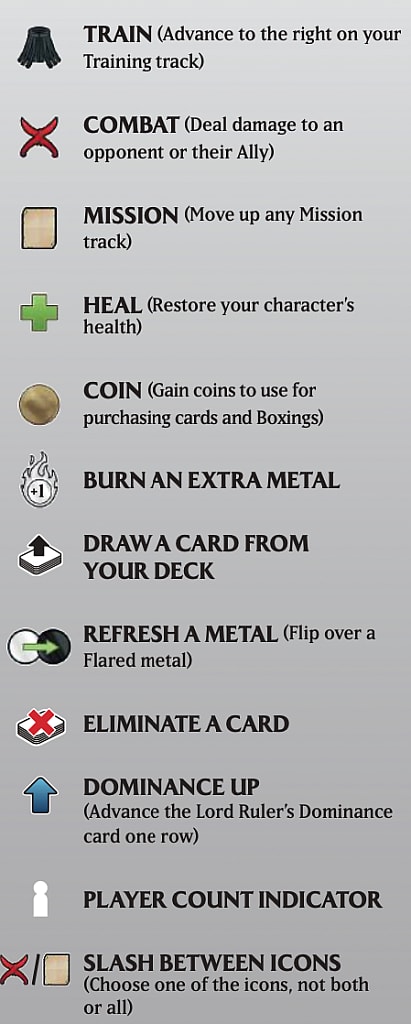
Solo and Co-op Modes
Mistborn can be played solo or cooperatively, where players team up against the Lord Ruler.
Setup Differences
- Do not use the Target Standee.
- No starting bonuses are given to players.
- Place the Lord Ruler’s Dominance Track and his card nearby.
- Set the Lord Ruler’s health dial to 48.
- Place the Lord Ruler’s deck of 36 cards near his Dominance card and health dial.
Lord Ruler’s Dominance Track
- Measures his power and focus on players.
- Starts at 1 Dominance.
- Edicts increase Dominance up to a max of 6.
- Moving along the Dominance Track can trigger special attacks.
- When Edicts or Adversary cards show an “X”, that number equals the highest Dominance value.
- Only the highest Dominance value counts.
Co-op Gameplay
- Players do not attack each other or each other’s Allies.
- They may use abilities like CLOUD to protect teammates.
- Each player takes turns as usual.
- After each turn, draw and play the top card of the Lord Ruler’s deck.
Lord Ruler Deck Cards
- Adversaries: Minions placed in front of players that impose negative effects.
- Have 1-3 Shields that must be destroyed in order (left to right).
- Shields require damage equal to or greater than their value to be destroyed.
- Damage can destroy multiple shields if sufficient.
- Once all shields are destroyed, the Adversary is discarded.
- Adversaries can be attacked by any player.
- Effects like Assassinate can remove one shield from any Adversary.
- Edicts: Represent the Lord Ruler’s will.
- When drawn, perform listed effects in order.
- Can move the Dominance Track up 1-2 times.
- May have additional negative effects.
- Lord Ruler heals 10 life points for each incomplete Mission.
- Eliminates two cards from the Market, replaced immediately.
Player Elimination
- If eliminated due to Lord Ruler or Adversary damage, the player is out.
- Skip their turn and do not draw Lord Ruler cards for them.
- Adjust player count for card effects accordingly.
Solo/Co-op Endgame
The game ends if:
- The Lord Ruler’s deck is exhausted — players lose.
- All players are eliminated — Lord Ruler wins.
- Lord Ruler’s health reaches 0 — players win.
- Players play 4 Atium on Confrontation — players win.
Note: Completing Mission Tracks does not end the game in solo/co-op but influences Lord Ruler healing.
Frequently Asked in Solo/Co-op
- Do SENSE abilities affect the Lord Ruler? No, they have no effect.
- Are you always highest and lowest on Mission tracks in solo? You are lowest if you haven’t reached the first reward; highest if you’ve passed the highest reward before the top.
- What does “Collective” mean on Lord Ruler Edicts? Damage or effects shared among players, which can be distributed as desired.
Video Tutorial
Browse Related Games!
 Official Casting Shadows Rules
 Official Twenty-Nine Rules
 Official Coup Rules
 Official Command of Nature Rules
 Official PUT A FINGER DOWN Rules
 Official Lost Cities Rules
 Official The Fox in The Forest Rules
 Official Fluxx Rules
Official Panguingue (Pan) Rules
Official Fluxx Rules
Official Panguingue (Pan) Rules
 Official Countries of the World: Guess in 10 Rules
 Official Canasta Rules
 Official The Resistance: Avalon Rules