
Last Updated on October 11, 2025 by The Official Game Rules Team
Cribbage is a unique card game that combines luck, skill, and strategic thinking. While many players focus on playing good hands, knowing how to maximize your score and applying smart strategies can be the difference between winning and losing. This guide breaks down the scoring system in Cribbage and offers practical strategies to help you consistently outperform your opponents.
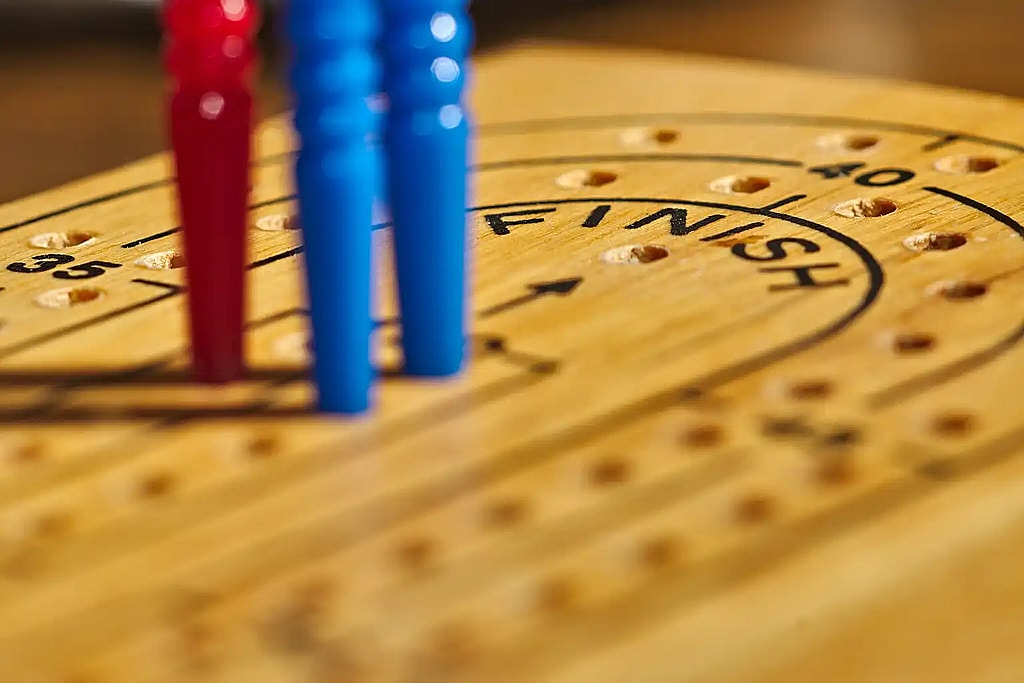
Photo thanks to Bruce Guenter – Creative Commons Attribution 2.0 Generic license.
Understanding Cribbage Scoring
Scoring in Cribbage happens in two main phases: pegging during play and counting hands at the end of each round. Points are recorded on a cribbage board using pegs.
Pegging Phase Scoring
During play, you can score points in several ways:
- Fifteen (2 points): Any combination of cards that totals 15.
- Pair (2 points): Two cards of the same rank.
- Pair Royal (6 points): Three cards of the same rank.
- Double Pair Royal (12 points): Four cards of the same rank.
- Run (1 point per card): Three or more cards in sequential order, regardless of suit.
- Go (1 point): If you cannot play a card without exceeding 31, you say “Go,” and the opponent scores 1 point.
- Thirty-One (2 points): Exact total of 31.
Hand Counting Scoring
At the end of each round, each player counts their hand plus the starter card, scoring:
- Fifteens: 2 points each.
- Pairs, Runs, and Flushes: As in pegging.
- Knobs (1 point): A jack in your hand that matches the starter card’s suit.
The dealer also counts the crib, which is an extra hand made from cards discarded by both players.

Cribbage Scoring Chart
Here’s a comprehensive scoring breakdown, both for pegging and hand/crib counting:
| Phase | Combination | Points |
|---|---|---|
| Pegging (During Play) | Hit exactly 15 | 2 |
| On 31 | 2 | |
| Pair | 2 | |
| Three of a kind | 6 | |
| Four of a kind | 12 | |
| Run (3+ cards in sequence) | 1 per card | |
| Go (no play possible) | 1 | |
| Last card under 31 | 1 | |
| Last card making 31 | 2 | |
| Show (Hand & Crib) | Combinations summing to 15 | 2 each |
| Pair | 2 | |
| Three of a kind | 6 | |
| Four of a kind | 12 | |
| Run (sequence length N) | N points | |
| Flush (4 cards in hand) | 4 | |
| Flush (5 cards including starter) | 5 | |
| One for his nob (Jack same suit as starter) | 1 | |
| His heels (Starter is Jack; dealer only) | 2 |
Pegging Guide: Visual Explained
This diagram provides a snapshot of how pegging works in Cribbage:
- 15 for 2 points: When the cumulative total hits 15 exactly.
- 31 for 2 points: Playing a card that brings the total to 31.
- Pairs: Pair yields 2 points; three-of-a-kind yields 6 points; four-of-a-kind yields 12 points.
- Runs: Any sequence of 3+ cards scores, one point per card.
- Go / Last Card: If you can’t play, you peg 1 point (“Go”), or the last card played under 31 gets 1 point; if that last card makes 31, you peg 2.
This visual makes these pegging scenarios easy to grasp quickly—perfect for blog readers learning the strategy.
Winning Strategies in Cribbage
Cribbage is a game of two halves: counting and pegging. While high-scoring hands can feel like winning the lottery, consistent, strategic play during the pegging phase is what separates a good player from a great one. Victory in Cribbage—the race to 121—requires a finely tuned balance of maximizing your own score while aggressively denying points to your opponent. This guide delves into the core principles of advanced Cribbage strategy, focusing on hand selection, pegging tactics, and end-game management.
The Critical Choice: Discarding to the Crib
The decision of which two cards to discard from your six-card deal is the single most important strategic choice in Cribbage. This choice changes dramatically depending on whether you are the Dealer or the Pone (non-dealer).
1. Strategy as the Pone (Non-Dealer)
As the Pone, your goal is simple: maximize your own hand score while actively giving the dealer the worst possible crib. You have no control over the cut card, so you must select the four cards that offer the highest average scoring potential regardless of the cut.
- Prioritize Runs and Flushes: Keep four cards that create a run of three or four, or a four-card flush (same suit). Runs are the most consistent high-scoring element. For example, keeping 5-6-7-8 is far better than keeping a pair of Queens and two unrelated low cards.
- The Power of the Five: The 5 is the most valuable card in Cribbage, as it pairs with ten-value cards (T, J, Q, K) to make 15s. A perfect Pone discard is often two cards that do not interact with your remaining four and have a value greater than 5 (to minimize the chances of a dealer’s 15) and are not part of a run.
- Deny the Dealer: Avoid discarding pairs, closely ranked cards (like 7-8 or 4-5), and any card that would create a 15 with a 5. The ideal defensive discards are widely separated cards like Ace-9 or 10-King, as they are least likely to combine for points in the crib.
2. Strategy as the Dealer
As the Dealer, your primary objective shifts to maximizing the score in the crib, as you get to count both your hand and the crib.
- Feed the Crib Fives: Since the crib is the dealer’s property, you should discard cards that synergize well. Fives are golden, as they combine with any ten-value card for two points (15-2). Discarding a 5 and a ten-value card (e.g., 5-Q) is a strong foundation.
- Keep the Hand Viable: Although you prioritize the crib, do not sacrifice a guaranteed, high-scoring hand. If you have a hand with 10+ points and you’d have to break it up for a high-potential crib, keep the good hand and aim for a solid, 4-6 point crib.
- Optimal Dealer Discards: The best cards to give yourself are pairs, runs, and cards that combine easily with a 5 or a ten-value card. Common strong discards include 5-J, 4-6, or any suited pair.
The Art of Pegging: Maximizing Points and Control
Pegging—the play of cards up to a total of 31—is where the game is truly won or lost. Unlike the hand where points are static, pegging points are dynamic and require immediate tactical decisions.
1. Leading for Points
The player leading the first card of a hand often has a disadvantage, as the second player can easily score a 15. The most effective lead cards are typically low:
- The Ace, 2, or 3: Leading with one of these forces the opponent to play a 9, 10, J, Q, or K to make a count of 10 or more, giving you excellent position to play a 5 for a 15-2 on your next turn.
- The Fourth Card in a Run: If you hold 3-4-5-6, leading the 3 is strong because you keep the 4-5-6 intact to complete a run if the opponent plays an adjacent card (like a 2 or a 7).
2. The Rule of Eleven
To successfully deny your opponent a 15, try to play a card that makes the total count 21 or less, but leaves the opponent with no single card that can bring the total to exactly 31. The best way to leave a total for your opponent is to aim for a count that is 11 points away from 31 (i.e., leaving the count at 20). If the count is 20, the opponent must play a ten-value card (10, J, Q, K) to reach 30, which leaves you the final peg for one point (Go or 31).
3. Pairing and Runs
- Pairing and Pegging: Always look for opportunities to pair (2 points) or create a run (3+ points) off your opponent’s play. If the opponent plays a 7, and you have two 7s, play one to score two points, then save the third 7 for the next round of pegging.
- The “Go” Trap: Never give your opponent the opportunity to score the final “Go” point unnecessarily. If the count is 28, and you have a 2, playing it to make 30 allows your opponent to play an Ace for 31-2. Instead, play the 2 only if the opponent cannot hit 31.
End-Game Strategy: The Dash to 121
The last few hands of Cribbage require a major shift in strategy, transitioning from point-maximization to score-protection. You must always know your position and your opponent’s position relative to the 121 finish line.
1. The “Magic Number” and Pegging Out
Once you are within 30 points of winning (e.g., 91+ points), every discard and pegging decision must prioritize scoring the necessary points during the pegging phase, as counting your hand is a certainty, while pegging is not.
- The 31/Last Card Strategy: If you are within 2-3 points of 121, you must use your pegging strategy to guarantee the final point. Often, this means holding back a 1 or 2 card, waiting for the opponent to declare “Go,” and then playing your final card for the win.
- Playing Low to Win: If you need 2 or 3 points to win, and you are the Pone, lead with an Ace or a 2. This is counter-intuitive to mid-game strategy, but it maximizes your chance of scoring a pair or a run during the opponent’s reply, or forces the opponent to use up valuable cards.
2. Dealing When Ahead vs. Behind
- Ahead (Protection): If you are significantly ahead, your goal is to deny your opponent points. When dealing, be risk-averse; discard defensively to the crib, even if it hurts your own hand score slightly. Your lead provides a cushion; focus on getting safely home.
- Behind (Aggression): If you are significantly behind, you must play aggressively. When dealing, take risks for a big crib (e.g., discarding a 5-5 pair), and play aggressively during pegging, seeking opportunities for three- or four-card runs, even if it means leaving your opponent an opening for a 15. You need the big points to catch up.
Variations: 5-Card and 6-Card Cribbage
While the most common version of cribbage is the 6-card game, there are also popular variations like 5-card cribbage, often played in pubs and casual settings. In 5-card cribbage, players are dealt fewer cards, and gameplay is slightly faster, but scoring principles remain largely the same. The 6-card version—used in tournaments—offers more strategic depth with extra discard and pegging opportunities.
If you want to dive deeper into each style of play, check out our detailed guides on 5-Card Cribbage Rules and 6-Card Cribbage Rules to see how strategies and scoring adapt between the two.
FAQ
The pone is the non-dealer — the player who cuts the deck and plays first during the pegging phase. While the dealer has the advantage of scoring the crib, the pone gets the first chance to peg points during play.
Each player plays with a four-card hand, plus the cut card revealed by the dealer. Scoring is based on combinations made from these five cards, including pairs, runs, flushes, and 15s. The dealer also counts an extra four-card hand called the crib, which uses the same cut card.
The end of the game occurs as soon as a player reaches 121 points — this can happen during pegging, counting the hand, or counting the crib. The game ends immediately; the other player doesn’t finish counting their hand.
A double run is a combination of cards that form two overlapping runs — for example, 6-7-7-8 scores 8 points (two runs of three and a pair). A triple run, such as 6-6-7-7-8, scores 15 points (three runs of three plus two pairs). Recognizing these high-value combinations is key to strong Cribbage strategy.
As the non-dealer, focus on maximizing points in your own hand, since you won’t score for the crib. Keep combinations that make 15s and runs, and discard cards that are least likely to assist the dealer’s crib.
After dealing, the pone cuts the deck, and the dealer reveals the cut card. This card counts for both players and the crib, completing each hand to five cards. If the cut card is a Jack, the dealer scores “His Heels” — 2 points immediately.
The best possible hand in Cribbage scores 29 points — consisting of three 5s and the Jack of the fourth suit, with the cut card being the missing 5 that matches the Jack’s suit.
The last player to bring the count to exactly 31 scores 2 points. If neither player can play without exceeding 31, the last person who played before the stop scores 1 point for “Go.”
Muggins is an optional rule where a player can claim any points the opponent forgets to score. For example, if your opponent fails to count a pair, you can say “Muggins!” and add those points to your own total. However, it’s not always used in friendly or beginner games.
Final Thoughts On Cribbage Scoring and Strategies
Cribbage is as much about strategy as it is about luck. By mastering scoring combinations, making smart discards, and adjusting your play based on position, you’ll increase your odds of winning. The best players think ahead—not just about their current hand, but about how their plays will impact both their score and their opponent’s.