

Last Updated on October 23, 2025 by The Official Game Rules Team
Number of Players: 2-7 | Game Time: 45min | Ages: 12+
Bohnanza is a classic card game of bean trading, planting, and harvesting where players compete to earn the most gold coins. The twist? You can’t rearrange your hand, forcing you to trade smartly and plan carefully. Learning how to play Bohnanza is easy—but mastering its timing and negotiation takes skill!

This post contains affiliate links. For more information, see our disclosures here.
How to Play Bohnanza
Object of the Game
The goal of Bohnanza is to earn the most gold coins by planting and harvesting sets of matching beans. You’ll trade beans with other players, manage your limited bean fields, and decide the best times to harvest for maximum profit.
Components
- 104 bean cards (8 types of beans, each showing how many copies exist)
- 5 bean field mats (each showing 2 or 3 fields)
- 1 starting player card
- Rules sheet
Setup
- Each player receives one bean field mat:
- 3 players: use the 3-field side
- 4–5 players: use the 2-field side
- Shuffle all the bean cards and deal 5 cards to each player.
- Important: You cannot rearrange the cards in your hand—ever. The order they’re dealt stays the same throughout the game.
- Place the remaining cards in the center as the draw pile, gold coin side up.
- Leave space beside it for a discard pile and for each player’s gold coin stack.
- The chosen starting player takes the Starting Player card.
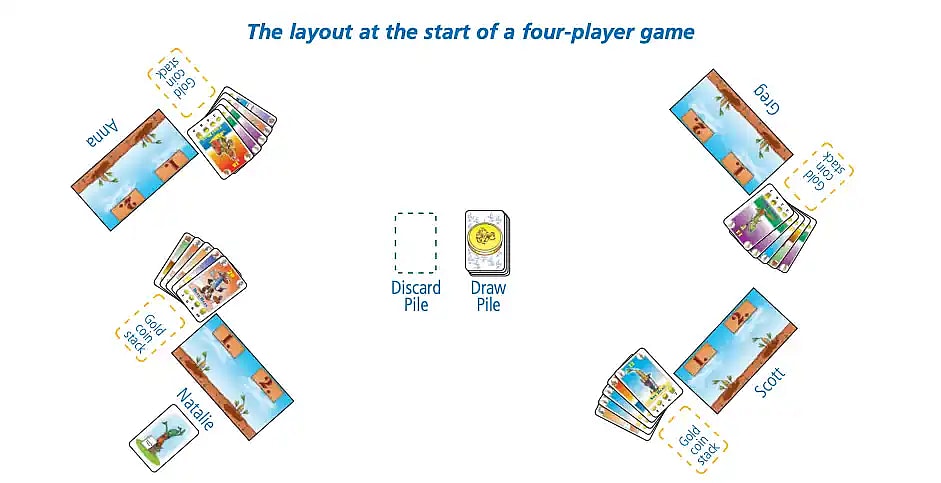
Bohnanza Gameplay
Bohnanza is played in turns, moving clockwise. Each player completes the following four phases on their turn:
Phase 1: Plant Bean Cards
- You must plant the first card in your hand into one of your bean fields.
- You may plant the second card as well, but no more than two cards per turn.
- You can only grow one type of bean per field, though you can have multiple fields with the same bean type.
- If you need to plant a bean type that doesn’t match any of your fields, you must harvest a field first.
Example #1: Natalie has turned over a Soy Bean and a Blue Bean. She keeps the Blue Bean, but there is no space for the Soy Bean in her bean fields, so she offers it up for trade to the other players. She asks: “Would anyone like this Soy Bean? I’d like to trade it for a Red Bean.”
Example #2: No-one wants to trade with Natalie, so she ups her offer: “I’ll give you the turnedover Soy Bean and a Chili Bean from my hand for a Red Bean.”
Example #3: Anna accepts Natalie’s offer of the Soy Bean and the Chili Bean Natalie puts it next to her bean fields horizontally. Anna does the same with the Soy Bean and the Chili Bean.
Phase 2: Turn Over and Trade
- Flip over the top two cards from the draw pile and place them face-up beside it.
- You may:
- Plant them in your own fields, or
- Trade them with other players.
Trading Rules:
- Only the active player may trade.
- You can trade using cards from your hand and/or the two revealed cards.
- You cannot trade cards from your fields or cards you just received in a trade.
- You can trade any number of beans for any number of other beans.
- You may also give cards as gifts if the other player accepts them.
All traded cards are placed horizontally next to the players’ fields and must be planted during the next phase.
Phase 3: Plant Traded and Revealed Beans
- After trading ends, all players must plant any horizontal cards they received in front of them.
- The active player also plants any turned-over cards that weren’t traded.
- If you must plant a bean type that doesn’t fit your current fields, you must harvest one field before planting.

Phase 4: Draw New Bean Cards
- Draw three cards, one at a time, and place them in order at the back of your hand.
- Then, the player to your left becomes the new active player.
Harvesting Beans
You can harvest beans at any time, even when it’s not your turn.
To harvest:
- Count how many cards are in your field.
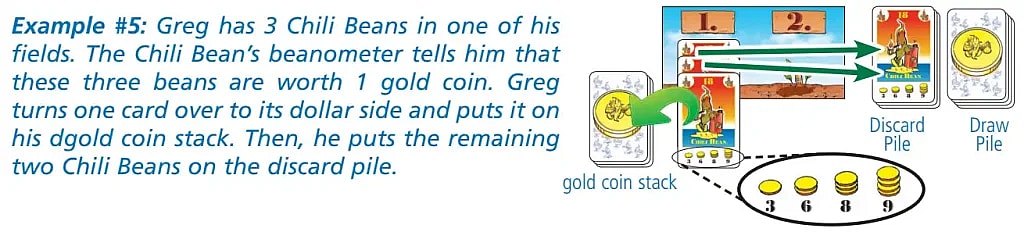
- Check the beanometer on the top card to see how many coins the set is worth.
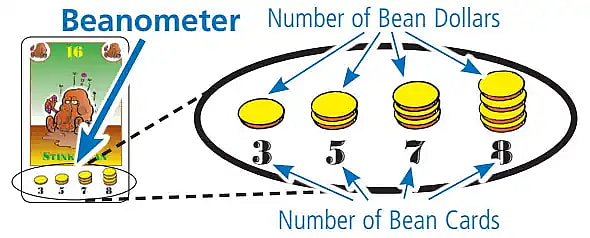
- Turn that many cards over to their gold coin side and place them in your coin stack.
- Discard the remaining cards face-up in the discard pile.
- The field is now empty and ready for new beans.
Bean Protection Rule
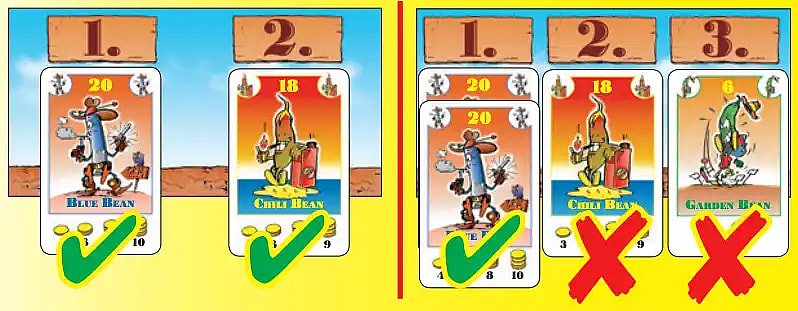
If one of your fields has only one bean, and another field has more than one, you cannot harvest the single bean field.
End of the Draw Pile
When the draw pile runs out:
- Shuffle the discard pile to form a new draw pile.
- The game continues until the deck runs out for the third time.
End of the Game
The game ends when the draw pile runs out for the third time.
- If it happens during Phase 2, finish Phases 2 and 3.
- Then, all players harvest their remaining bean fields.
- Cards left in hands are ignored.
- Each gold coin card counts as 1 point.
The player with the most gold coins wins!
If there’s a tie, the player furthest clockwise from the starting player wins.
Variants
3–7 Player Game (With Cocoa, Wax, and Coffee Beans)
- Add the three extra bean types for larger games.
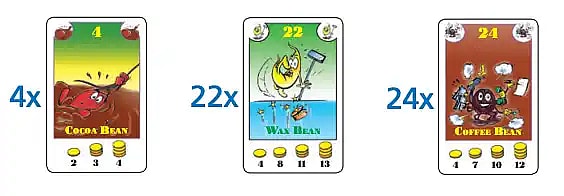
- Depending on player count, remove specific bean types to balance the deck:
- 3 players: remove Cocoa Beans
- 4–5 players: remove Coffee Beans
- 6–7 players: remove Cocoa and Garden Beans
- 3 players use 3 fields; 4–7 players use 2 fields.
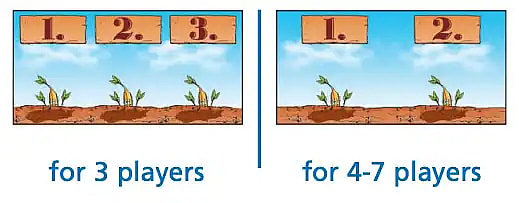
- The game ends after the 2nd reshuffle with 3 players or after the 3rd reshuffle with 4+ players.
- During Phase 4, each player draws 1 card clockwise, instead of the active player drawing three.
2-Player Variant: The Bean Duel
- Draw two new cards and add them to the back of your hand.
- Remove Garden and Cocoa Beans.
- Each player may only harvest during their own turn.
- The game ends after the first deck exhaustion.
Turn sequence:
- Plant or discard offered beans.
- Plant up to two hand cards, then discard one from anywhere in your hand.
- Draw three cards and reveal them. Plant any or leave them as an offer.
Bohnanza FAQ
No. This is the most important rule in Bohnanza—you must play and trade cards in the exact order you received them.
No. When you harvest, you must clear the entire field.
No. Only the active player can initiate trades during their turn.
You must harvest one of your fields to make room before planting.
Yes. You’re never required to trade or accept gifts.
No. Only gold coin cards in your stack count toward your final score.
Conclusion
Bohnanza is a game of clever trading, timing, and resource management. By learning how to play Bohnanza strategically—knowing when to trade, when to harvest, and how to manage your limited fields—you’ll maximize your gold coin earnings and outsmart your opponents. With its mix of luck and negotiation, Bohnanza remains one of the most beloved trading card games for families and game nights alike.
Browse Related Games!
 Official Casting Shadows Rules
 Official Twenty-Nine Rules
 Official Coup Rules
Official Panguingue (Pan) Rules
Official Coup Rules
Official Panguingue (Pan) Rules
 Official Command of Nature Rules
 Official The Fox in The Forest Rules
 Official Countries of the World: Guess in 10 Rules
 Official Do You Really Know Your Family? Rules
 Official Canasta Rules
 Official Liar’s UNO Rules
 Official Lost Cities Rules
 Official The Mind Rules