

Last Updated on October 13, 2025 by The Official Game Rules Team
We’re Not Really Strangers is an intimate and thought-provoking card game designed to deepen connections and spark meaningful conversations. Players take turns drawing cards that prompt personal questions, challenges, or reflections, encouraging vulnerability and insight. Whether you’re playing with friends, family, or a romantic partner, this game is perfect for anyone looking to explore their relationships on a deeper level. Get ready for powerful moments and unexpected discoveries.

This post contains affiliate links. For more information, see our disclosures here.
How to Play We’re Not Really Strangers — Complete Rules
Game Objective
We’re Not Really Strangers is a relationship-building card game designed to deepen emotional connections. Through thoughtful questions and conversations, players share personal experiences, uncover new insights, and strengthen their bonds. The object of the game isn’t to win—it’s to connect through honesty and vulnerability.
What You Need to Play
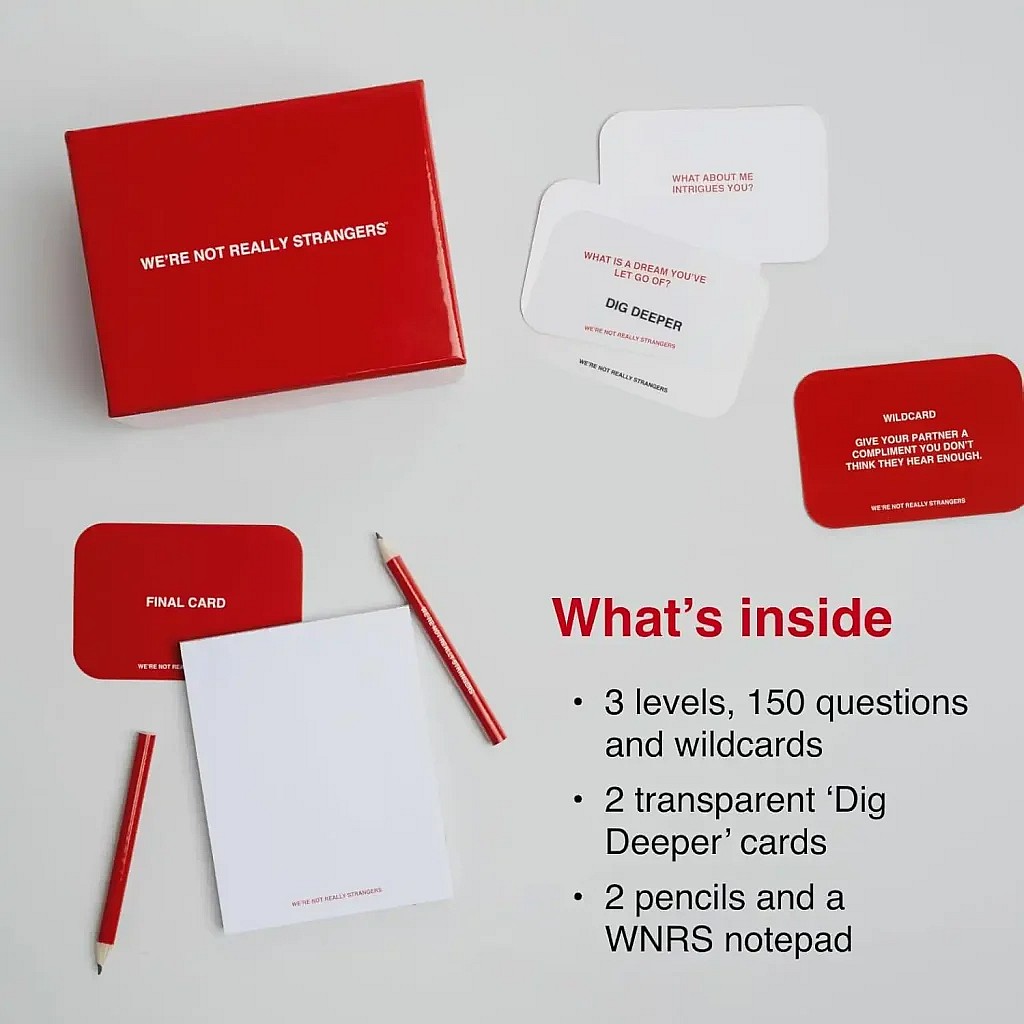
- Deck of Cards: Contains three levels of questions, each becoming more personal and introspective.
- Players: Best for 2–6 players, though it can be adapted for larger groups.
- Setting: A quiet, comfortable space helps players focus and engage in meaningful dialogue.
Setup
- Shuffle the Deck: Mix all cards thoroughly.
- Choose a Starting Player: Any fair method works. The starting player draws the first card.
- Understand the Levels: The deck includes three levels of questions, each designed to go deeper as you progress through the game.
We’re Not Really Strangers Gameplay
Level 1: Perception
The first level focuses on lighthearted and introductory questions to help players warm up. These questions encourage curiosity and surface-level connection.
Examples:
- “What’s your favorite way to spend a day off?”
- “If you could live anywhere in the world, where would it be?”
This level builds trust and sets the tone for deeper conversations ahead.
Level 2: Connection
The second level moves beyond small talk, inviting players to reflect on memories, emotions, and personal values.
Examples:
- “What’s a memory that still makes you smile?”
- “How do you feel about your relationship with your family?”
These questions encourage thoughtful introspection and empathy between players.
Level 3: Reflection
The final level is about vulnerability and honesty. Questions in this stage help players share their truest thoughts, fears, and experiences, creating space for genuine emotional connection.
Examples:
- “When was the last time you felt completely seen?”
- “What’s something you’ve always wanted to tell me but haven’t?”
By the end of this level, players often feel closer and more emotionally open.
End of the Game: Reflect and Connect
When all cards have been played, take time to reflect on what you learned about one another. Many players find the best part of We’re Not Really Strangers comes after the final card—when conversation continues naturally, inspired by the game.
Tips for Playing We’re Not Really Strangers
- Create a Safe Space: Everyone should feel comfortable sharing openly and without judgment.
- Be Honest and Vulnerable: The more genuine your responses, the more rewarding the experience.
- Take Your Time: There’s no rush—pause and reflect before answering.
- Respect Boundaries: If a question feels too personal, it’s perfectly fine to skip it.
- Play to Connect: Use the game as a bridge to deepen friendships, relationships, or new acquaintanceships.
Why Play We’re Not Really Strangers
More than a simple conversation game, We’re Not Really Strangers is a tool for authentic communication. Whether you’re playing with a partner, a close friend, or someone you’ve just met, it fosters empathy, understanding, and connection. Each session can reveal something new—not only about others but about yourself.
Start Playing Today
If you’re ready to spark deeper, more meaningful conversations, grab a We’re Not Really Strangers deck and start connecting. You’ll be surprised how quickly honesty and curiosity can turn into real understanding.
FAQs
The goal is to foster meaningful conversations and emotional connection through reflective card questions that deepen over three levels. It’s not about winning—it’s about understanding yourself and others.
The game is best for 2–6 players. It’s designed for smaller, more intimate settings but can be adapted for groups.
Yes. Each round brings new insights and perspectives—even if you’ve played before.
Wildcards are special cards that ask players to take actions rather than just answer questions. These prompts often encourage creativity, physical gestures, or shared reflection, adding spontaneity and emotion to the game.
No. Take as long as needed to think and answer thoughtfully.
Absolutely. If a question feels uncomfortable, players may skip it without penalty.
It’s best suited for adults and older teens due to the emotional and introspective nature of the card questions. For a younger audience, some questions may be skipped or simplified to fit their comfort level.
Yes. While it’s often played with partners or friends, the game can be deeply rewarding with family members—just choose questions that feel appropriate for everyone’s comfort zone.
Absolutely. Many players use the game to reconnect with a spouse or partner. It opens conversations that might not come up in daily life and helps strengthen emotional intimacy.
The notepads and pencils are used for specific prompts—usually in Level 3 or Wildcards—that ask players to write notes, predictions, or reflections about themselves or others. These can become keepsakes of your self-reflection journey.
Yes. Though designed for multiple players, the deck works as a self-reflection tool. You can journal your answers, use the notepad to record thoughts, and revisit them over time to explore personal growth.
“We’re Not Really Strangers” is more than just a game; it’s an opportunity for genuine connection and understanding between players. By fostering vulnerability, empathy, and open communication, it encourages deeper relationships and meaningful interactions that can last long after the game is over.
Browse Related Games!
 Official Casting Shadows Rules
 Official Twenty-Nine Rules
 Official Le Neuf (Nines) Rules
 Official The Fox in The Forest Rules
 Official Coup Rules
 Official Imploding Kittens Expansion Rules
 Official Do You Really Know Your Family? Rules
 Official Paco Rules
 Official Canasta Rules
 Official Five Crowns Rules
Official Betrayal Deck of Lost Souls Rules
Official Panguingue (Pan) Rules
Official Five Crowns Rules
Official Betrayal Deck of Lost Souls Rules
Official Panguingue (Pan) Rules