

Canasta is a classic card game that combines strategy, skill, and a little bit of luck. Played with two decks of cards and popular in both two-player and four-player partnerships, mastering Canasta requires understanding the rules, scoring system, and tactical plays. In this guide, we’ll go deep into strategies that can elevate your game, help you make better decisions, and maximize your points.
How to Play Canasta (Quick Overview)
Before diving into strategy, here’s a brief overview of Canasta rules:
- Players: 2–6 (most commonly 2 or 4 in partnerships)
- Deck: Two standard 52-card decks + 4 jokers (total 108 cards)
- Objective: Form melds (sets of cards of the same rank) and canastas (7-card melds) to score points
- Winning: The game ends when one team reaches 5,000 points or when all cards are played, depending on the variation
Key Elements to Remember:
- Red threes are bonus cards.
- Jokers and twos are wild cards.
- Canastas score extra points.
- Discarding strategically can prevent your opponent from picking up valuable cards.
Canasta Scoring Visual Chart
| Card Type | Points per Card | Notes |
|---|---|---|
| Red 3s | 100 each | Bonus points if melded |
| Black 3s | 5 each | Cannot be melded unless last card |
| Jokers | 50 each | Wild card |
| Twos | 20 each | Wild card |
| 8–King | 10 each | Standard point value |
| 4–7 | 5 each | Standard point value |
| Canasta (natural) | 500 points | Seven cards of same rank, no wilds |
| Canasta (mixed) | 300 points | Seven cards including wilds |
This visual chart helps quickly assess which cards are most valuable for strategic play.
Basic Canasta Strategy Tips
- Track Discards: Always pay attention to what your opponents discard. This can reveal which cards they need and allow you to block them.
- Hold Wild Cards Carefully: Don’t rush to use jokers and twos; save them for completing canastas.
- Build Canastas Wisely: Prioritize natural canastas (without wild cards) for maximum points. Mixed canastas are helpful but less valuable.
- Control the Discard Pile: Prevent opponents from picking up high-value cards by discarding strategically.
- Go Out Safely: Don’t end the game too soon; ensure your hand contributes maximum points before going out.
Advanced Canasta Strategies
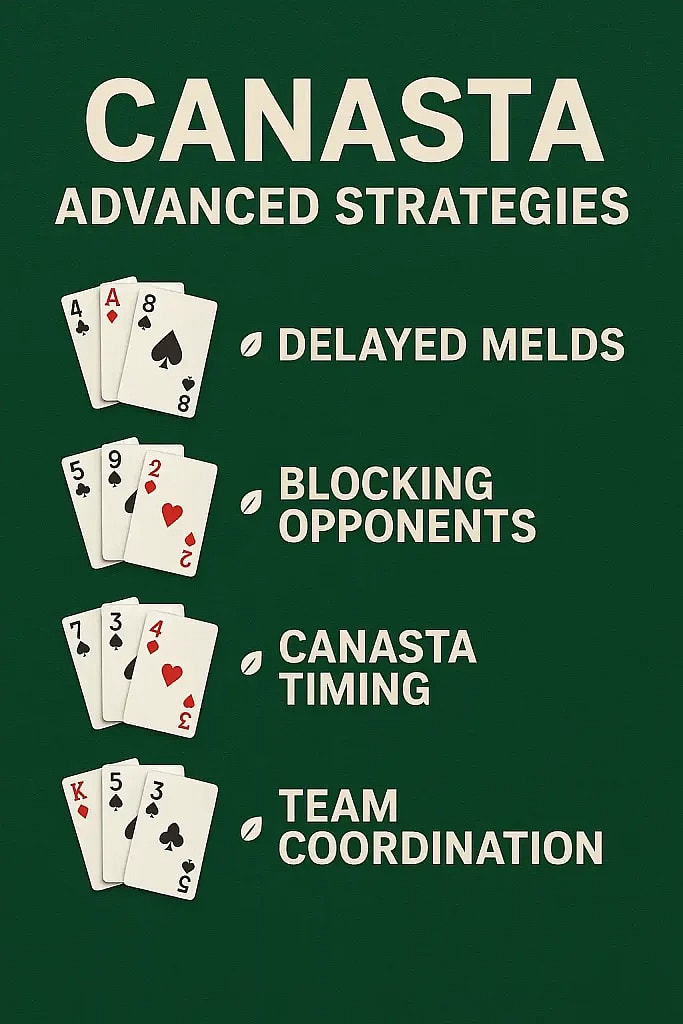
- Delayed Melds: Keep potential melds in your hand to surprise opponents and control timing.
- Blocking Opponents: Discard low-value cards to the pile that your opponent likely cannot use.
- Canasta Timing: Aim to complete canastas toward the mid- or late-game when they have the most impact on the final score.
- Team Coordination: In four-player partnerships, communicate subtly through your play to assist your partner without revealing too much.
- Discard Pile Awareness: Anticipate when an opponent might pick up the pile; try to leave low-value cards while retaining strategic ones.
- Flexible Strategy: Adjust between aggressive canasta-building and conservative point-gathering depending on your lead.
Common Mistakes to Avoid
- Rushing to Meld: Premature melds waste valuable wild cards.
- Ignoring Red 3s: Missing these bonus cards can cost you crucial points.
- Predictable Discards: Always vary your discards to avoid giving opponents easy pickups.
- Overcommitting Wild Cards: Using them too early reduces your options for high-value canastas.
FAQ – Canasta Strategy
Q1: Should I always aim for a natural canasta?
A: Yes, whenever possible. Natural canastas are worth more points and often determine the game outcome. However, mixed canastas are better than leaving cards unused.
Q2: How do wild cards affect strategy?
A: Jokers and twos are powerful for completing canastas but are also high-risk if discarded. Hold them until you can make maximum use of them.
Q3: When should I pick up the discard pile?
A: Only if you can immediately use the top card in a meld and can eventually use most of the pile. Picking up without planning can hurt your game.
Q4: How do partnerships impact strategy?
A: Partnerships require coordination. Support your partner by leaving useful cards in the discard pile and communicating through legal in-game signals.
Q5: How important is card counting in Canasta?
A: Very important. Keeping track of which cards have been played helps you anticipate opponents’ moves and adjust your strategy.
Tips for Winning More Often
- Always assess the risk vs. reward of going out early.
- Watch opponents’ hand size to predict their ability to form canastas.
- Balance between scoring points and blocking opponents.
- Practice both two-player and four-player variations to adapt strategies.
- Review previous games to identify patterns and mistakes.
Mastering Canasta is about patience, planning, and understanding your opponents’ tendencies. By applying these strategies, using the scoring chart to guide your decisions, and staying adaptable, you’ll improve your chances of consistently winning.
You may also like
 Gin Rummy Strategy: Expert Tips to Win Every Game
 Hearts Strategy: Tips, Advanced Strategies, and Winning Techniques
 The 10 Games AI Thinks You Should Try Next
 The 50 Best Card Games (Of All-Time)
 How to Win Trumps Card Game: Advanced Strategies and Tips
 Advanced Strategies for Hand and Foot: Win More in Every Round