

Last Updated on July 14, 2025 by The Official Game Rules Team
Double Nine Dominoes is a classic tile-based domino game that can be enjoyed by players of various ages. The set includes domino tiles ranging from 0-0 to 9-9. Here are the detailed rules for playing with a Double Nine Dominoes set:

This post contains affiliate links. For more information, see our disclosures here.
Double Nine Domino Rules and Beginner-Friendly Games
Domino Sets
Most domino games are played with a standard double-six set, which includes 28 tiles ranging from double-blank (0-0) up to double-six (6-6). Larger sets such as double-nine and double-twelve exist and are used for games with more players or for extended play. These sets make the same games more complex and take longer to complete.
Shuffling and Drawing
To start a game, place all dominoes face down on the table and mix them well by sliding them around. This randomizes the tiles.
Once shuffled, players draw the required number of dominoes for the chosen game. Any unused tiles remain in the center, called the boneyard. Players draw from the boneyard during gameplay when they can’t make a legal move.
Basic Gameplay
In most domino games, players take turns placing dominoes end-to-end by matching numbers. For example, if there is a 6-4 on the table, the next tile must match one of those numbers, such as a 6-1 or 4-4. Dominoes are usually played in a line, but doubles are often placed perpendicular to the chain.
To determine who starts, each player draws one tile. The player with the highest double goes first. If no doubles are drawn, the tile with the highest total number of pips determines the starter. Play proceeds clockwise.
Scoring methods vary by game. Some are based on pips, while others depend on completing specific actions.
Beginner Games
The First Game
- Shuffle all dominoes face-down.
- Each player draws an equal number. If the number doesn’t divide evenly, set aside any leftovers without revealing them.
- For 3 players with a double-six set, each takes 9 dominoes. One remains unused.
- Players keep their hands hidden from opponents.
- The player with the highest double starts. If they can play another matching tile, they may continue as long as they can play matching numbers.
- When a player can’t play, the turn passes to the next person.
- The first player to play all their tiles wins.
- To determine 2nd or 3rd place, players total the remaining pips in hand. The lowest total wins the higher placement.
Blind Dominoes
- Divide tiles evenly without revealing them. Discard any leftovers.
- Each player arranges their stack face-down in a row.
- The first player reveals their leftmost tile and places it in the center.
- On their turn, each player reveals their leftmost tile. If it matches an end, they play it; if not, they return it face-down to the right end of their row.
- Continue until a player plays all their tiles. If no one can play for several turns, declare a stalemate and restart.
Doubles
- Shuffle and deal:
- 2–4 players: 7 dominoes each
- 5 players: 5 dominoes each
- Extra tiles form the boneyard.
- The starting player must place a double. If they don’t have one, they draw until they do.
- The second and third players must each match one end of the starting double. They draw from the boneyard if needed.
- The line alternates between a double and a matching tile.
- If the boneyard runs out, players pass if they can’t play.
- First to use all their tiles wins.
Muggins
- Suitable for 2–4 players.
- Deal as follows:
- 2 players: 7 each
- 3 players: 6 each
- 4 players: 5 each
- Remaining dominoes form the boneyard.
- Highest double starts. If it’s 5-5, the player scores 2 points.
- Players take turns, matching ends. Doubles are placed crosswise and can be added to only after both ends are filled.
- You must play if you can; otherwise, draw until you can or the boneyard is empty.
- Scoring:
- If the sum of both open ends is a multiple of 5 (5, 10, 15, etc.), score 1 point for every 5.
- When someone plays all their tiles, they score 1 point for every 5 pips in their opponents’ hands.
- First to 61 points wins.
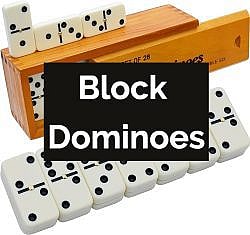
Block Dominoes
- Each player draws 7 tiles.
- Highest double plays first. Alternatively, determine randomly.
- Players take turns placing tiles to match ends. Doubles go across the line and can only be connected on their sides.
- If a player can’t play, they pass.
- When no moves remain, the round ends.
- Players total the pips in their hands. The player with the lowest total wins the round and adds the total value of all opponents’ hands to their score.
- Alternatively, if someone uses all their tiles, they win the round and score the total of their opponents’ pips.
- First player to exceed 101 points wins the game.
Draw Variation
Same rules as Block, but when a player can’t play, they must draw from the boneyard until they can or until the boneyard is empty.
Sebastopol
1. Doubles are played like regular dominoes and can only be joined at the ends.
2. This is a variant of Block.
3. Use a double-six or double-nine set.
4. Each player draws 7 dominoes.
5. The 6-6 or 9-9 starts the game. If no one has it, players draw until it appears.
6. That tile is placed in the center.
7. The first four moves must form a cross, placing tiles on all four sides of the starting double.
Once the cross is complete, players may play on any open end.
Browse Related Games!
 Official Memoir ’44 Rules
 Official Magnetic Chess Game with Stones Rules
 Official First Orchard Rules
 Official Root Rules
 Official Block Dominoes Rules
 Official Mastermind for Kids Rules
 Official Mouse Trap Rules
 Official Colorbrain Rules
 Official Gaia Project Rules
 Official The Lord of The Rings: Duel for Middle-Earth Rules
 Official The Night Cage Rules
 Official Panda Royale Rules