

Last Updated on October 10, 2025 by The Official Game Rules Team
Type: Sci-Fi | Players: 1-4 Players | Length: 45min-1.5 hours (depending on # of players)
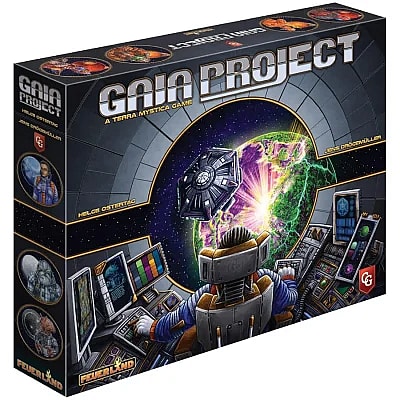
Gaia Project is a deeply strategic, sci-fi board game of space exploration, resource management, and faction development. Designed as the spiritual successor to Terra Mystica, it challenges players to expand their interstellar civilizations across a modular galaxy. Each of the 14 asymmetrical factions offers a distinct playstyle, unique powers, and specialized technologies to master.
If you’re new to this complex Euro-style game, this guide breaks down every phase, rule, and mechanic in detail — so you’ll know exactly how to play Gaia Project and maximize your strategy every turn.
This post contains affiliate links. For more information, see our disclosures here.
How to Play Gaia Project
TABLE OF CONTENTS
Components | Setup | Gameplay | Phase I | Phase II | Phase III | Phase IV | End of Game and Scoring | Strategy | FAQ
Components
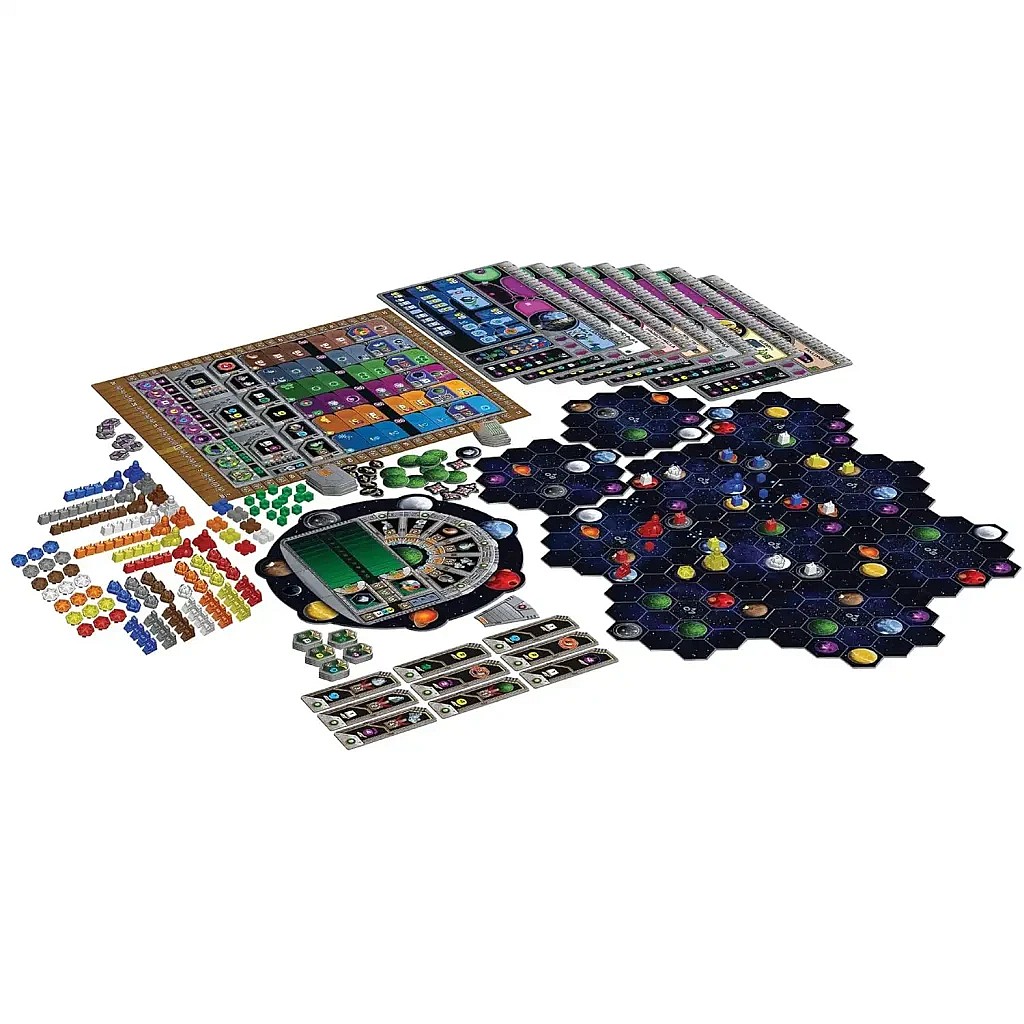
Each Gaia Project box includes a large assortment of modular tiles, tokens, and faction materials.
Core Boards and Tiles
- 10 Space Sector Tiles (used to form the modular galaxy)
- 1 Research Board
- 1 Scoring Board
- 10 Round Scoring Tiles
- 6 Final Scoring Tiles
- 10 Round Boosters
- 36 Standard Tech Tiles (4 of each type)
- 15 Advanced Tech Tiles
- 19 Federation Tokens
- 12 Gaia Planet Tokens
- 1 Lost Planet Token
- 6 Space Stations (used by specific factions)
Faction and Player Materials
- 7 Double-sided Faction Boards (14 total factions)
- 7 Faction Cards
- 4 Player Aids
- 17 Decision Cards (for solo play and automa)
- 1 Terraforming Reference Card
- 1 Turn Order Card
Player Pieces (each color)
- 8 Mines
- 4 Trading Stations
- 3 Research Labs
- 1 Planetary Institute
- 2 Academies
- 3 Gaiaformers
- 15 Satellites
- 7 Player Tokens (for tracking on the Research Board and VP track)
- 3 Bonus Tokens
- 1 First Player Marker
Resource and Marker Tokens
- 14 Credit Markers
- 7 Ore Markers
- 7 Knowledge Markers
- 30 Q.I.C. (Quantum Intelligence Cubes)
- 50 Power Tokens
- 1 Brainstone (used by Taklons faction)
- 20 Action Tokens
- 15 Record Tokens
Setup
1. Build the Galaxy
The setup depends on the number of players:
- 3–4 Players: Use all 10 sector tiles as shown in the standard configuration. Make sure tiles 05, 06, and 07 are solid-side up.
- 1–2 Players: Use only tiles 01–07, with 05, 06, and 07 showing the outlined side. Return unused tiles to the box.
Each tile features planets of various types. Arrange them so that wormholes line up and there are balanced opportunities for all players.
2. Research Board Setup
Place the Research Board near the game area.
- Shuffle and place the Standard Tech Tiles with green backs on their respective spaces — one per research area. Stack the remaining identical tiles in piles of four on top.
- Randomly assign Advanced Tech Tiles (one per research area) on the spaces between levels 4 and 5.
- Sort and stack the Federation Tokens by type (green side face-up).
- Place the special Gleens Federation Token aside for that faction’s exclusive use.
3. Scoring Board Setup
Place the Scoring Board beside the Research Board.
- Randomly draw and place Round Scoring Tiles for all six rounds.
- Place two Final Scoring Tiles to the right side of the board near the ranking tracks.
- Return unused tiles to the box.
4. Round Boosters and Supply
Draw a number of Round Boosters equal to the number of players +3 (e.g., 7 in a 4-player game).
Return the rest to the box.
Place all general tokens (Action Tokens, Gaia Planet Tokens, Lost Planet Token, Q.I.C., Power Tokens, and Record Tokens) near the board.
5. Choose Factions
Each player selects or is randomly assigned a faction from the available boards. For your first game, it’s recommended to use:
- 1 Player: Hadsch Hallas (Human), Taklons (Automa)
- 2 Players: Hadsch Hallas, Xenos
- 3 Players: Terrans, Taklons, Geodens
- 4 Players: Terrans, Hadsch Hallas, Xenos, Taklons
Each player takes:
- Their Faction Board
- All structures of their color
- 3 Gaiaformers
- Ore, Knowledge, and Credit markers
- Player tokens (for Research and VP tracking)
6. Place Starting Resources
Each faction begins with specific resource values (printed on the board).
Example:
- Terrans start with 3 Knowledge, 4 Ore, and 15 Credits.
Place your resource markers on your board’s tracks accordingly.
If your faction has starting Q.I.C., take them now.
Place Power Tokens into Power Areas I and II as indicated on your faction board. (e.g., Terrans begin with 4 in I and 4 in II.)
7. Setup the Research Board
Place one player token per faction in each of the six research tracks (level 0).
If your faction starts with a higher level (indicated by icons on your board), move that token up and immediately gain the associated one-time bonus.
8. Place Mines (First Colonies)
Following the order printed in the setup reference, players place their initial Mines on planets. These become your first colonies and determine your early strategy.
9. Choose Round Boosters
Beginning with the last player and moving counterclockwise, each player selects one available Round Booster.
Place it faceup in front of you.
10. Determine First Player
The group’s chosen method (e.g., random draw) decides the first player. That player receives the First Player Marker.
Gameplay
The game is played over six rounds, each divided into four phases:
- Income Phase
- Gaia Phase
- Action Phase
- Clean-up Phase
Players gain resources, perform actions, and build their galactic empires across these rounds. After the final round, scoring determines the winner.
Game Objective
The goal in Gaia Project is to earn the most Victory Points (VP) by the end of the game.
VP can be gained from:
- Building and upgrading structures
- Advancing on research tracks
- Forming federations
- Achieving round and final scoring objectives
- Completing Gaia Projects
- Gaining tech tiles and federation tokens
- Remaining resources at game end
The player with the highest total VP wins.
Game Board Setup
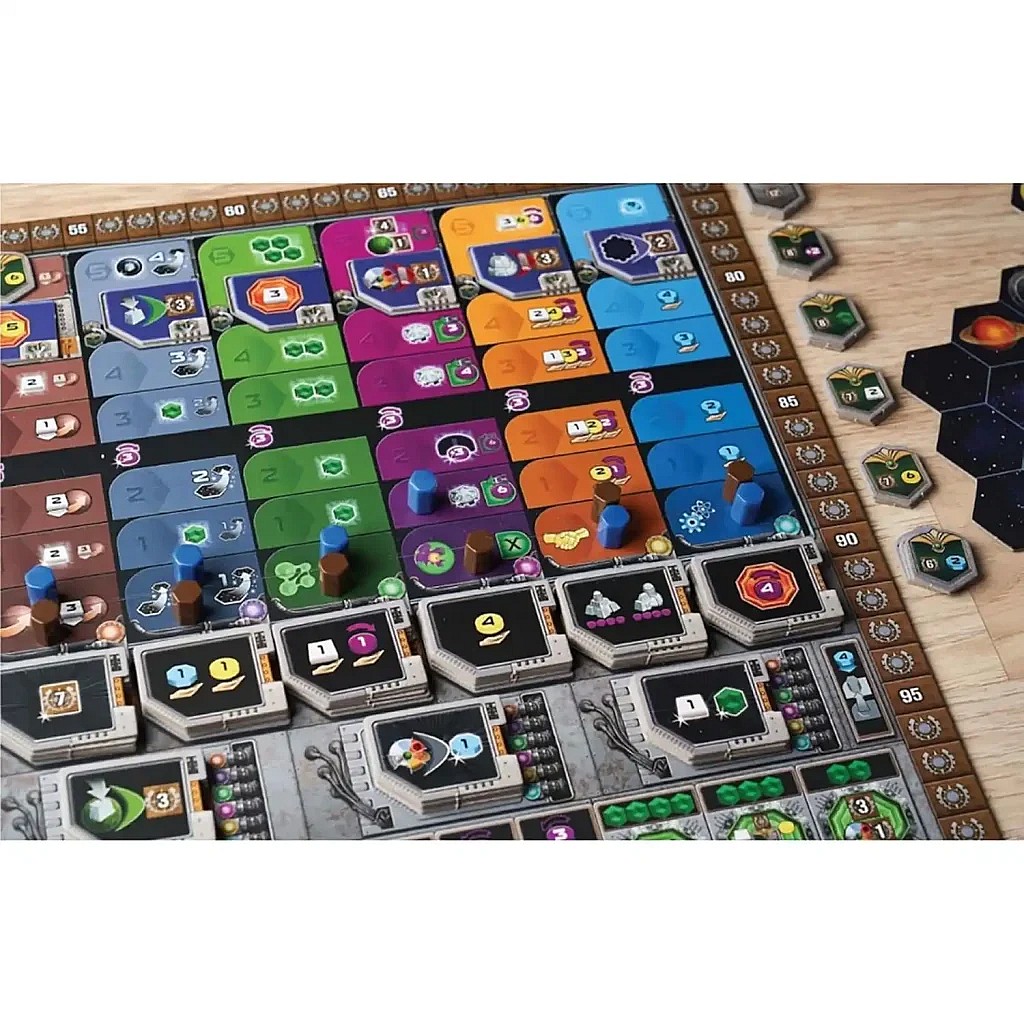
The Research Board and Scoring Board are central to gameplay:
- Research Board: Tracks player progress in six research areas — Terraforming, Navigation, Artificial Intelligence, Gaia Project, Economy, and Science.
- Advancing provides new abilities, bonuses, and end-game VP.
- Scoring Board: Displays round scoring goals, round boosters, and final scoring categories.
- Galaxy Map: The modular tiles form a network of planets — each type habitable only by certain factions (unless terraformed).
Planets come in several types:
- 7 Homeworld Colors
- Gaia Planets (green)
- Transdim Planets (purple, can be transformed into Gaia)
- The Lost Planet (special, unique world)
Player Setup
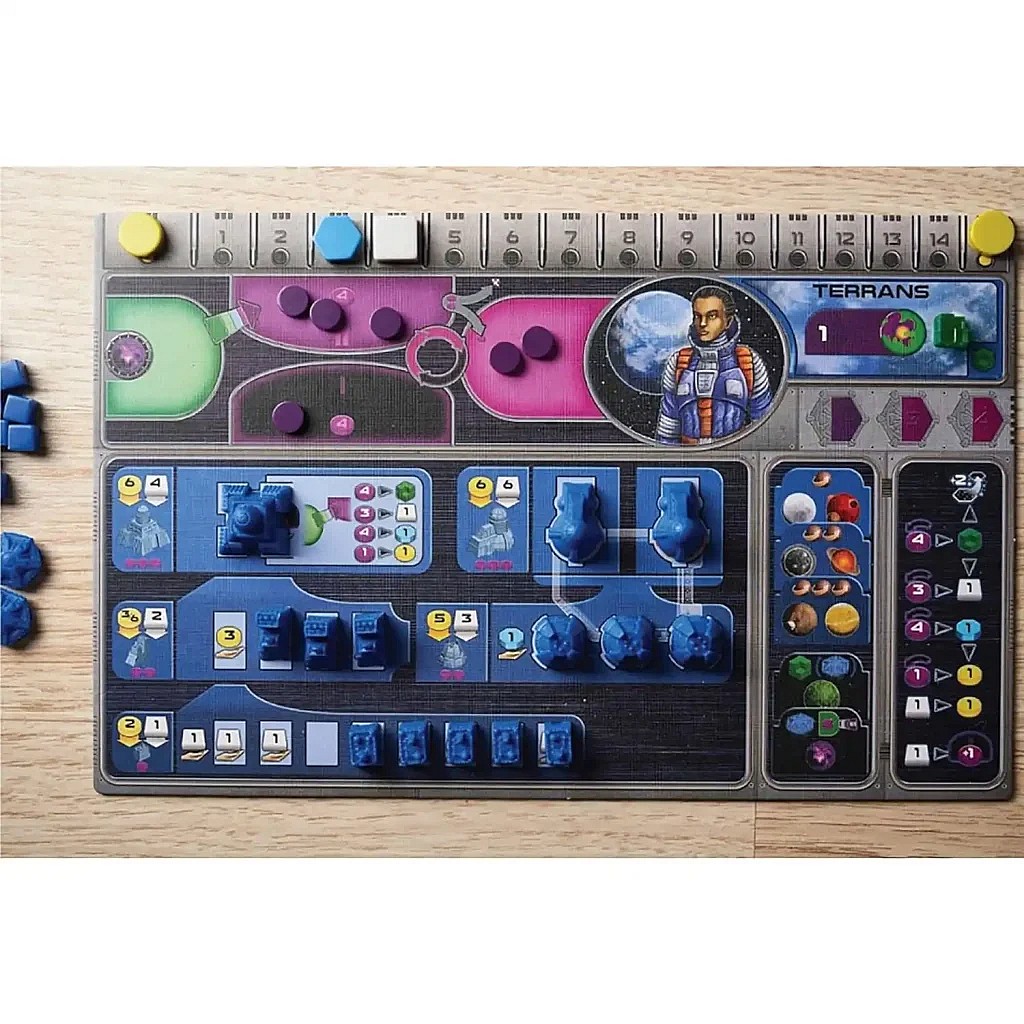
Each player manages their own Faction Board, which includes:
- Resource tracks (Credits, Ore, Knowledge)
- Power cycle (Areas I–III and Gaia area)
- Technology bonuses
- Unique faction ability
- Structure upgrade tracks (Mines → Trading Stations → Research Labs → Planetary Institute / Academies)
Players expand, terraform, and connect planets through Mines and Federations.
PHASES OF THE GAME
Each of the six rounds in Gaia Project follows the same sequence of four phases.
Every phase serves a distinct purpose, advancing your faction’s economy, planetary control, and research. Mastering these phases is key to efficient growth and victory.
Phase I: Income Phase
The Income Phase begins each round (including the first). During this phase, all players collect resources from various sources on their Faction Board, Round Booster, Tech Tiles, and Research levels.
1. Collecting Income
Each player gains the resources shown on their active income icons, which may include:
- Credits (₵) — Used to construct or upgrade buildings.
- Ore (⛏️) — Used primarily for building and terraforming.
- Knowledge (📘) — Used for research advancements.
- Q.I.C. (Quantum Intelligence Cubes) — Used to expand range or terraform Gaia Planets.
- Power Charges — Moves Power Tokens through your Power Cycle.
Your total income is the sum of all active icons visible on:
- Uncovered spaces on your Faction Board
- Tech Tiles that grant ongoing income
- Research Board levels that produce resources
- Your Round Booster tile
Each player performs income collection simultaneously.
2. Resource Tracking
Each player adjusts their resources by moving the appropriate markers on their Faction Board’s tracks:
- Ore, Knowledge, and Credits each have their own numbered tracks.
- The maximum for each resource is 15 (for Ore and Knowledge) and 30 Credits (15 per token). You can’t exceed these limits.
3. Power Charging Order
When you gain income that includes Power charges, decide the order in which you gain and charge Power. You must fully resolve one source of income before moving to another.
Example:
You may choose to charge 4 Power before gaining a Power Token, or the reverse, depending on your needs for the upcoming round.
Phase II: Gaia Phase
During the Gaia Phase, players manage their Gaiaformers and Power Tokens to transform Transdim Planets into Gaia Planets and cycle Power Tokens through the Gaia area.
1. Move Power from Gaia Area
All Power Tokens currently in your Gaia area are returned to Area I of your Power Cycle (except for the Terrans, who place them in Area II, as shown on their Faction Board).
2. Complete Gaia Projects
If you started a Gaia Project in a previous round, it now completes:
- Place a Gaia Planet Token on the Transdim Planet where your Gaiaformer was placed.
- The planet now becomes a Gaia Planet and is considered habitable to your faction.
- The Gaiaformer remains on the Gaia Planet until you build a Mine there, at which point it returns to your Faction Board.
These green Gaia Planets can now be colonized like normal planets.
Phase III: Action Phase
This is the heart of the game, where players perform most of their actions.
Starting with the first player and proceeding clockwise, players take one action per turn until all players have passed.
When you pass, you’re out for the remainder of the phase — but you’ll still participate in Power-charging opportunities from opponents’ builds.
There are 10 types of actions in total, divided into standard, special, and free actions.
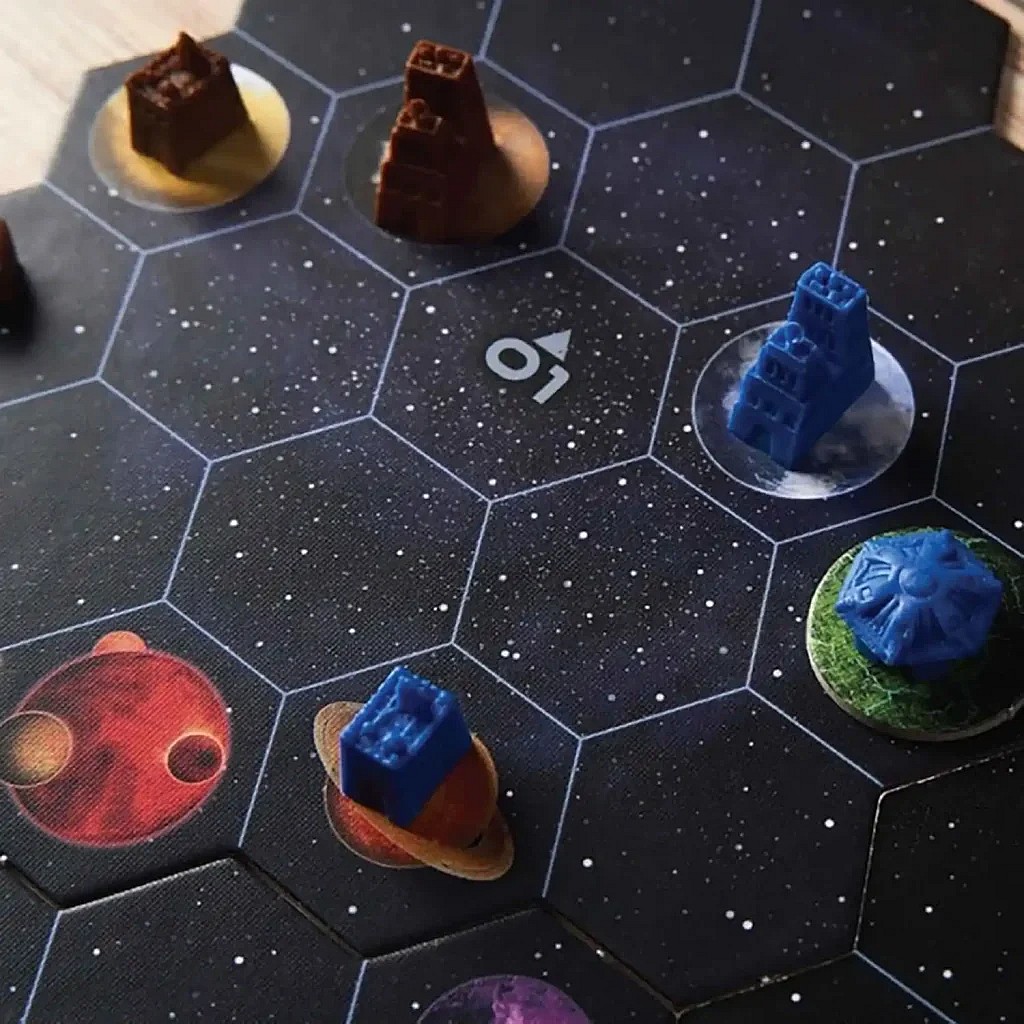
1) Build a Mine
Mines are the foundation of your empire. Building them lets you colonize new planets and unlock income spaces on your board.
Cost:
- 2 Credits + 1 Ore
- You must have at least one Mine available on your Faction Board.
Conditions:
- The planet must be unoccupied.
- It must be accessible within your range.
- It must be habitable or able to be terraformed.
Accessibility:
- Your Navigation level determines how far your reach extends:
- Level 0–1: Range = 1
- Level 2–3: Range = 2
- Level 4: Range = 3
- Level 5: Range = 4
- Each Q.I.C. spent extends range by +2.
Habitability and Terraforming:
- Each faction can only settle on planets of its home type without modification.
- To settle on other types, you must terraform the planet:
- Each terraforming step costs Ore based on your Terraforming research level.
- Level 0–1: 3 Ore per step
- Level 2: 2 Ore per step
- Level 3+: 1 Ore per step
Special Cases:
- Gaia Planets: Spend 1 Q.I.C. to settle, unless a Gaiaformer is already there.
- Transdim Planets: Cannot be settled directly — must be transformed through a Gaia Project first.
When placing your Mine, take the leftmost Mine from your Faction Board and place it on the planet. This exposes new income icons on your board for future rounds.
2) Start a Gaia Project
Transform Transdim Planets into Gaia Planets using a Gaiaformer.
Requirements:
- You must have an available Gaiaformer.
- You must be in range of a Transdim Planet without another Gaiaformer.
- You must spend the required amount of Power based on your “Gaia Project” research level:
| Gaia Project Level | Power Cost |
|---|---|
| 1–2 | 6 Power |
| 3 | 4 Power |
| 4–5 | 3 Power |
Move that Power from any combination of Areas I–III to the Gaia area on your board.
Completion:
The transformation completes in the next Gaia Phase, at which point the planet becomes habitable.
3) Upgrade a Structure
Upgrading allows you to enhance your structures to more powerful ones with increased income and new abilities.
Each upgrade follows the structure chain on your Faction Board:
| Upgrade Path | Cost | Notes |
|---|---|---|
| Mine → Trading Station | 6 Credits + 2 Ore (3 Credits + 2 Ore if adjacent to an opponent’s structure) | Gain extra income and adjacency benefits. |
| Trading Station → Planetary Institute | 6 Credits + 4 Ore | Unlocks your faction’s unique ability. |
| Trading Station → Research Lab | 5 Credits + 3 Ore | Gain a Standard or Advanced Tech Tile. |
| Research Lab → Academy | 6 Credits + 6 Ore | Gain a Tech Tile and choose one of two academies (2 Knowledge per round OR 1 Q.I.C. action). |
When upgrading, remove the previous structure from the board and return it to your Faction Board (rightmost available space). Then place the upgraded structure on that planet.
Gaining Tech Tiles:
When upgrading to a Research Lab or Academy, you gain a Tech Tile:
- Take any Standard Tech Tile you don’t already own, or
- Take an Advanced Tech Tile (requires level 4/5 in that research area and flipping one Federation Token to its gray side).
Advanced Tech Tiles grant powerful, unique effects and are limited — they are not refilled.
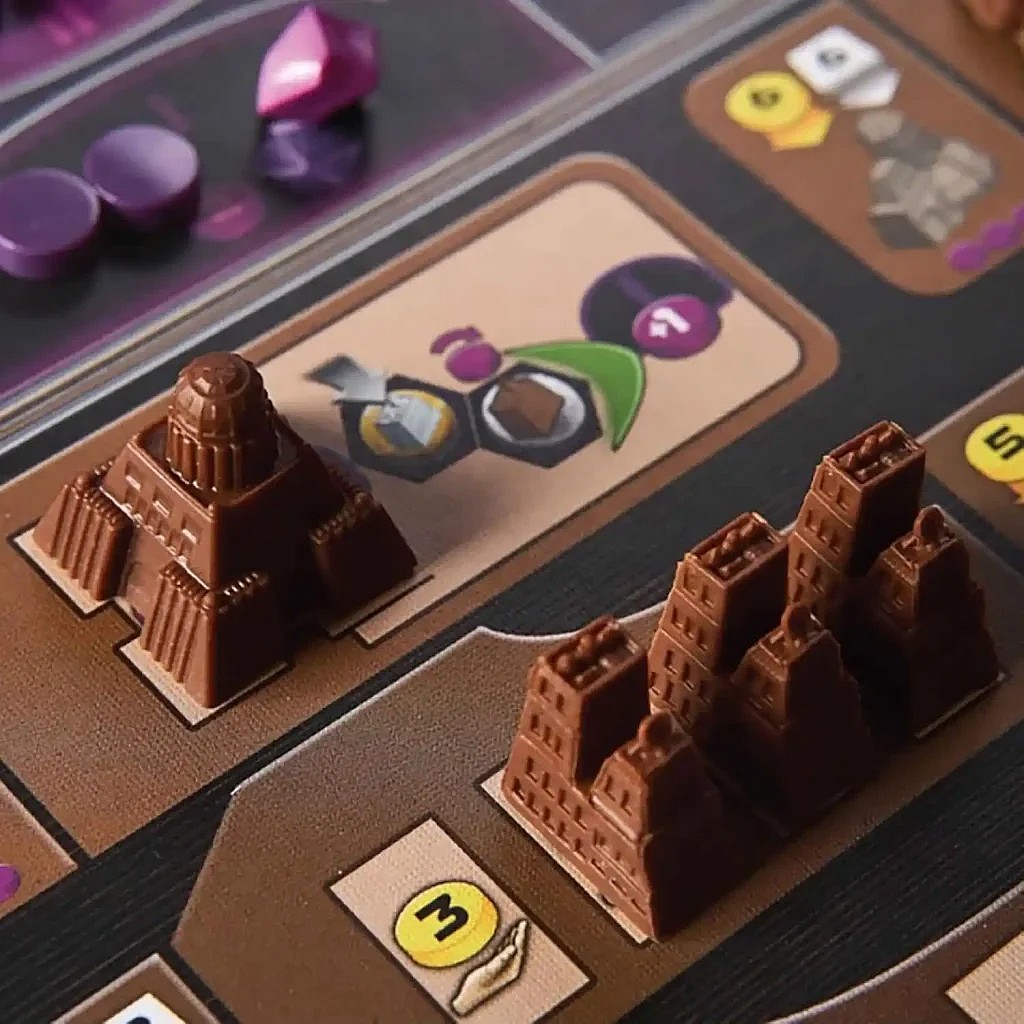
4) Form a Federation
Federations are networks of your connected planets with enough combined Power Value to form a political alliance.
Requirements:
- Total Power Value of connected structures must be ≥ 7.
- Mines = 1
- Trading Stations / Research Labs = 2
- Planetary Institutes / Academies = 3
- The planets must be connected, either directly or via Satellites.
To build a Satellite, discard one Power and place one of your Satellites in an empty space adjacent to one of your planets or other Satellites.
Completion:
When you form a Federation:
- Take a Federation Token of your choice from the supply (green side up).
- Immediately gain its resources or VP reward.
- Place a Record Token on one of the Federation’s planets as a reminder.
Each Federation can only be formed once, and no structure may belong to more than one Federation.
5) Research Progress
Spend 4 Knowledge to advance one level on a Research Track of your choice.
- Gain any one-time bonus (if shown with a white star icon).
- Apply any ongoing benefit from that level immediately.
- Advancing from Level 2 → Level 3 also allows you to charge 3 Power.
- Only one player can ever reach Level 5 in each track.
To advance to Level 5, you must flip one of your Federation Tokens from its green side to its gray side.
Each research area provides distinct benefits:
- Terraforming – Reduces cost of adapting planets.
- Navigation – Expands colonization range.
- Artificial Intelligence – Enhances Federation formation.
- Gaia Project – Improves efficiency of Gaiaformers.
- Economy – Provides more resources during Income.
- Science – Generates Knowledge income.
6) Power and Q.I.C. Actions
At the bottom of the Research Board are octagonal Power (purple) and Q.I.C. (green) action spaces.
- Spend Power or Q.I.C. to activate the space’s effect.
- Place an Action Token on the space afterward — each may only be used once per round.
Typical examples include:
- Gaining resources (Ore, Knowledge, or Credits)
- Advancing on the Research Board
- Building Satellites
- Free Terraforming or Range bonuses
7) Special Actions
Orange octagonal spaces on your Faction Board, Tech Tiles, or Round Boosters represent Special Actions.
They cost nothing but can only be used once per round.
After using one, place an Action Token on it to show it’s spent.
8) Pass
If you cannot or choose not to take further actions, declare Pass.
- When you pass, return your current Round Booster to the supply.
- Then select one of the available face-up Round Boosters for the next round and place it face-down in front of you.
- You may not use the same Booster in consecutive rounds.
- The first player to pass takes the First Player Marker for the next round.
- You may still charge Power when others build after you’ve passed.
Some Round Boosters or Tech Tiles trigger “When Passing” effects, indicated by a red icon.
9) Free Actions
You can take any number of Free Actions on your turn, before or after your main action (but not during).
Free Actions List:
- Discard 1 Power from Area II → Move 1 Power from Area II to Area III.
- Spend 4 Power → Gain 1 Q.I.C.
- Spend 3 Power → Gain 1 Ore.
- Spend 1 Q.I.C. → Gain 1 Ore.
- Spend 4 Power → Gain 1 Knowledge.
- Spend 1 Power → Gain 1 Credit.
- Spend 1 Knowledge → Gain 1 Credit.
- Spend 1 Ore → Gain 1 Credit.
- Spend 1 Ore → Gain 1 Power (in Area I).
You may perform each as many times as you can afford.
10) Passive Action: Charge Power
Whenever another player builds or upgrades a structure, you may spend VP to charge Power, provided one of your structures is within range (2 spaces).
To charge Power:
- Pay 0/1/2/3 VP to charge 1/2/3/4 Power respectively.
- You can only charge Power for your highest-value adjacent structure (if tied, pick one).
- You may decline to charge Power if desired.
- You can still charge Power even after you’ve passed.
Phase IV: Clean-Up Phase
After all players have passed, the round ends with a brief clean-up step.
- Remove all Action Tokens from Power, Q.I.C., and Special Action spaces.
- Flip Round Boosters face-up.
- Remove the current Round Scoring Tile from the Scoring Board.
- Prepare for the next round (except after Round 6).
If this was Round 6, skip the clean-up and proceed to Final Scoring.
END OF THE GAME AND SCORING
The game of Gaia Project concludes at the end of the sixth round, after all players have passed in the final Action Phase. Once the final round ends, proceed to Final Scoring, where Victory Points (VP) from various sources are totaled to determine the winner.
The player with the most VP wins.
In the case of a tie, the tied players share the victory.
Final Scoring Overview
Victory Points come from four primary sources:
- Final Scoring Tiles
- Research Board Progress
- Remaining Resources
- Federation Tokens and Tech Tiles
Each of these areas can grant large point swings — especially the first two — so players must balance their midgame economy with long-term scoring potential.
1. Final Scoring Tiles
At setup, two Final Scoring Tiles are randomly selected and placed beside the Scoring Board. Each one introduces a unique endgame scoring condition.
During the game, each player’s progress toward these goals is tracked using satellites on the ranking tracks beside the tiles.
At the end of the game, each final scoring tile awards VP based on ranking:
| Rank | Victory Points |
|---|---|
| 1st | 18 VP |
| 2nd | 12 VP |
| 3rd | 6 VP |
| 4th | 0 VP |
If two or more players tie for a rank, combine the total VP for the tied ranks and divide evenly (round down if necessary).
Examples of Final Scoring Tiles
- Most Structures in Federations:
Counts all structures within federations (the Lost Planet mine also counts). - Most Structures Overall:
Rewards players who built the largest number of buildings across the board. - Most Different Planet Types Colonized:
Includes all standard planets, Gaia Planets, and the Lost Planet. - Most Gaia Planets Colonized:
Each Gaia Planet counts once, regardless of mine type. - Presence in Most Space Sectors:
Counts sectors containing at least one of your structures. - Most Satellites:
Counts satellites placed on the board, including Ivits’ space stations.
2. Research Board Scoring
Each research track represents scientific advancement.
At the end of the game, you score VP for the progress you’ve made across all six tracks.
For every level 3, 4, or 5 reached or passed in each research area, gain 4 VP.
For example:
- Reaching Level 5 in Navigation = 12 VP (4 + 4 + 4)
- Reaching Level 3 in Science = 4 VP
It’s often beneficial to diversify progress across multiple tracks, as each additional Level 3 milestone increases total endgame VP.
3. Resource Scoring
After all other scoring is complete, convert leftover resources into VP.
- Every 3 resources (of any type — Credits, Ore, or Knowledge) = 1 VP
- Q.I.C. and Power Tokens do not count for this conversion.
This step rewards efficient resource management and leftover economic power.
4. Federation Tokens and Tech Tile Scoring
Some Federation Tokens, Tech Tiles, and Advanced Tech Tiles grant additional VP either during the game or at the end.
Examples include:
- Federation Tokens worth 6–12 VP
- Tech Tiles that give VP for building or colonizing
- Advanced Tech Tiles that reward federations or research levels
Be sure to count all of these bonuses in your final total.
Determining the Winner
After adding all VP from:
- Round Scoring Tiles
- Final Scoring Tiles
- Federation Tokens
- Research Progress
- Remaining Resources
…the player with the highest score wins the game.
If tied, players share the victory — or can agree to break ties by most Gaia Planets controlled, if desired.
STRATEGY TIPS
Mastering Gaia Project requires balancing expansion, research, and timing. Here are key strategic insights for both beginners and intermediate players.
1. Plan Your Expansion Efficiently
Focus your early turns on building mines and expanding into reachable territories.
Gaia Project’s modular map means space is tight — claiming planets early ensures future access to valuable sectors.
2. Time Your Research Upgrades
Advancing on the Terraforming and Navigation tracks early pays off, as it reduces long-term costs and expands your reach.
Later in the game, shifting into Science or Economy ensures a consistent resource engine.
3. Build Federations Intelligently
Federations are powerful scoring tools but also expensive.
Try to:
- Build them in connected clusters.
- Combine planets with high-level structures (Planetary Institutes, Academies) to minimize satellite costs.
- Use Federation Tokens strategically for resource boosts or late-game research.
4. Manage Power Wisely
Your Power Cycle is one of the game’s most intricate systems.
Don’t rush to spend Power — wait for moments when efficient Power Actions or Gaia Projects will yield lasting benefits.
5. Use Round Scoring Tiles to Guide Decisions
The Round Scoring Tiles are the game’s tempo markers.
Tailor your play to them — if “Upgrade Structures” gives bonus VP this round, focus on upgrades, even if it slows expansion temporarily.
6. Choose Factions to Match Your Playstyle
Each faction has a unique ability and recommended research focus:
- Terrans: Focus on Gaiaforming efficiency.
- Taklons: Prioritize Power manipulation.
- Xenos: Excel at Federation formation.
- Hadsch Hallas: Economic powerhouses — perfect for beginners.
Experiment with combinations to learn how each faction interacts with the research board differently.
7. Time Your Passing
Passing first not only secures the First Player Marker for next round, but can also secure the best Round Booster before others grab it.
If you’ve achieved your goals for the round, don’t hesitate to pass early.
8. Don’t Neglect Late-Game Research
Endgame VP from Research Tracks can exceed 30–40 points.
If you have resource surplus in Rounds 5–6, prioritize research advancement — it’s one of the most efficient ways to close the gap with strong opponents.
FREQUENTLY ASKED QUESTIONS (FAQ)
Yes. You can start as many Gaia Projects as you have available Gaiaformers and enough Power to pay the cost for each.
You can’t reuse that Gaiaformer until you’ve built a Mine on its planet and returned it to your board.
Yes — once a planet becomes a Gaia Planet, it’s neutral. If you reach it first and can pay the cost, you can colonize it.
Charging Power: Moves Power Tokens toward Area III (makes them usable). Spending Power: Uses Power Tokens from Area III for actions, moving them back to Area I.
No. Each track ends at Level 5, and only one player per area can reach that level.
No. Only your own planets and satellites count toward forming Federations.
Yes. If you cannot or do not wish to take further actions, you must Pass. You’ll still participate in Power charging during others’ turns.
Yes. For all purposes related to Federations and final scoring, Ivits’ space stations function as satellites.
They apply immediately when performing the corresponding action (for example, upgrading or building during that round).
Yes. Gaia Planets count as a unique planet type, distinct from the seven colored planet types.
Conclusion
Having navigated the complexities of the research tracks, faction abilities, and economic engine, you are now equipped with the essential Gaia Project rules. The key to understanding how to play Gaia Project successfully lies in mastering the core actions of expanding your presence, terraforming planets to match your faction, and advancing on the research tracks to unlock powerful bonuses. Remember that strategic Power management and efficient QIC utilization are crucial for maintaining momentum and securing victory points across the seven scoring rounds in this deep, space-faring economic challenge.
Browse Related Games!
 Official Cootie Rules
 Official The Lord of The Rings: Duel for Middle-Earth Rules
 Official Mancala Rules
 Official Mycelia Rules
 Official Tsuro of the Seas Rules
Official Liar’s Dice Rules
Official Tsuro of the Seas Rules
Official Liar’s Dice Rules
 Official Santorini Rules
 Official Roll For It! Rules
Official Ticket to Ride Rules
Official Roll For It! Rules
Official Ticket to Ride Rules
 Official Paint The Roses Rules
Official Magnetic Chess Game with Stones Rules
Official Paint The Roses Rules
Official Magnetic Chess Game with Stones Rules
 Official Aquatica Rules