

Last Updated on February 26, 2026 by The Official Game Rules Team
In Forest Shuffle, players step into the role of ecosystem builders, carefully cultivating a thriving forest where trees, animals, plants, and mushrooms coexist in harmony. Every card represents part of the natural balance — towering trees provide shelter, animals seek ideal habitats, and plants thrive under specific conditions. Your goal is to create the most ecologically rich and balanced forest, scoring the most points before winter ends the growing season.

This post contains affiliate links. For more information, see our disclosures here.
How to Play Forest Shuffle
Overview
Players: 2–5 | Ages: 10+ | Playing Time: ~60 minutes
Objective of the Game
Players compete to build a flourishing forest ecosystem by strategically planting trees and attracting wildlife. Points are earned based on how well your flora and fauna interact — certain species prefer specific trees, habitats, or companions. When the third Winter Card appears, the game ends, and the player with the most points wins.
Components
- 180 Cards
- 66 Tree cards
- 48 Split (Top/Bottom) cards
- 44 Split (Left/Right) cards
- 3 Winter cards
- 1 Game board (The Clearing)
- 5 Cave cards
- 14 Reference cards
- 1 Scorepad

Setup
- Place the Clearing Board in the center of the table, within easy reach of all players.
- Set out the Reference Cards nearby for quick rule checks.
- Each player takes a Cave Card and places it in front of themselves.
- Prepare the Deck:
- Set aside the 3 Winter Cards.
- Shuffle the remaining deck and remove cards based on player count:
- 2 players: remove 30 cards
- 3 players: remove 20 cards
- 4 players: remove 10 cards
- 5 players: play with all cards
- Divide the deck into three roughly equal piles. Shuffle two Winter Cards into one pile, place the third Winter Card on top, then stack the other piles on top to form a single draw deck.
- Deal 6 cards to each player. If you receive no tree cards, you may take one mulligan — discard your hand and draw 6 new cards.
- The player who most recently walked in a forest takes the first turn.
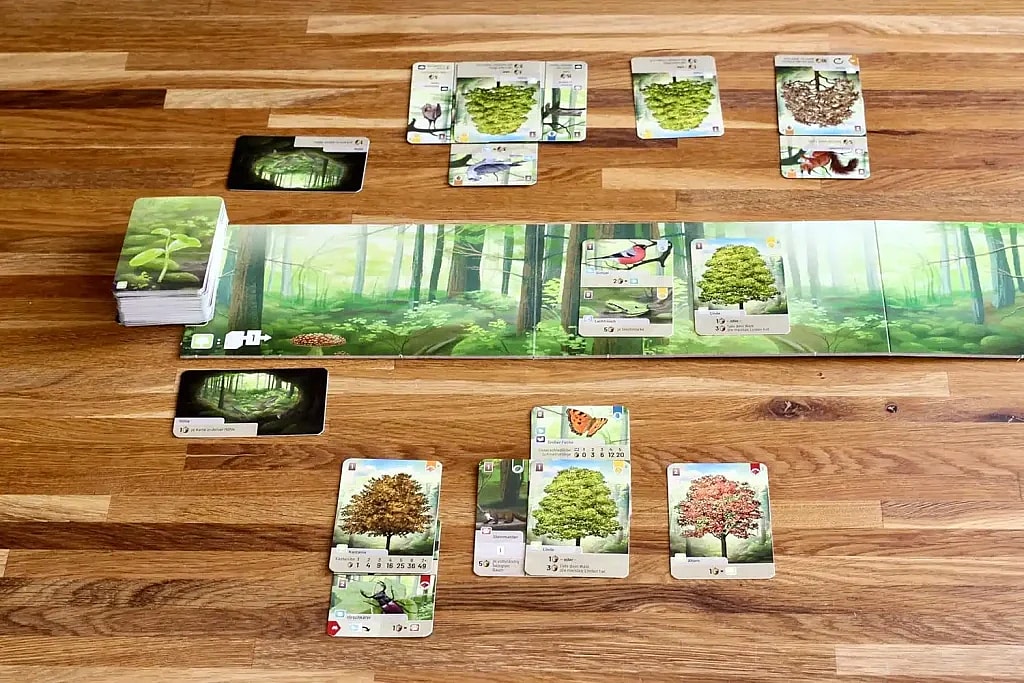
How to Play Forest Shuffle
Players take turns in clockwise order. On your turn, choose one of the two possible actions:
A. Draw Two Cards
Draw two cards, one at a time. For each draw, you may:
- Take the top face-down card from the deck, or
- Take a face-up card from the Clearing.
Note: You may not exceed 10 cards in hand. If you have 9 cards, you can only draw one.
Winter Cards
The lower third of the deck contains three Winter Cards.
- When drawn, place it face-up next to the Clearing and immediately draw a replacement card.
- When the third Winter Card is revealed, the game ends instantly.
B. Play a Card and Check the Clearing
Cards come in two types:
- Tree Cards – Provide the foundation of your forest and offer placement slots on all four sides.
- Split Cards – Feature animals, plants, or mushrooms, appearing in either top/bottom or left/right formats.
To play a card:
- Pay its cost by discarding that number of cards from your hand into the Clearing.
- Place the card in your forest:
- Trees can be placed anywhere in front of you.
- Split cards must attach to an open side of a Tree (matching their orientation).
- Activate any effects or bonuses on the card (optional).
Tree Saplings
You may play any card face down as a Tree Sapling. Saplings act like trees but don’t count as any specific species.
Adding to Trees
Each Tree can have one card on each side — top, bottom, left, and right.
Whenever you play a Tree, also draw the top card from the deck and place it face-up into the Clearing.
Effects and Bonuses
Some cards include special effects or bonuses:
- Effects:
- Instant Effects trigger immediately when played.
- Permanent Effects (usually from mushrooms) remain active for the rest of the game.
- Bonuses:
- Trigger if all cards used to pay the cost share the same tree symbol as the played card.
Example:
If you play a Roe Deer and pay with cards that both show a Birch symbol, you activate its bonus.
Checking the Clearing
At the end of your turn, if there are 10 or more cards in the Clearing, remove all cards and return them to the box. Then, the next player takes their turn.
End of the Game
When the third Winter Card appears, the game ends immediately. Players may not finish their current turn.
Scoring Forest Shuffle
Each visible card in your forest provides points according to its scoring condition.
- Add up all visible cards in your forest.
- Add bonus points for cards stored under your cave (if applicable).
The player with the highest total score wins. In the case of a tie, players share the victory.
FAQ: Forest Shuffle Common Questions
No, all split cards must be attached to a tree or sapling in your forest.
The game ends immediately before the tree is placed — the round does not continue.
No. The hand limit always applies, even when drawing through card effects.
No, only the visible portion of a split card contributes to your forest and score.
No, saplings only provide placement spots — they don’t count as trees for scoring purposes.
Conclusion
Forest Shuffle blends nature and strategy, rewarding careful balance over sheer expansion. Each choice — which trees to plant, which animals to attract, and when to take risks — contributes to the ecosystem you build. When winter arrives, the most harmonious and diverse forest wins.
Browse Related Games!
 Official Phase 10 Tiles Rules
 Official Casting Shadows Rules
 Official Twenty-Nine Rules
 Official Coup Rules
 Official The Fox in The Forest Rules
 Official Command of Nature Rules
Official Panguingue (Pan) Rules
Official Command of Nature Rules
Official Panguingue (Pan) Rules
 Official Canasta Rules
 Official 2-7 Triple Draw Poker Rules
Official Betrayal Deck of Lost Souls Rules
Official 2-7 Triple Draw Poker Rules
Official Betrayal Deck of Lost Souls Rules
 Official Countries of the World: Guess in 10 Rules
 Official Five Crowns Rules