

Last Updated on May 8, 2026 by The Official Game Rules Team
Hand and Foot is a multi-round rummy-style card game that involves building melds and managing two distinct piles of cards: the “Hand” and the “Foot.” This page provides a clear breakdown of the rules, guiding you through the melding requirements, card drawing, and strategic pile management that define this game.

This post contains affiliate links. For more information, see our disclosures here.
How to Play Hand and Foot
Objective
The goal in Hand and Foot is to be the team with the most points scored by getting rid of all the cards in your “hand” and then your “foot” by melding them strategically.
Setup
1. In Hand and Foot, the number of decks used depends on the number of players. A general rule is to use one deck per player, plus one extra deck. Here’s the breakdown:
- 2 players – 3 decks (162 cards)
- 3 players – 4 decks (216 cards)
- 4 players – 5 decks (270 cards)
- 6 players – 7 decks (378 cards)
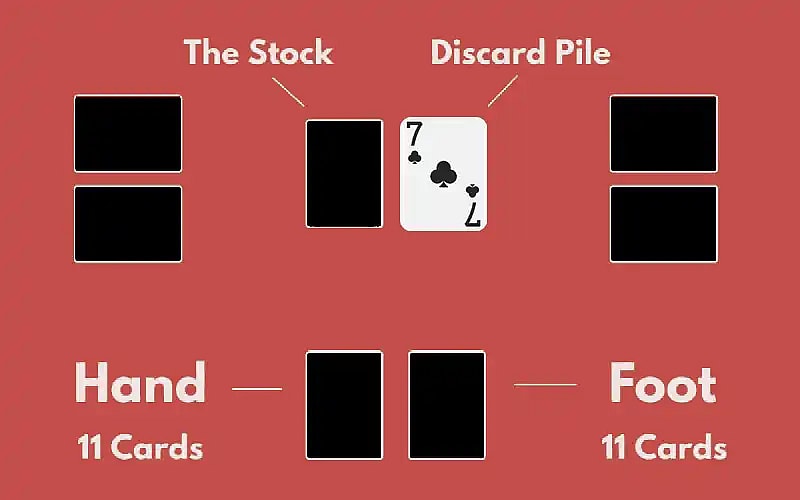
Each player is typically dealt two sets of cards: a hand and a foot, each containing 11 cards. The remaining cards form the draw pile.
2. Deal the Cards:Each player receives 11 cards for their Hand, which they can look at immediately.
Each player is dealt a second set of 11 cards for their Foot, which is kept face down until their Hand is played.
3. Prepare the Stock and Discard Piles:Place the remaining cards face-down as the Stock pile.
Flip the top card to start the Discard pile. If it’s a Red Three, Deuce (2), or Joker, replace it with a new card.
Card Values & Scoring
- Jokers (Wild Cards): 50 points each
- Deuces (2) (Wild Cards): 20 points each
- Aces: 20 points each
- Eights through Kings: 10 points each
- Threes through Sevens: 5 points each
Game Rounds
The game is played over four rounds, each requiring a minimum point total for the first meld.
- Round 1: Minimum meld of 50 points
- Round 2: Minimum meld of 90 points
- Round 3: Minimum meld of 120 points
- Round 4: Minimum meld of 150 points
To meet the minimum requirement, players can combine multiple melds, using cards from their hand, wild cards, and the top discard. However, the other six cards from the discard pile cannot contribute toward the minimum points.
Gameplay
The goal is to play through your Hand, then move to your Foot, creating melds along the way.
- Turns:
- Draw two cards from the Stock pile at the start of your turn.
- Create melds or add cards to existing melds.
- Discard one card at the end of your turn.
- Melds:
- A meld consists of 3 to 7 cards of the same rank, placed face up.
- Clean Meld (Red Book): Seven natural cards (no wild cards). Worth 500 points.
- Dirty Meld (Black Book): At least four natural cards and one or more wild cards. Worth 300 points.
- Once a meld reaches seven cards, it is complete and becomes a Book.
- Picking Up the Discard Pile:
- Players can take the top seven cards from the discard pile if:
- They have two cards in their Hand matching the top card of the discard pile.
- They immediately lay down those three cards as part of a meld.
- Only the top card of the discard pile can count toward the minimum meld requirement.
- Playing the Foot:
- Once your Hand is depleted, announce you’re playing your Foot and continue.
- Discarding your last card marks the end of your turn.
- Going Out:
- To end a round, a player must have at least one Clean Book, one Dirty Book, and discard their final card.
Scoring
At the end of each round:
- Calculate points for completed melds.
- Add the value of all cards played during the round.
- Deduct points for any cards left in a player’s Hand or Foot.
The team or player with the highest cumulative score at the end of all rounds wins the game.
Hand and Foot Strategy
While Hand and Foot relies heavily on luck of the draw, smart play can make the difference between winning and losing. Here are some strategy tips to keep in mind:
- Manage Your Hand and Foot Wisely
Don’t rush into your Foot pile too early. Make sure your Hand is under control before opening up the second stack, or you risk spreading yourself too thin. - Use Wild Cards Carefully
Jokers and 2s are powerful, but burning through them early can leave you with nothing to complete melds later. Save them for finishing Canastas or meeting minimum meld requirements. - Prioritize Canastas
Building full Canastas is key to scoring. Work with your partner (if playing teams) to focus on creating multiple Canastas instead of scattering your melds across too many ranks. - Control the Discard Pile
Always watch what you throw away. Giving opponents access to a pile full of useful cards can swing the game. Similarly, if the pile is dangerous, consider “freezing” it by discarding a wild card. - Balance Going Out
Sometimes the temptation is to go out quickly, but waiting can give you more time to build extra Canastas and rack up points. Know when it’s worth holding off versus when to close the round. - Team Coordination
If playing in pairs, communicate non-verbally by the melds you lay down. Focus on complementing each other’s plays rather than working separately.
Ready to take your Hand and Foot game to the next level? Checkout our Advanced Strategies for Hand and Foot guide!
Video Tutorial
Hand and Foot FAQ
Most versions use five to six standard decks of cards, including jokers. The number of decks should be enough so that each player has a “hand” and a “foot” plus plenty left for the draw pile.
It is usually played with four players in partnerships, but it can also be played with three, five, or six players using slight rule adjustments.
The hand is the initial set of cards each player starts with. Once a player uses all the cards in their hand, they pick up their foot and continue playing.
Players score points by forming melds and completing books of seven cards. The game usually ends when one player goes out, and the partnership with the highest total score wins.
Red threes are special bonus cards worth extra points when laid down.
Black threes are blocking cards that cannot be used in melds and can prevent players from discarding strategically.
Yes, but only if you can use the top card of the discard pile immediately in a meld, and sometimes rules require extra matching cards from your hand to pick it up.
A clean book (natural) contains seven cards without wilds.
A dirty book (mixed) contains up to four wilds along with natural cards.
A typical game lasts about 90 minutes to 2 hours, depending on the number of players and house rules.
Notes/Variations
- Starting Melds (Optional): Some variations allow players to create their first meld(s) on the table before their first turn by using cards from their hand. This can jumpstart the game.
- Red Threes: While red Threes cannot be used in melds, drawing one allows you to immediately discard another card from your hand without ending your turn.
Hand and Foot is a rummy-style card game, so similar games include other Canasta variations and rummy-based games. Here are a few you might enjoy:
Canasta Variants
- Traditional Canasta – The original game that Hand and Foot is based on, played with two decks and teams.
- Samba – A variation that allows sequences (runs) in addition to sets.
- Pennies from Heaven – A more complex Canasta variant with extra rounds and more cards per player.
- Bolivia – Similar to Samba but with stricter rules about wildcards.
Other Rummy-Based Games
- Kalooki (Kaluki) – A rummy-style game with jokers acting as wildcards.
- Gin Rummy – A two-player game focused on forming sets and runs.
- Phase 10 – A set-building game with specific phases to complete in order.
Browse Related Games!
 Official Casting Shadows Rules
 Official Command of Nature Rules
 Official Twenty-Nine Rules
 Official Monopoly Buy Everything Rules
 Official Sambola Rules
 Official Coup Rules
 Official Camping with Sasquatch Rules
 Official South African Kaluki Rules
 Official The Fox in The Forest Rules
 Official Canasta Rules
Official Panguingue (Pan) Rules
Official Ranter-Go-Round Rules
Official Canasta Rules
Official Panguingue (Pan) Rules
Official Ranter-Go-Round Rules