

Last Updated on May 8, 2026 by The Official Game Rules Team
Phase 10 is a special deck card game for 2–6 players, combining strategy, luck, and a race to complete all ten phases. Players aim to complete specific card combinations each hand while strategically managing their player’s cards and taking advantage of the top card of the draw pile or the top of the discard pile. Multiple variations exist, including a shorter version for quicker play. If you are more of a visual learner, checkout the simple video tutorial.
Want to play Phase 10 with a standard deck of cards? Learn how to play here.

This post contains affiliate links. For more information, see our disclosures here.
How to Play Phase 10
Objective of the Game
The main goal in Phase 10 is to be the first player to complete all ten phases in sequential order. Each phase has a specific requirement, such as a combination of sets, a combination of colors, or a combination of number cards. Successfully completing a whole phase allows a player to advance to the next phase. Players who fail to complete their phase must replay phase number in a later turn. Strategic play involves carefully managing player’s cards, taking additional cards when advantageous, and minimizing the points left in hand at the end of a hand.
Enjoying Phase 10? Checkout Phase 10 Tiles, which shuffles together the original rummy-type card game everyone loves with the tactile fun of tiles and two quicker ways to play!
Setup
- Shuffle the deck: The special deck includes 108 cards:
- Regular cards numbered 1–12 in four colors
- Red cards and green cards for color combinations
- Skip cards for skipping opponents’ turns
- Deal cards: Each player receives ten player’s cards. Remaining cards form the top card of the draw pile. Turn the first card over to start the top of the discard pile.
- Choose a dealer: Randomly select a dealer. Play proceeds in clockwise direction, starting with the player to the left of the dealer.
- Decide on variations: Players may choose between the official rules, a shorter version, or house rules, including optional new cards or blank cards to create custom phases.
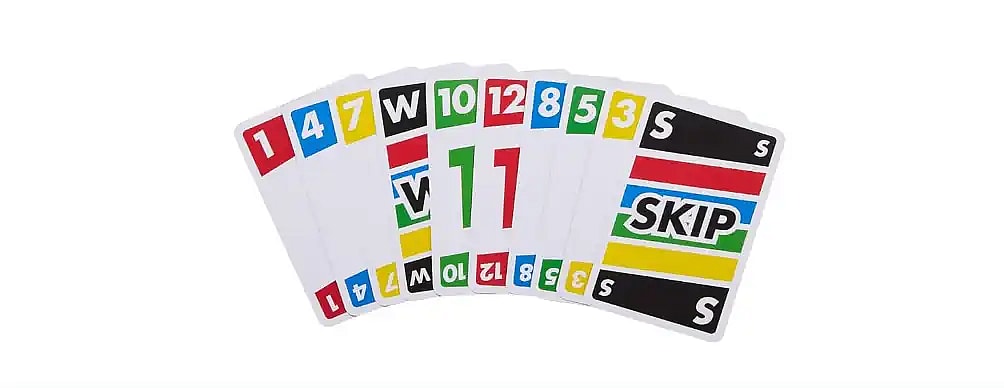
Player Turn Overview
During a player’s turn, the following steps occur:
- Draw a card: The player must draw either the top card of the draw pile or the top of the discard pile.
- Play cards:
- Attempt to complete your own phase using a natural card or combination of cards.
- Lay down any additional cards to existing sets or combinations on the table.
- Only a complete phase can be played; partial sets do not count.
- Discard: Place one card from your hand onto the top of the discard pile. If the discarded card is a skip card, the next player loses their turn.
Key Notes:
- A player may not play cards from other players’ completed phases unless house rules allow it.
- If a player cannot complete their phase, they retain all player’s cards for the next hand.
- Strategic decisions involve when to draw from the discard pile versus the draw pile to obtain the intended card for a phase.
Completing Phases
Phases are made of sets, runs, cards of all one color, or a combination of sets and runs. These are the ten Phases:
- 2 sets of 3
- 1 set of 3 + 1 run of 4
- 1 set of 4 + 1 run of 4
- 1 run of 7
- 1 run of 8
- 1 run of 9
- 2 sets of 4
- 7 cards of 1 color
- 1 set of 5 + 1 set of 2
- 1 set of 5 + 1 set of 3
Each player can make only one Phase during each hand.
Important Rules:
- Players must lay down the whole phase at once; partial completion is not allowed.
- Successfully completing a complete phase advances a player to the next phase in the following hand.
- If a player cannot complete a phase, they must replay phase number on their later turn.

End of a Hand
A hand ends when a player discards their last card or successfully lays down their phase.
- Remaining players score points based on the total value of cards left in hand.
- Cards left in hand count toward total points: high-numbered cards are worse.
- The fewest total points are preferable when the hand ends.
- After scoring, a new hand begins, and the role of new dealer rotates clockwise direction.
Scoring and Winning
- Track the phases each player has completed and the points accumulated from remaining player’s cards.
- The first player to complete the final phase wins the game.
- In the event of a tie, the player who completed their whole phase first or has the fewest total points in the hand takes the lead.
Variations and House Rules
- Shorter version: Reduce the number of phases for quicker play.
- Official rules: Standard gameplay using the full special deck.
- Custom cards: Players may use new cards or blank cards to create unique phases.
- Additional rules: Some variations allow players to play additional cards on top of other completed phases for strategic advantages.
Regional versions: Phase 10 has multiple editions in different countries, including the UK, Australia, and Canada, often featuring new cards or alternative color sets for variety in gameplay.
Strategic Tips
- Pay attention to the top card of the discard pile; taking the intended card at the right moment can complete your own phase.
- Decide when to hold red cards or green cards for combination of colors phases.
- Use skip cards strategically to delay opponents on later turns.
- Consider minimizing your player’s cards to reduce the value of your hand in case someone else completes their phase first.
Video Tutorial
Phase 10 FAQ
The objective is to be the first player to complete all 10 phases in order. Each phase has a specific set of cards you must collect and lay down.
Phase 10 is designed for 2 to 6 players, but it’s best with 3–6 for more competition.
If you fail to complete your current phase, you must try the same phase again in the next hand while other players may advance.
Wild cards can represent any number or color needed to complete a phase.
Skip cards let you choose an opponent to lose their turn. They cannot be used in phases and do not count toward sets or runs.
At the end of each hand, players add up the value of cards left in their hands: Number cards = face value, Skip = 15 points, Wild = 25 points.
The first player to complete all 10 phases wins. If more than one player finishes Phase 10 in the same round, the player with the lowest score is the winner.
A full game usually takes 45–90 minutes, depending on the number of players and pace of play.
With a mix of strategy, memory, and luck, Phase 10 remains one of the most exciting and dynamic card games for family and friends.
Browse Related Games!
 Official Casting Shadows Rules
 Official Twenty-Nine Rules
 Official Coup Rules
 Official Command of Nature Rules
 Official The Fox in The Forest Rules
Official Panguingue (Pan) Rules
Official The Fox in The Forest Rules
Official Panguingue (Pan) Rules
 Official UNO Flip Rules
 Official 2-7 Triple Draw Poker Rules
 Official Canasta Rules
 Official Phase 10 Tiles Rules
 Official Five Crowns Rules
 Official Monopoly Buy Everything Rules