

Last Updated on February 18, 2026 by The Official Game Rules Team
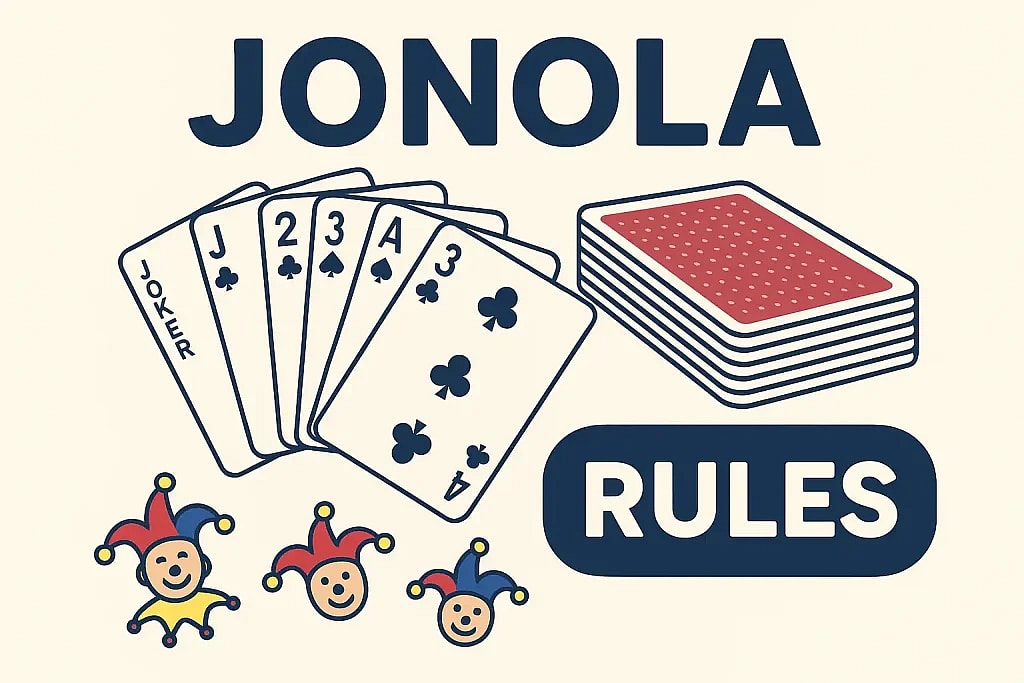
The Jonola card game is a modern adaptation of the original canasta game, designed to create faster turns, fairer play, and more consistent excitement from start to finish. Often described as an exciting 3-pack version of canasta, Jonola Canasta blends the structure of the old game with refinements that reduce uneven play and increase unpredictability.
Whether you’re new to canasta or a long-time fan of various versions of canasta like samba or bolivia, this guide explains the complete basic rules, scoring, gameplay flow, strategy, and helpful tips so you can confidently bring Jonola to your table.
Jonola is considered by many regular players to be an excellent game for family gatherings, leisure time, and competitive card nights alike.
This post contains affiliate links. For more information, see our disclosures here.
How to Play Jonola (Complete Guide)
Special Features of Jonola Canasta
Jonola Canasta introduces thoughtful changes that address some common frustrations found in the original canasta.
1. Three Decks of Cards (Including Jokers)
The game uses 3 decks of cards shuffled together, including a total of 9 jokers. These jokers function as wild cards, helping players complete melds and required canastas more quickly.
Using three decks instead of two increases opportunities for melding and reduces the slow build-up that sometimes defined the old game.
2. Limited Pick-Up from the Discard Pile
One of the most important rule changes is that players may pick up a maximum of five cards from the discard pile at one time.
In the original canasta, a player could sometimes take the entire discard pile, leading to lopsided scoring and long sorting turns. In Jonola:
- You may only take the top card and up to four additional cards beneath it.
- The discard pile never completely disappears in one turn.
- This ensures ongoing variety and prevents runaway hands.
This limitation improves game balance and reduces frustration.
3. Faster Turn Structure
Each player draws between 2 and 5 cards on their turn. Because hands steadily grow and players have frequent access to cards, the game moves quickly toward the required canastas and the final round.
4. Reduced Penalties
Jonola removes many harsh penalties that existed in older rule sets. While mistakes can still affect gameplay, most penalties have been softened or eliminated to create a simple family game atmosphere rather than a highly punitive one.
Objective of the Game
The goal of Jonola Canasta is to:
- Complete the required canastas.
- Meld all cards from your hand.
- Go out by playing your last card.
- Score more than the target number of points over multiple hands.
A canasta consists of seven cards of the same rank.
- A canasta made entirely of natural cards (no wild cards) is called a red canasta.
- A canasta containing wild cards is sometimes referred to as a black canasta, depending on house rules.
The player or partnership with the highest score at the end of the game wins.
Number of Players
2 or 3 Players
Each player competes individually with their own hand and tabled melds.
4 Players
Players form two partnerships.
- Partners sit opposite each other.
- Each player plays their own hand.
- Partners combine their tabled cards.
- The player to the left of the dealer begins.
Setup
- Shuffle all 3 decks of cards together, including the jokers.
- Deal the appropriate number of cards to each player (commonly 15 cards in 4-player games, though house rules may vary).
- Place the remaining cards face-down to form the draw stacks.
- Turn the top card face-up to start the discard pile.
If the first top card is a black three or other restricted card (depending on house rules), follow standard replacement procedures.
Card Values and Rank
Understanding rank and card values is critical.
- Aces are high-value cards.
- 4 through King follow standard ascending rank.
- Jokers and twos act as wild cards.
- Black threes often function as bonus cards when held at the end.
- Red threes may carry special scoring rules in certain variations.
Each rank must form a separate meld. You cannot mix ranks within a meld.
Gameplay Overview
Each turn follows a clear sequence:
1. Draw Cards
On your turn, you must either:
- Draw from the face-down stacks, or
- Perform a pick-up from the discard pile (maximum five cards, including the top card).
To pick up from the discard pile, you must be able to use the top card immediately in a valid meld.
2. Meld Cards
You may:
- Lay down an initial meld (if you meet the minimum point requirement).
- Add to existing melds (yours or your partnership’s).
- Create new melds.
An initial meld must meet a minimum point threshold based on your current score.
3. End Your Turn
You must discard one card face-up onto the discard pile to end your turn.
Play continues clockwise to the next player.
The Initial Meld
Before laying down cards, you must satisfy the minimum requirement for your initial meld.
The required point value varies depending on your accumulated score.
Once the initial meld has been placed:
- You may freely add to melds in later turns.
- You may assist your partner’s melds (in partnership play).
Because of the larger card pool and jokers, players can often reach their initial meld more quickly than in original canasta.
Required Canastas
To go out, players must complete the required canastas.
Typically:
- At least one canasta is required.
- Some variations may require two or more.
A canasta consists of seven cards of identical rank.
There is no maximum number of wild cards allowed in a meld beyond standard structural rules, but most tables limit wild cards to fewer than natural cards within a meld.
Going Out and the Last Card
To go out:
- You must have completed the required canastas.
- You must play all remaining cards.
- Your final play must end with a discard (unless going out concealed under specific house rules).
Once a player plays their last card, the hand ends immediately.
Scoring
Points are calculated based on:
- Melded cards
- Canastas (natural vs mixed)
- Bonus cards
- Unmelded remaining cards (negative points)
A red canasta scores significantly higher than mixed canastas.
Because Jonola distributes cards more evenly, scoring tends to stay close throughout the game, maintaining unpredictability until the final hand.
A game typically consists of 3 or 4 different hands and takes about 1–1.5 hours.
What Makes Jonola Different from Original Canasta?
Compared to the original canasta:
- Limited discard pile pick-up prevents dramatic swings.
- Players draw multiple cards per turn.
- Reduced penalties create a more forgiving experience.
- Three decks increase meld opportunities.
- Fewer rule disputes due to a single clarified structure.
The result is a good game that avoids frustration and encourages strategy over luck.
Many expert players appreciate the improved balance, while newer players find it more accessible than other various versions of canasta such as samba or bolivia.
Strategy Tips for Jonola
1. Meld Early in Partnerships
In 4-player games, complete your initial meld as soon as possible. This signals your partner about which ranks you are building.
2. Control the Discard Pile
Plan safe discards carefully. Avoid placing cards that allow the next player to execute a strong pick-up.
3. Use Wild Cards Wisely
Jokers and twos are powerful but limited. Avoid overusing wild cards in early melds unless necessary.
4. Watch for Red Canastas
Once a red canasta appears, the hand can accelerate rapidly. Prepare your exit strategy.
5. Track Remaining Cards
Be mindful of the remaining cards in the stacks and what ranks are already heavily used.
6. Avoid Risky Last Card Plays
Before discarding your last card, consider whether it enables the next player to complete a required canasta.
Variations
Jonola has minor variations depending on regional play. In australia, some regular players adjust:
- Minimum initial meld requirements
- Number of required canastas
- Treatment of bonus cards
Some families blend Jonola rules with elements from samba or other canasta formats.
House rules should be agreed upon before play begins.
History of Jonola
Jonola Canasta emerged as a refined evolution of the original canasta, an old game that became widely popular in the mid-20th century.
Over time, players sought ways to:
- Reduce uneven play.
- Speed up hands.
- Improve fairness.
- Limit extreme discard pile swings.
Jonola addressed these concerns and positioned itself as a new game built on proven foundations.
Some attribute early promotional efforts to enthusiasts named John, though the exact origins are often debated among fans.
FAQ
The game uses 3 decks of cards combined, including 9 jokers.
You may pick up a maximum of five cards from the discard pile at one time.
These are the minimum number of completed seven-card melds needed before going out.
Most traditional penalties from original canasta have been removed or reduced to create a smoother experience.
Yes, but it is structurally simpler and focuses on balanced card distribution rather than complex sequence melds.
Yes. While strategic depth exists for expert players, the streamlined basic rules make it accessible as a simple family game.
Conclusion
The Jonola Canasta card game modernizes the classic structure of original canasta while solving many of its most common frustrations. By limiting discard pile pick-up, using three decks, incorporating jokers as wild cards, and reducing harsh penalties, Jonola creates an engaging, balanced experience for both regular players and newcomers.
It retains the strategic richness that made canasta a favourite across generations, yet adds improved pacing and fairness that make it ideal for modern leisure time.
If you enjoy card games that combine partnership tactics, timing, and careful discard management, Jonola offers an ongoing variety of decisions and a satisfying level of unpredictability from the first deal to the last card.
Browse Related Games!
 Official Command of Nature Rules
 Official Monopoly Buy Everything Rules
 Official Casting Shadows Rules
 Official Camping with Sasquatch Rules
 Official Hanabi Rules
 Official Twenty-Nine Rules
 Official Coup Rules
Official Durak Rules
Official Coup Rules
Official Durak Rules
 Official The Fox in The Forest Rules
 Official South African Kaluki Rules
 Official Canasta Rules
 Official 2-7 Triple Draw Poker Rules