

Last Updated on May 8, 2026 by The Official Game Rules Team
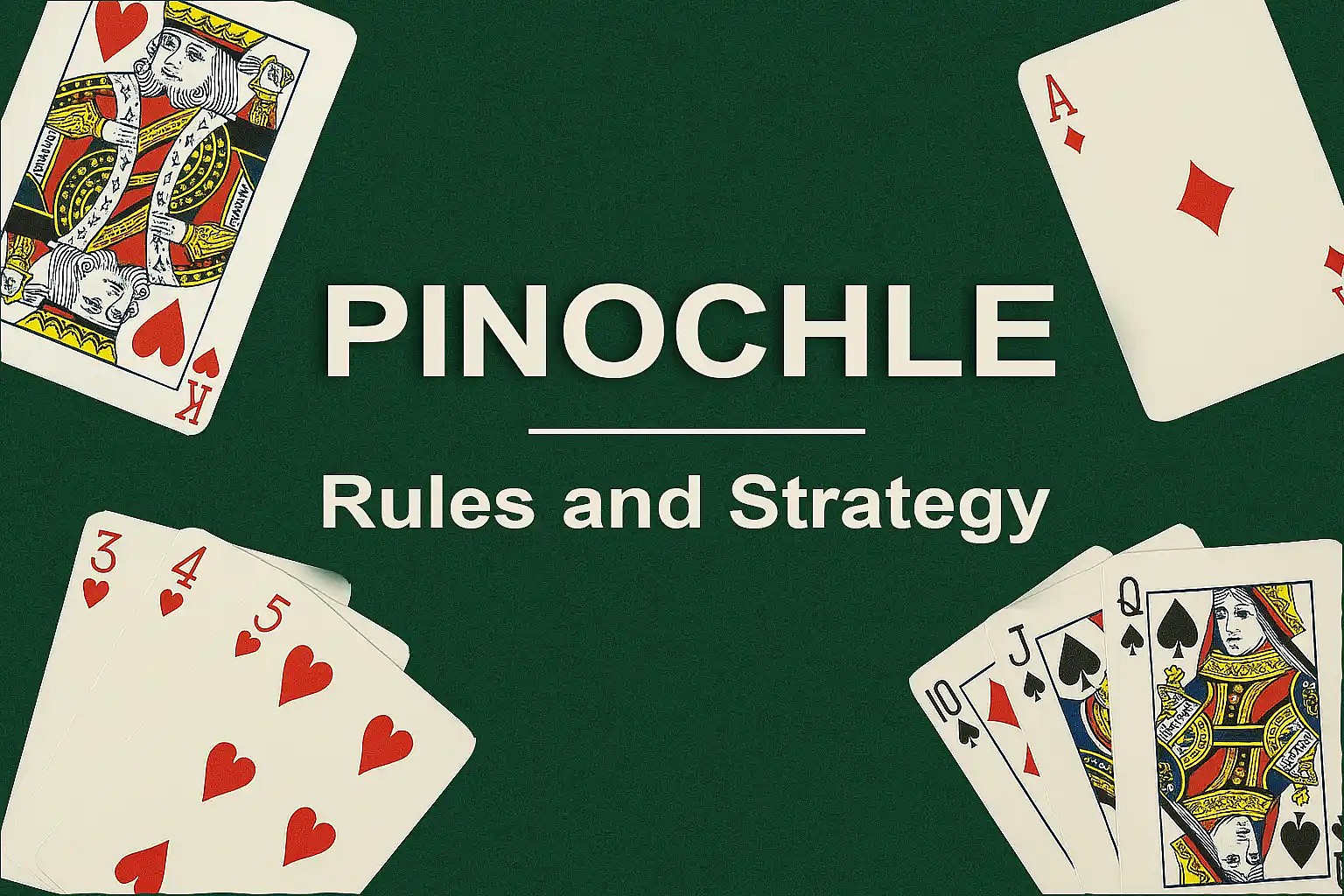
“Pinochle” is a trick-taking card game typically played with a 48-card deck, where players form partnerships and try to score points by winning tricks and melding specific card combinations. Here’s a breakdown of the rules:
This post contains affiliate links. For more information, see our disclosures here.
How to Play Pinochle
The Deck
Pinochle is played using a specialized 48-card deck. This deck includes two copies each of the following cards in all four suits: Ace (high), 10, King, Queen, Jack, and 9 (low).
In some versions, a 64-card deck is used, which adds 8s and 7s (also doubled in each suit).
Objective of Pinochle
The objective is to win tricks and score points by:
- Capturing valuable cards during trick-taking.
- Creating melds—specific combinations of cards that earn bonus points.
More of a visual learner? Checkout our video tutorial at the bottom of the page!
Card Ranks and Point Values
Trick Values:
- Ace – 11 points
- 10 – 10 points
- King – 4 points
- Queen – 3 points
- Jack – 2 points
- Last trick of the round – 10 bonus points
- 9s, 8s, and 7s – No point value
Meld Scoring
Melds are declared combinations of cards, shown to score additional points. They are grouped into three classes:
Class A (Trump Melds):
- Flush (A, 10, K, Q, J of trump) – 150 points
- Royal marriage (K and Q of trump) – 40 points
- Marriage (K and Q in any other suit) – 20 points
- Dix (9 of trump, or 7 if using 64-card pack) – 10 points
Class B (Same-Rank Sets):
- All Aces (one of each suit) – 100 points
- All Kings – 80 points
- All Queens – 60 points
- All Jacks – 40 points
Class C (Pinochles):
- Single Pinochle (Q♠ + J♦) – 40 points
- Double Pinochle (Q♠ + J♦ twice) – 300 points
Dealing
- Deal 12 cards to each player, usually 3 or 4 cards at a time.
- The next card is flipped face-up to designate the trump suit.
- The rest of the deck becomes the stock pile, placed face-down.
Gameplay
Each round consists of a series of tricks:
- The non-dealer leads the first trick. Thereafter, the winner of the previous trick leads next.
- A trump card beats all other suits unless overruled by a higher trump.
- If a non-trump suit is led, the highest card in that suit wins unless a trump is played.
- Players can lead any card, and there is no obligation to follow suit.
After each trick, both players draw from the stock, starting with the trick winner, to return their hands to 12 cards.
Melding Rules
After winning a trick and before drawing, a player may declare one meld by placing the cards face-up on the table.
Meld Rules:
- Only one meld per turn is allowed.
- At least one card must be newly played from the hand.
- A card that has been melded may be used again, but only for a different meld class or a higher-scoring meld within the same class.
Example: You may not score both a marriage and a pinochle with K♠, Q♠, and J♦ in the same turn. However, you could play Q♠ and J♦ as a pinochle for 40 points, then add K♠ on a later turn for the marriage.
Once melded, a card may still be played in a trick. However, once used in a trick, it can no longer be reused for melding.
The Dix Special Rule:
- If the trump card is a dix (9 of trump or 7 in 64-card pack), the dealer scores 10 points immediately.
- A player holding a dix may score it by showing it after winning a trick, and may meld another combination on the same turn.
- A player may also exchange the dix for the trump card after winning a trick.
Endgame (The Playoff Phase)
- After the twelfth trick, players finish drawing the final cards: the trick winner draws from the stock; the other player takes the face-up trump (or the dix, if it was swapped earlier).
- From this point on:
- Players must follow suit, if possible.
- If a trump is led, the opponent must try to win by playing a higher trump.
- If unable to follow suit, a player must play a trump, if they have one.
This final phase includes 12 last tricks, after which all trick and meld points are totaled.
Scoring
You can keep score on paper or with chips:
- Meld points are counted immediately.
- Trick points are added after all play is complete.
Note: Round final scores are rounded to the nearest 10. For example:
- 87 points = 90
- 124 points = 120
- 125 points = 120
- Extra points are lost if they don’t round up.
Winning the Game
There are two ways to play:
Single Deal (Quick Game):
- The player with the most points at the end of the hand wins.
Match Play:
- Continue rounds until a player reaches 1,000 points.
- If both reach 1,000 simultaneously, extend the game to 1,250, then 1,500, and so on, until a clear winner emerges.
Declaring Out
At any time, a player may announce they’re declaring out. Play immediately stops and points are counted.
If the game was extended to 1,250 or 1,500 points, the declaration must meet the current target to win.
If they have 1,000 or more, they win the game—even if their opponent has a higher score.
If they fall short, they lose the game instantly.
Video Tutorial
Pinochle FAQ
Pinochle is typically played with 2, 3, or 4 players. In 4-player games, players usually form two teams of two.
Pinochle uses a 48-card deck consisting of two copies each of the 9, 10, Jack, Queen, King, and Ace in all four suits.
Players aim to score points through melds and tricks. The team or player with the highest total score after a set number of hands wins.
Melds are specific combinations of cards that earn points, such as: Runs (A-10-K-Q-J of the same suit), Marriage (King and Queen of the same suit), Pinochle (Jack of Diamonds + Queen of Spades).
Each player bids on the number of points they believe their team can score in that round. The highest bidder declares the trump suit.
Players play cards in turns, and the highest card of the lead suit or highest trump wins the trick. Tricks contribute points at the end of the round.
The trump suit beats all other suits. Players must follow suit if possible, but a trump can be played to win a trick.
Yes, single-deck Pinochle is often used for 2–3 players, while double-deck Pinochle is common for 4-player games.
Similar Trick-Taking Games with Bidding & Melds
These games share core Pinochle elements like bidding, forming melds, and trick-taking.
- Bezique – The French ancestor of Pinochle, with similar meld scoring and two-player format.
- Schnapsen – A fast-paced German game with melds and trick play for two players.
- Belote – A classic French game that involves bidding, trumps, and melds, often seen as a cousin to Pinochle.
- Scat – Germany’s national card game, using trick-taking and bidding for three players.
- Euchre – A fast trick-taking game using a smaller deck, involving partnerships and trump suits.
Browse Related Games!
 Official Casting Shadows Rules
 Official Command of Nature Rules
 Official Twenty-Nine Rules
 Official Truc Rules
 Official Monopoly Buy Everything Rules
Official Belote Rules
Official Monopoly Buy Everything Rules
Official Belote Rules
 Official Five Crowns Rules
 Official Coup Rules
 Official Paco Rules
 Official Hanabi Rules
 Official The Fox in The Forest Rules
 Official Sambola Rules