

Last Updated on December 31, 2025 by The Official Game Rules Team
Quiddler is a clever and competitive word-building card game that blends vocabulary skills with strategy and timing. Designed for 1 to 8 players, ages 8 through adult, Quiddler challenges players to form allowable words from letter cards while managing risk, bonuses, and penalties across multiple rounds. Unlike many word games that rely on a shared board, Quiddler focuses on each player’s words, personal scoring decisions, and adapting to changing hand sizes as the game progresses.
Over the course of the game, hands gradually grow larger, forcing players to choose between shorter words that are safer to play and longer words that can unlock valuable bonus points. With a shared deck, a central draw pile, and a constantly changing discard pile, every turn presents meaningful choices that can affect the final high score.

This post contains affiliate links. For more information, see our disclosures here.
How to Play Quiddler Card Game
Objective of the Game
The goal of Quiddler is to earn the highest number of points by forming valid words from the cards in your hand. Across a series of hands, players score points for letters used in words, lose points for unused cards, and compete for bonuses such as:
- Longest word
- Most words in a single hand
At the end of the last hand of the game, the player with the highest total score wins.
Components and The Deck
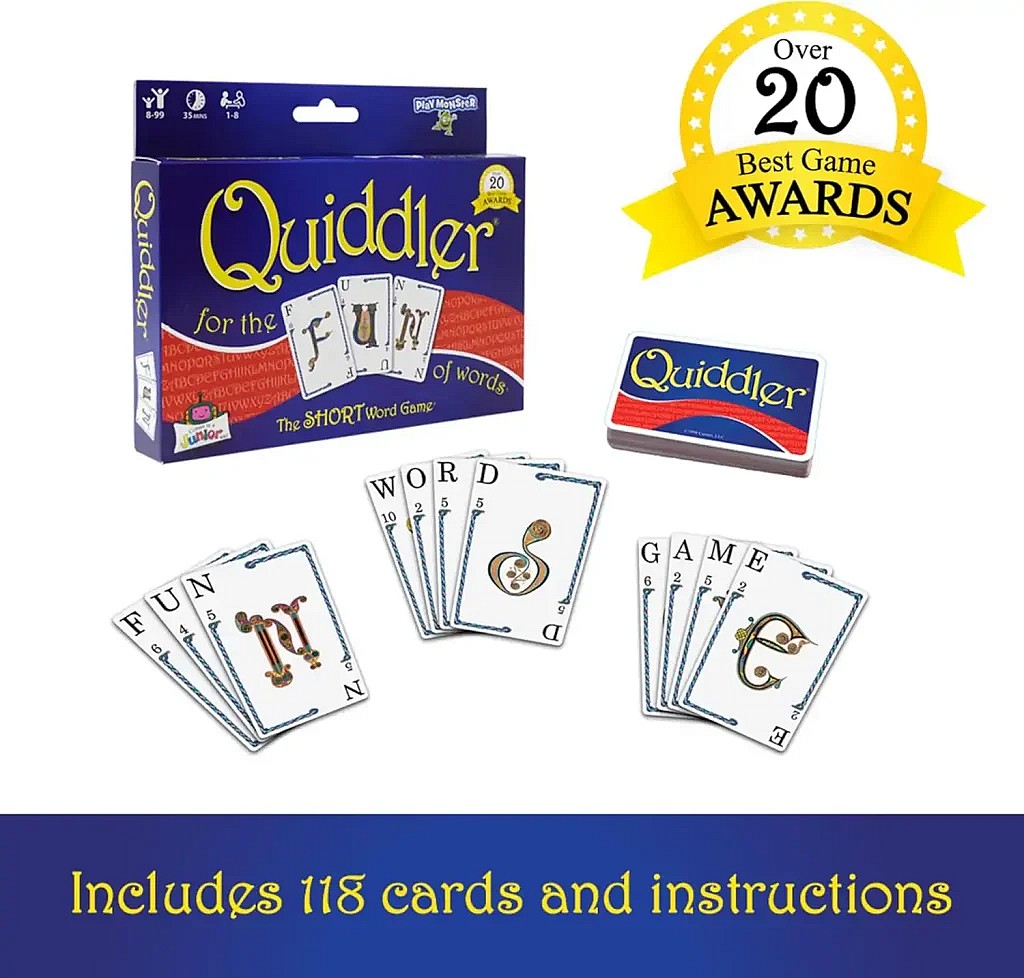
Quiddler uses a specialized 118-card deck made up of:
- Single-letter cards (A–Z)
- Double-letter cards:
- TH – 2
- CL – 2
- ER – 2
- QU – 2
- IN – 2
Each card has a printed point value. The artwork on the cards features decorated letters, inspired by Celtic manuscripts from 500–800 AD, including the Book of Kells and Book of Durrow.
Letter Frequency in the Deck
Understanding letter frequency is essential for strategy. The table below shows how many times each letter appears in the Quiddler deck.
| Letter | Number of Cards |
|---|---|
| A | 10 |
| B | 2 |
| C | 2 |
| D | 4 |
| E | 12 |
| F | 2 |
| G | 4 |
| H | 2 |
| I | 8 |
| J | 2 |
| K | 2 |
| L | 4 |
| M | 2 |
| N | 6 |
| O | 8 |
| P | 2 |
| Q | 2 |
| R | 6 |
| S | 4 |
| T | 6 |
| U | 6 |
| V | 2 |
| W | 2 |
| X | 2 |
| Y | 4 |
| Z | 2 |
These frequencies influence which letters are worth holding for future words and which are safer to discard earlier in the hand.
Setup
- Shuffle the entire deck thoroughly.
- Choose a scorekeeper to track points using a score sheet and running tally.
- Determine the first dealer by any agreed method.
- Seat players in a circle.
The Deal and Hand Progression
Quiddler is played over eight hands, with each hand increasing in size.
- First hand of the game: 3 cards per player
- Second hand: 4 cards
- Third hand: 5 cards
- Continue adding one additional card per hand
- Eighth hand: 10 cards per player
Cards are dealt one at a time in clockwise rotation, starting with the player to the dealer’s left.
After dealing:
- Place all remaining cards face down in the center of the cards to form the draw pile
- Turn over the top card to start the discard pile
Quiddler Gameplay
Turn Order
- The player to the dealer’s left goes first
- Play continues in clockwise rotation
Taking a Turn
On your turn, you must:
- Draw one card
- Either from the top of the draw pile
- Or take the top discard from the discard pile
- Form words privately using the cards in your hand
- Words must be bonafide words found in the agreed-upon dictionary
- Words must use at least two cards
- Proper nouns, prefixes, suffixes, abbreviations, and hyphenated words are not allowed
- Discard one card to the discard pile to end your turn
You may not lay words on the table unless:
- You are going out
- Or another player has already gone out, triggering final turns
Going Out
A player may go out only on their own turn.
To go out:
- After drawing, you must be able to arrange all but one card in your hand into allowable words
- Lay down your words
- Discard one final card
Once a player goes out:
- All remaining players each get one last turn
- During these final turns, players may lay down words even if they still have unused cards
Final Turns and Scoring a Hand
After the last turn:
- Cards used in words score positive points
- Unused cards count against the player’s score
- No player may score below zero in a single hand
The scorekeeper records each player’s total for the hand and updates the running tally.
Bonuses
Each hand offers two possible bonus points:
- Most Words Bonus
- 10 points to the player who formed the greatest number of separate words
- Longest Word Bonus
- 10 points to the player with the longest word (measured by letters, not cards)
Notes:
- Bonuses may go to the same player
- If players tie for a bonus, no bonus is awarded
- In two-player games, use only one bonus
Challenges and Dictionary Use
If a player believes a word is invalid, they may issue a challenge before cards are gathered.
- If the word is valid, the challenger loses points equal to the word’s value
- If the word is invalid, the player who played it loses those points and may not rearrange cards
Players may consult the dictionary only when it is not their turn.
Strategy Tips for Quiddler
Balance Long vs Short Words
- Longer words help secure the longest-word bonus
- Shorter words reduce risk if you cannot go out
Track Letter Frequency
- Rare letters (Q, Z, J) are high-risk if unused
- Common letters like E, O, and T are safer to hold
Watch the Discard Pile
- Picking up from the top of any remaining stack (discard pile) can complete valuable words
- Be cautious about discarding useful double-letter cards
Time Your Exit
- Going out early can prevent opponents from optimizing their hands
- Waiting too long risks penalties from unused cards
Quiddler FAQ
1–8 players, though 2–5 is ideal for faster gameplay.
30–60 minutes depending on rounds and number of players.
No. Only standard dictionary words are allowed unless house rules specify otherwise.
Each round starts with a set number of cards dealt to each player. One extra card is added each subsequent round.
Yes, you can reorganize your hand as often as you like to find the best words.
Yes, provided they are valid dictionary words.
Tie-breakers may include longest word formed, highest single-word score, or simply awarding both the same points.
Conclusion
Quiddler is a rewarding word game that combines vocabulary, probability, and strategic timing. With expanding hand sizes from the first hand of the game through the last hand of the game, players must constantly adapt their approach, weighing the risks of unused cards against the rewards of bonuses. Whether you’re chasing the highest number of points, aiming for the longest word, or simply enjoying clever wordplay, Quiddler delivers depth and fun for both families and adult players alike.
Browse Related Games!
 Official Casting Shadows Rules
 Official Twenty-Nine Rules
 Official Coup Rules
 Official Command of Nature Rules
 Official The Fox in The Forest Rules
 Official Canasta Rules
Official Panguingue (Pan) Rules
Official Canasta Rules
Official Panguingue (Pan) Rules
 Official Lost Cities Rules
 Official Paco Rules
Official Canadian Salad Rules
Official Paco Rules
Official Canadian Salad Rules
 Official Countries of the World: Guess in 10 Rules
 Official Monopoly Buy Everything Rules