Last Updated on January 7, 2026 by The Official Game Rules Team
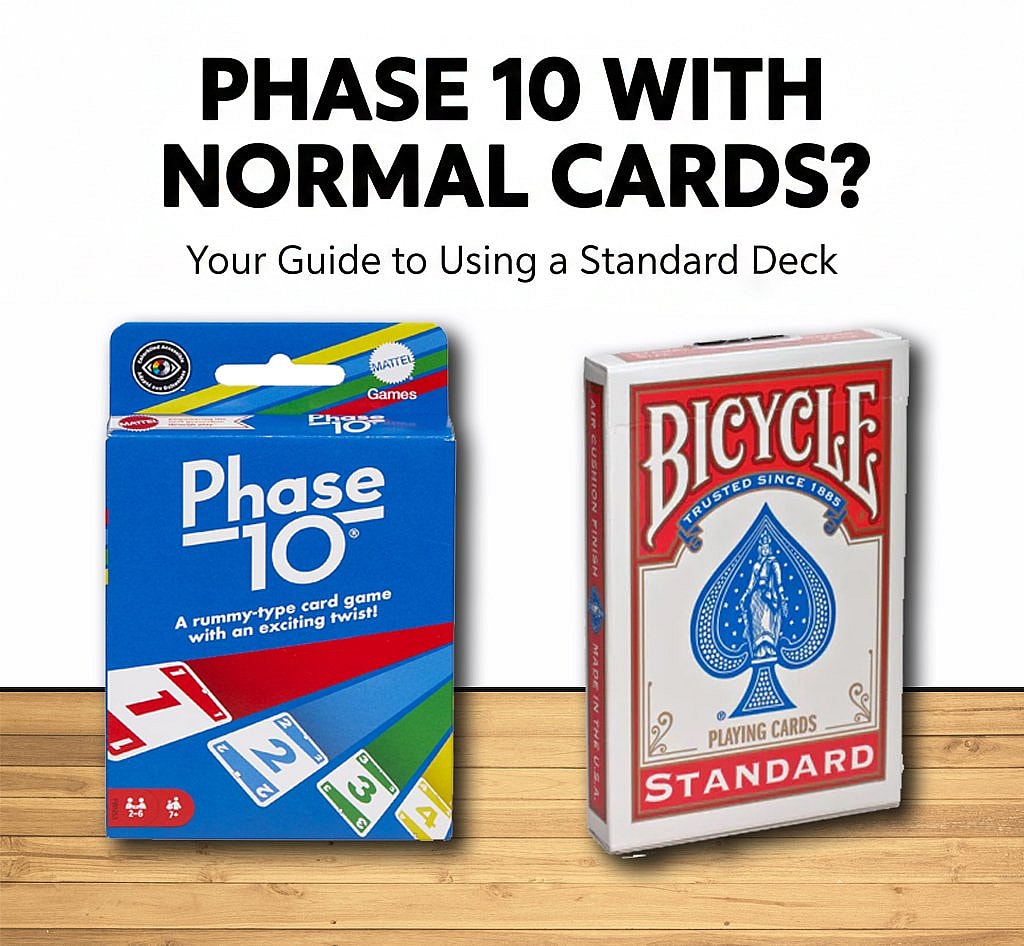
Phase 10 is usually played with a special deck, but you can easily recreate the full experience using normal playing cards. If you don’t have the official cards—or simply want a more flexible version—this guide explains how to play Phase 10 with normal cards step by step, without losing the strategy or structure that makes the game so popular.
This version works for casual play, family game nights, or travel situations where a standard deck is all you have.
What Is Phase 10?
Phase 10 is a rummy-style card game where players complete ten specific phases in order. Each phase requires forming a particular combination of sets, runs, or colors. Players must complete the current phase before moving on to the next one, and the game continues over multiple rounds.
The objective is not just to finish all ten phases, but to do so while keeping your score as low as possible.
What You Need to Play Phase 10 With Normal Cards
To play Phase 10 with regular cards, gather the following:
- Two standard 52-card decks (104 cards total)
- 2 to 6 players
- Pen and paper (or notes app) for tracking phases and scores
Using two decks ensures there are enough duplicate cards to create runs and sets similar to the official Phase 10 deck.
Card Conversions (Very Important)
Because the Phase 10 deck contains custom cards, you’ll need to assign meanings to standard playing cards.
Card Substitutions
- Ace → Number 1
- 2–10 → Number cards (2 through 10)
- Jack → Number 11
- Queen → Number 12
- King → Wild card
- Joker → Skip card
Kings can substitute for any number or color in a phase, while Jokers are used to skip another player’s turn.
Setup
- Shuffle both decks together thoroughly.
- Deal 10 cards to each player.
- Place the remaining cards face down as the draw pile.
- Flip the top card face up to start the discard pile.
- The player to the left of the dealer goes first.
How Gameplay Works
On your turn, you must:
- Draw one card (from either the draw pile or discard pile)
- Play cards if possible
- Discard one card to end your turn
Players continue clockwise until someone goes out.
Completing Phases
Each player is assigned the same phase at the start of a round. You must complete that phase exactly as written before you can lay down any cards.
Examples:
- Sets must be the same number (eg, three 7s)
- Runs must be consecutive numbers in the same color if required
- Wild cards (Kings) can substitute, but some groups limit how many can be used per phase
Once you complete your phase, you may lay it down and begin playing remaining cards to get rid of them.
Hitting and Adding Cards
After laying down a completed phase, you may add cards to:
- Your own phase
- Other players’ completed phases
This helps you empty your hand faster and reduce your score.
Ending a Round
The round ends when one player gets rid of all their cards. That player is credited with completing their phase for that round.
All other players:
- Score the cards left in their hands
- Repeat the same phase next round if they failed to complete it
Scoring With Normal Cards
Scoring works the same way as traditional Phase 10.
Card Values
- Ace → 5 points
- 2–9 → 5 points
- 10, Jack, Queen → 10 points
- Joker (Skip) → 15 points
- King (Wild) → 25 points
Lower scores are better. Strategy often involves dumping high-value cards early.
The 10 Phases (Standard Order)
Players must complete these phases in order:
- Two sets of three
- One set of three and one run of four
- One set of four and one run of four
- One run of seven
- One run of eight
- One run of nine
- Two sets of four
- Seven cards of one color
- One set of five and one set of two
- One set of five and one set of three
A player cannot skip or rearrange phases.
Winning the Game
The game ends when a player completes Phase 10. All players then total their scores from every round.
The winner is the player who:
- Completed all ten phases
- Has the lowest total score
Completing phases quickly helps, but managing points is just as important.
Helpful Strategy Tips
- Save wild cards for difficult phases like long runs
- Don’t hoard high-value cards late in a round
- Watch what phases your opponents are stuck on
- Discard cards that help others as little as possible
- Sometimes it’s better to go out quickly than finish your phase perfectly
Why Play Phase 10 With Normal Cards?
Playing Phase 10 with normal cards is:
- More flexible
- Easier to teach
- Great for travel
- Perfect when you don’t own the official deck
It also lets you customize rules, difficulty, and pacing for your group.
Final Thoughts
If you’ve ever wondered how to play Phase 10 with normal cards, this version gives you everything you need to recreate the full game using standard decks. With clear card substitutions, familiar scoring, and the same ten-phase structure, you won’t miss the official deck at all.
Once you’ve played a few rounds, you’ll find this version feels just as strategic, competitive, and fun as the original. If you’re looking for other card games that don’t need a fancy deck, try UNO with normal cards or Skip-Bo with a standard deck!