

Go is one of the oldest board games still played today—a minimalist game of black and white stones that contains a depth of strategy few modern games can match. With roots tracing back over 2,500 years to ancient China, Go has since spread through Korea and Japan, becoming a cultural touchstone and an enduring test of skill and patience.
For those new to Go, the board may look simple—just a grid and a handful of stones. But beneath that simplicity lies a vast, intricate battle for territory, balance, and influence. This complete guide to Go will walk you through the fundamentals: how it’s played, the key rules, scoring systems, and why it continues to captivate players around the world.
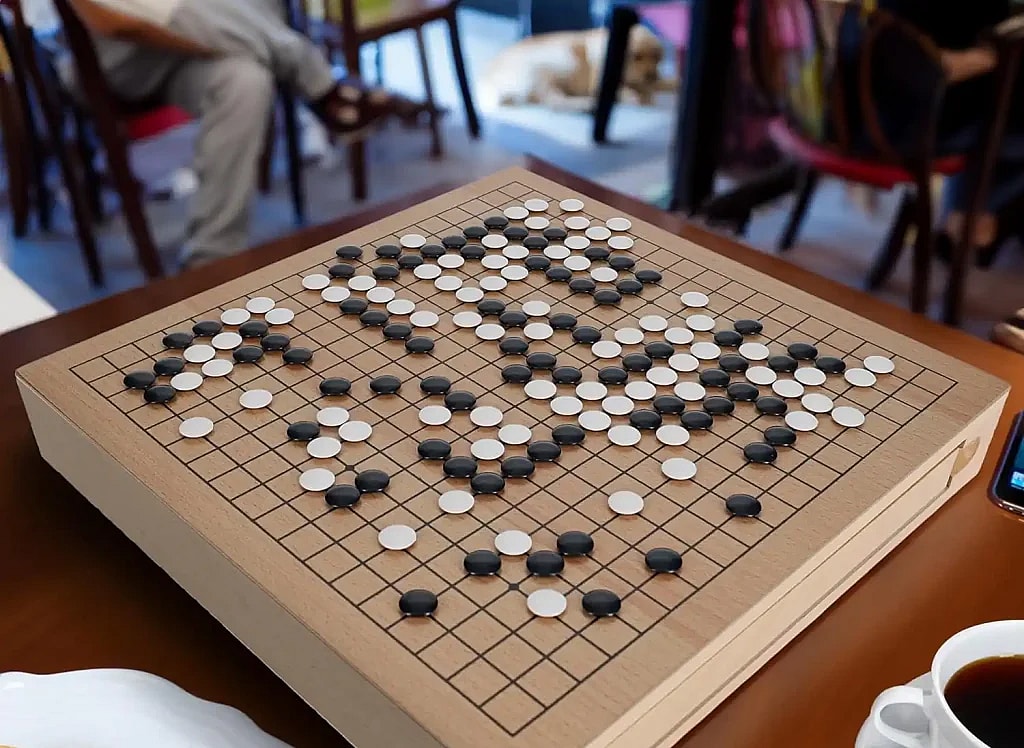
The Basics: What Is Go?
At its core, Go is a two-player game in which each participant takes turns placing stones on a grid—traditionally 19 by 19 lines, though beginners often start on 9×9 or 13×13 boards. One player uses black stones, the other white. The goal is not to eliminate your opponent, but to control more territory on the board by the end of the game.
Territory in Go consists of the empty points you surround with your stones, and points gained from capturing your opponent’s stones.
How the Game Is Played
Play begins with an empty board. The player with the black stones goes first, placing a stone on any unoccupied intersection. Players alternate turns, adding one stone at a time. Once placed, stones don’t move—but they can be captured and removed if surrounded on all sides by enemy stones, a concept known as “liberties.”
A group of stones must always have at least one open adjacent intersection to remain on the board. If a move leaves a group with no liberties, it is removed—unless it captures opponent stones in the process, in which case it remains.
The game continues until both players pass their turn, usually when no more profitable moves remain.
Capturing, Ko, and the Flow of Play
One of the most elegant parts of Go is how territory and power shift back and forth during play. Capturing a group of stones can dramatically change control of the board, but aggressive play can backfire if you overextend.
To prevent endless loops, Go includes a rule called Ko, which forbids a player from making a move that would exactly recreate a previous board position. This rule ensures that each game progresses.
Another restriction is the suicide rule—you cannot place a stone where it would immediately be captured (have no liberties), unless doing so captures surrounding opponent stones and grants it new liberties.
Understanding the Endgame and Scoring
A game of Go ends when both players agree there are no good moves left and pass their turns. The board is then scored. Two major systems exist:
- Japanese and Korean (territory scoring) count only the number of empty points a player controls plus captured stones.
- Chinese (area scoring) counts both the number of controlled points and the number of stones a player has on the board.
While the math differs slightly, both systems usually produce the same winner in casual play.
Strategy in Simplicity
Though the rules are easy to learn, Go’s true beauty lies in the strategic possibilities. Expert players balance offense and defense, sacrifice and territory, local skirmishes and global positioning.
Beginners are often advised to focus on the corners and sides first—these areas are easier to enclose and control. It’s also important to stay efficient: using as few stones as possible to achieve your goals is the essence of good play.
Key concepts include:
- Life and death: ensuring your groups can’t be captured
- Influence: controlling large swaths of the board without necessarily enclosing them
- Sente and gote: playing to maintain the initiative
- Shape: recognizing efficient, resilient formations of stones
Players often study joseki, which are established opening sequences, and tesuji, clever tactical moves that can shift the course of a battle.
A Short Glossary of Go Terms
- Liberty – An empty space next to a stone or group
- Atari – A stone or group in immediate danger of capture
- Seki – A standoff where neither side can safely capture
- Hane – A move that wraps around an opponent’s stone
- Komi – Points added to white’s score to compensate for going second
- Handicap – Stones placed on the board to balance skill between players
The Rich History of Go
Go’s history spans millennia. It was originally used to teach strategy and concentration to nobles in China. From there, it traveled to Korea and Japan, where the game evolved and flourished. In Edo-period Japan, Go players were granted status similar to that of samurai, and formal houses of Go developed intricate techniques and professional systems.
Today, Go remains a national pastime in much of East Asia, and is gaining popularity worldwide. Tournaments are held on every continent, and computer Go programs—especially since DeepMind’s AlphaGo—have taken the game to new technological heights.
Where to Play Go Today
Modern Go players are no longer limited to finding in-person opponents. Online platforms like OGS (Online Go Server) and KGS let players of all levels match up instantly. Mobile apps such as GoQuest, Pandanet, and SmartGo offer puzzles, AI opponents, and interactive lessons.
And for those who want to go deeper, AI engines like KataGo and Leela Zero can analyze your games and suggest stronger moves.
Why Go is Still Played
In a world filled with fast-paced, rule-heavy games, Go’s meditative pace and simple framework offer a refreshing challenge. It’s a game where even a beginner can enjoy meaningful play, but mastery can take a lifetime.
With every move, Go demands clarity, balance, and foresight. Whether you’re playing on a physical board with slate stones or battling an AI online, Go remains a timeless pursuit of beauty and strategy.
Related Posts
 Best Icebreaker Games for Office Holiday Parties
 25 Awesome Easter Games for Adults (Yes, Some Involve Alcohol!)
 The 10 Games AI Thinks You Should Try Next
 21 Best Board and Card Games to Play on Thanksgiving
 How to Win Trumps Card Game: Advanced Strategies and Tips
The 50 Best Board Games (Of All-Time)
How to Win Trumps Card Game: Advanced Strategies and Tips
The 50 Best Board Games (Of All-Time)