

Last Updated on October 12, 2025 by The Official Game Rules Team
Go is an ancient strategy game where two players compete to control territory by placing stones on a grid. Despite its simple rules, Go offers endless depth and challenge. Fun fact: the number of possible board configurations in Go is greater than the number of atoms in the observable universe! This vast complexity is one of the reasons why Go is considered one of the most challenging and strategic games ever created. Here’s a breakdown of the rules:

This post contains affiliate links. For more information, see our disclosures here.
How to Play Go (Game)
Overview
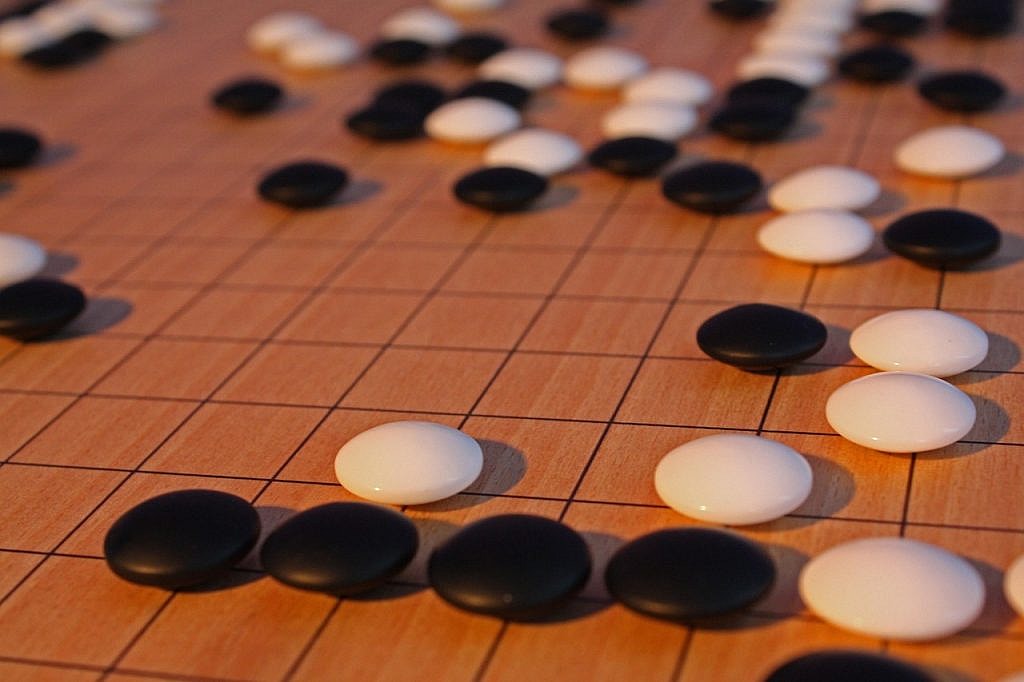
Go is a strategic board game played on a grid of intersecting lines—most commonly 9×9, 13×13, or 19×19. One player controls black stones, and the other uses white stones. The board begins empty, and players take turns placing a single stone on any intersection (not inside the squares).
Black always plays first, and once a stone is placed, it remains there unless captured and removed.
Goal of the Game
The objective of Go is to earn more points than your opponent by controlling territory and capturing enemy stones.
- You score one point for each empty intersection completely surrounded by your stones and one point for every captured opponent stone.
- To balance the advantage of moving first, White receives a 7-point bonus, known as komi.
The player with the highest total score at the end of the game is the winner.

Territory
A player’s territory consists of all empty intersections that can only be reached by moving through that player’s stones or the edge of the board. Each enclosed empty space within your area counts as one point of territory.
Protecting your territory while reducing your opponent’s is the foundation of Go strategy.
Liberties
Each stone has a number of liberties, which are the empty intersections directly adjacent to it (up, down, left, and right).
If all of a stone’s liberties are filled by your opponent’s stones, that stone is captured and immediately removed from the board.
Chains
When stones of the same color are connected along the grid lines, they form a chain. Chains share their liberties, allowing connected stones to defend one another and making them harder to capture.
Diagonal contact alone doesn’t connect stones into a chain.
Capturing Stones
To capture an opponent’s stone or chain, you must place stones so that all of its liberties are occupied. Once the final liberty is taken, the captured stones are removed from the board and kept aside as prisoners, each worth one point at the end of the game.
Diagonal Connections
Diagonal adjacency does not connect stones or share liberties.
This means that even if your stones touch diagonally, they are treated as separate groups for the purposes of capturing and defense.
The Suicide Rule
Players cannot make a move that leaves their own stone or chain without liberties, as this would be considered suicide.
Exception – Capture by Suicide:
If placing a stone fills your own liberties but simultaneously captures an opponent’s group (removing their stones from the board), the move is legal and your stone remains in place.
Ending the Game
Players may choose to pass instead of placing a stone. When both players pass consecutively, the game ends.
Each pass adds one captured stone to the opponent’s total. To ensure fairness, White always makes the final pass.
After the game ends, players count territory and prisoners to determine the score.
Dead Stones
At the end of play, both players agree on which stones are dead—groups that can no longer avoid capture. Dead stones are removed from the board and added to the opponent’s prisoner count.
If players disagree about a position, they may resume play until the situation is settled.
Repetition Rule (Ko Rule)
The Ko Rule prevents an endless back-and-forth capture loop.
You cannot make a move that would recreate the exact same board position as a previous turn. Players must make a move elsewhere before returning to that spot.
Seki (Mutual Life)
A Seki occurs when two opposing groups share liberties in such a way that neither player can fill them without losing their own stones. Both groups remain alive — but only because capturing first would result in immediate self-capture.
Seki typically happens near the edge of the board or in corners where space is limited. The shared empty points between the groups are considered neutral and do not count as either player’s territory.
In scoring, each player keeps their stones alive in a Seki, but no points are earned for the shared spaces. Recognizing a potential Seki helps you preserve groups that can’t be safely expanded or defended otherwise.
Example:
Imagine a situation where a small group of Black stones and a small group of White stones each have two shared empty points between them. If Black plays on one of those points, White would immediately capture the entire Black group — and vice versa. Since neither player can move safely, both groups remain on the board, creating a Seki.
Learning the Game
Go is simple to learn but takes a lifetime to master. Once you understand these core rules—territory, liberties, and captures—you can start playing your first games.
Even a small Go board offers deep strategy and endless variation, explaining why this 2,500-year-old game remains one of the most studied and beloved in the world.
Strategy for Go
While Go has simple rules, its depth of strategy is nearly endless. Success comes from balancing territory control, stone efficiency, and timing throughout the game.
1. Think in Terms of Influence
Instead of focusing only on small captures, think about how each move influences the entire board. A single stone can extend your reach, block your opponent’s expansion, or secure valuable corner territory. Early on, aim to build frameworks — loose formations that can later become solid territory.
2. Corners, Then Sides, Then Center
Beginners should start by securing corners first, since they require fewer stones to enclose. From there, extend along the sides before pushing into the center. This progression maximizes efficiency and limits overextension, forcing your opponent to react to your growing control.
3. Balance Attack and Defense
Don’t chase every capture — over-attacking often weakens your own groups. Strong players know when to switch from offense to defense. Reinforce stones with few liberties, connect weak groups, and force your opponent into smaller, less efficient shapes.
4. Manage Liberties and Eyes
Groups need two eyes (separate internal empty spaces) to live. When attacking, reduce your opponent’s eyes; when defending, focus on creating them. Keeping track of liberties for every major group helps you see which battles are urgent and which can wait.
5. Be Wary of Overconcentration
Avoid clustering too many stones in one area. Overconcentration wastes potential influence elsewhere on the board. Spread your forces to control multiple areas simultaneously — flexibility is key in Go.
6. Use the Ko Rule to Your Advantage
Ko fights (repeated board positions) are moments of tension and opportunity. Before re-taking a Ko, make a Ko threat elsewhere on the board to pressure your opponent. If they respond, you can safely reclaim the position.
7. Plan for the Endgame
In the final stages, every liberty and point of territory matters. Focus on securing borders, filling in neutral spaces, and capturing any remaining weak groups. Efficiency becomes more important than aggression.
8. Learn from Your First Games
In your first games, focus on understanding shape, liberty management, and basic life and death positions. Reviewing completed games — even briefly — helps identify patterns, mistakes, and areas for improvement.
Go FAQ
The goal of Go is to control more points of territory on the Go board than your opponent by the end of the game. Territory includes all empty intersections surrounded by your stones and any captured enemy stones.
For beginners, it’s best to start with smaller boards (like 9×9 or 13×13) for shorter games and an easier introduction to the basic concepts of capturing and territory control before moving to the standard 19×19 board.
In handicap games, the weaker player (usually playing Black) places a set number of stones on the board before play begins. This gives them a strategic advantage, helping to balance skill levels between players.
Black plays first in Go, followed by White. Players alternate turns placing one stone at a time on any empty intersection.
At the end of the game, the winner is the player with the highest total score — the sum of the number of stones they have on the board plus the number of empty points in their controlled territory, minus any prisoners captured by the opponent.
A point of territory is any empty intersection completely surrounded by one player’s stones. For example, all open points within White’s enclosed area are counted as White territory.
Each captured stone (a prisoner) counts as one point for the opponent. White prisoners add to Black’s score, and vice versa. The combination of territory and prisoners determines the final outcome.
When a single stone or connected group of stones has no open intersections (liberties) remaining, it is captured and removed from the board as enemy stones.
The ko rule prevents endless repetition of moves. If a move would recreate the exact same board position as the previous turn, it’s illegal — the player must make a move elsewhere before returning to that position.
The edge of the board limits the number of liberties a stone can have, making edge and corner play crucial in strategy. Controlling the corners often provides a strong foundation for building larger territories.
Stones are only directly connected along orthogonal lines (up, down, left, right). Diagonal stones are not considered connected, which is important when determining captures and territory boundaries.
At the end of the game, each player counts the number of stones they have on the board and the number of points of territory they control. The winner is the player with the higher total after subtracting captured stones (prisoners) from their score.
Conclusion
And there you have it—the official rules for the game of Go, a game of deceptive simplicity and infinite depth. While the rules are straightforward—capture stones by surrounding them, control territory, and play to the end—the strategies they enable are boundless. The true joy of Go lies not just in winning, but in the lifetime of learning, planning, and appreciating the aesthetic beauty of a well-played game. The board awaits; the best way to master the rules is to start playing!
For even more Go strategies, rules and history, check out our Complete Go Guide!
Browse Related Games!
 Official The Lord of The Rings: Duel for Middle-Earth Rules
 Official Scattergories Rules
 Official Rajas of The Ganges Rules
 Official Mahjong Rules
 Official The Night Cage Rules
 Official Mancala Rules
 Official Gaia Project Rules
 Official Magnetic Chess Game with Stones Rules
 Official Root Rules
 Official Panda Royale Rules
 Official Bamboo Rules
 Official Aquatica Rules