

Last Updated on October 14, 2025 by The Official Game Rules Team
Canasta Caliente is a fast-paced variation of the classic Canasta card game, blending strategy, teamwork, and luck with a fiery twist. Players form partnerships and compete to score the most points through strategic card melds, timely use of bonus cards, and clever management of stop cards. The goal is to reach 5,000 points before your opponents by creating Canastas and earning extra points through well-planned plays.
This post contains affiliate links. For more information, see our disclosures here.
How to Play Canasta Caliente
4-Player Version
Four players are teamed in partnerships. Partners sit opposite each other. The rules are only slightly different when 2, 3, 5 or 6 play. You’ll find these variations following the main rules.
Setup and the Deal
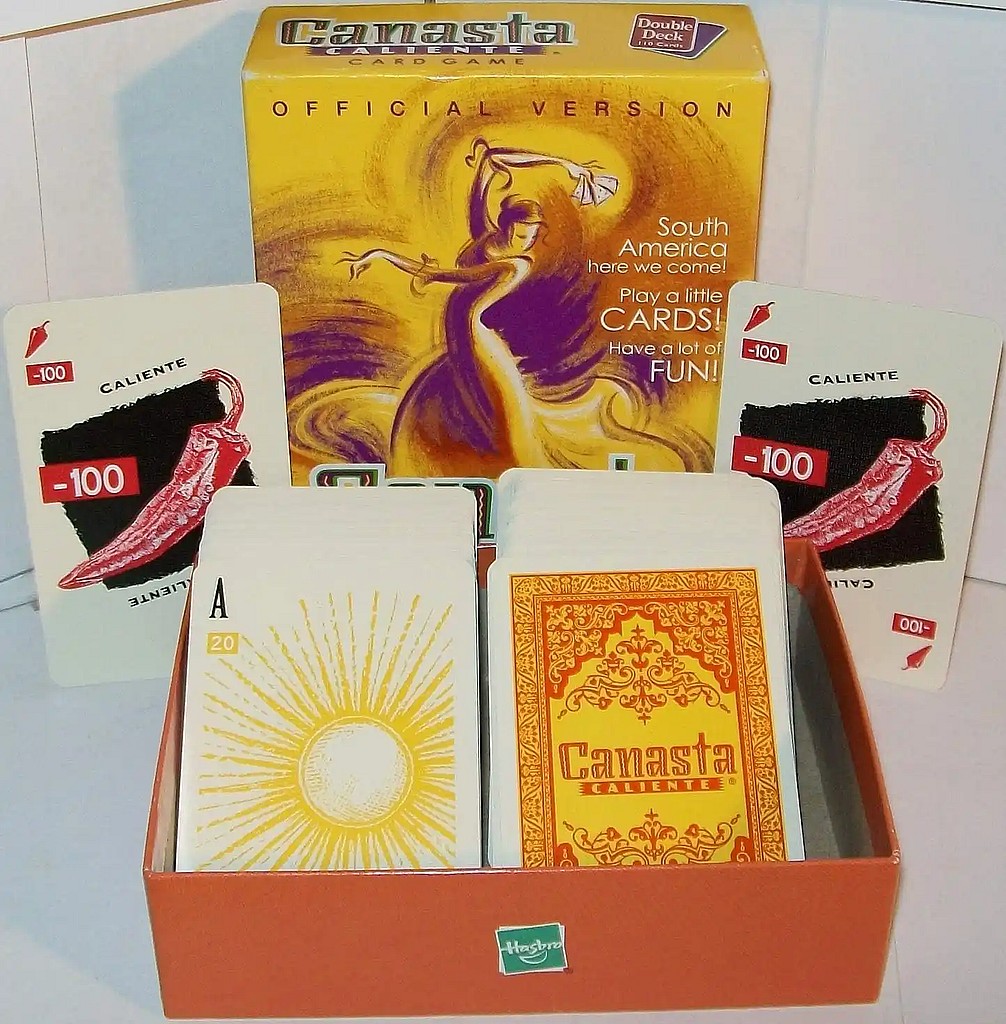
Each player is dealt 11 cards. The dealer shuffles thoroughly, offers a cut, and places the rest of the cards face down to form the Draw pile. The top card is turned face up to start the Prize pile (the discard pile). If the up card is a wild card or a Bonus card, turn it sideways to indicate that the Prize pile is frozen, and continue turning cards until a natural card appears on top.
Players sit in partnerships across from one another. The deal passes to the left of the dealer after each round.
Card Composition:
- Natural cards: 4 through Ace (88 total)
- Wild cards: 12 total (8 little wilds and 4 big wilds)
- Bonus cards: 4
- Stop cards: 4
The Caliente cards are used only in the Caliente variation. Remove them for the standard game.
Gameplay
Play proceeds clockwise, starting with the player to the left of the dealer. On each turn, a player follows three basic steps:
- Draw a Card – You may either draw the top card of the Draw pile or take the entire Prize pile (if eligible).
- Meld (Optional) – Form new melds or add additional cards to your team’s existing melds.
- Discard One Card – End your turn by discarding a single card face-up onto the Prize pile.
Drawing and Melding Cards
When you draw from the Draw pile, you can immediately create or expand melds if possible.
- Melds are sets of three or more cards of the same rank, such as three Sevens or four Kings.
- Sequences (like 5-6-7) are not allowed.
- You must have more natural cards than wild cards in any meld.
Your partnership’s first meld must meet the first meld requirement based on your team’s score:
| Team’s Score | Minimum Meld Value |
|---|---|
| 0–1,495 | 50 points |
| 1,500–2,995 | 90 points |
| 3,000 or more | 120 points |
| Negative | Any 3-card set |
Taking the Prize Pile
You may take the Prize pile only if you can use its top card (the up card) to make a valid meld.
- Before your first meld: You must use the up card in a 3-card meld made of natural cards and meet the first meld requirement.
- After your first meld:
- If the pile is not frozen, you can take it by adding the up card to a new or existing meld.
- If the pile is frozen, you can only take it by combining the up card with two natural cards from your hand to create a new meld.
When you successfully take the up card, you must take the entire Prize pile into your hand.
Special Cards
Wild Cards
Wild cards substitute for natural cards in a meld but never form a set on their own. Discarding one freezes the Prize pile, limiting other players’ access to it.
Bonus Cards
If you draw a Bonus card, place it face up near your team’s melds immediately and draw a replacement card.
- You cannot discard a Bonus card.
- If you forget to play it, you may do so on your next turn.
- If you end a hand with a Bonus card in your hand, you receive -100 points.
Stop Cards
Discarding a Stop card blocks the next player from taking the Prize pile.
- You cannot meld Stop cards unless you are going out, and then only as a set of three or four.
- Wild cards cannot be added to Stop card melds.
Going Out and Ending a Hand
You may go out (end the hand) once your team has created at least one Canasta.
- A Canasta is a meld of seven or more cards of the same rank.
- You may end your hand by playing all your cards or discarding your last card.
- Before going out, you may ask your teammate, “May I go out?”—their answer is binding.
Tip: Don’t go out too soon. Sometimes it’s better to keep playing for additional point bonuses or to avoid negative points if your teammate holds high-value cards.
When the Draw Pile Runs Out
If the Draw pile is exhausted and no one has gone out:
- The game continues as long as the up card can be properly taken.
- A player may pass if they cannot or choose not to take the up card.
- If the hand ends on a pass, no team receives the 100-point going-out bonus.
Scoring
When the hand ends, calculate your team’s score:
- Add the point values of all cards melded, then subtract the value of the cards remaining in both teammates’ hands.
- Add any bonuses:
- +100 points for going out first
- +100 points for each Bonus card played (only after your first meld)
- +500 points for each natural Canasta
- +300 points for each mixed Canasta
- +400 extra points if all four Bonus cards were played
- +100 bonus for going out “concealed” (a rare event where you go out in one turn)
- Penalties:
- -100 points for each unplayed Bonus card in hand
- If your team did not meet its first meld requirement, each Bonus card played counts -100 points
The end of the game occurs when at least one team reaches 5,000 points after a hand. The higher total wins.
Game Variations
Variation–Prize Pile Always Frozen
In this variation, the top card in the Prize pile can only be taken if:
- you use it to form a set with two natural cards from your hand, or,
- you add it to an existing meld of six or fewer cards— but not to a completed canasta (7 or more cards)!
Here are the only changes to standard Four-Player Canasta when
two, three, five or six play:
2 Player Rules
a) Deal 15 cards per player on each hand.
b) Each player plays for him or herself.
c) When drawing from the Draw Pile, draw two cards. Discard
one (as usual) at the end of your turn.
d) To go out, a player must have at least two canastas.
3 Player Rules
a) Deal 13 cards per player on each hand.
b) Each player plays for him or herself.
5 Player Rules
a) One team will have two players, the other will have three.
b) One player on the three-player team sits out each hand.
c) The player sitting out the hand may not advise his teammates
but does handle the scoring.
6 Player Rules
a) Form two teams of three players each.
b) Rules are same as 5-Player Canasta except one player from
each team sits out each hand.
6 Player Rules–Three Decks
a) You may elect to have two partnerships of three players each,
or three partnerships of two players each. Each player is seated
between two opponents.
b) Deal 13 cards per player on each hand.
c) Play for 10,000 points. When a team reaches 7,500 points, it
needs 150 points to make its initial meld on subsequent hands.
d) There is no extra bonus for having four Bonus cards, but five
or six Bonus cards add an extra 600 points.
e) At least two canastas are needed to go out.
Canasta Caliente FAQ
The objective of Canasta Caliente is to score more points than your opponents by creating valid card melds and earning point bonuses from bonus cards and extra points. The game ends when a player goes out by playing their entire hand, and the team’s score is tallied.
Each card has a specific value of the cards, with natural cards (like 4s through Aces) earning positive points and certain special cards (like the stop card) influencing play but not directly adding to the score. Jokers and 2s serve as wild cards, which can significantly boost your point bonus when used in melds.
When the stop card is played, it immediately freezes the discard pile. The next player cannot pick up the pile until a natural card is played. This adds strategy and luck, as it can block opponents from extending their partnership’s melds.
Each partnership must meet a first meld requirement based on their current team’s score. This means the total point values of your first meld must meet a minimum threshold before you can play additional cards.
Yes. There is a three-player game version where each player competes individually rather than in pairs. The rules are mostly the same, but you’ll deal fewer cards per player to keep rounds balanced and strategic.
If your total point values and melds don’t meet the required first meld and you fail to go out, you may end up with negative points. This happens when penalties and unplayed cards in your hand outweigh your earned melds.
The end of the game occurs when a player goes out by playing their entire hand or when the draw pile is exhausted. All partnership’s melds are then counted, and final scores—including extra points and point bonuses—are calculated.
Yes, several additional rules can affect gameplay, such as restrictions on new melds, bonuses for certain combinations, and the handling of last cards. Always refer to the official instructions for any house rule variations.
Similar Games
If you enjoy the blend of strategy and teamwork in Canasta Caliente, you might also like:
- Hand and Foot – A popular Canasta variant involving multiple hands per player and more card management.
- Samba – A Canasta-style game that allows sequences as melds and uses bonus cards for higher point values.
- Pennies from Heaven – A multi-hand partnership game that adds layers of complexity and extra points.
- Classic Canasta – The original version of the game, perfect for learning the first meld requirements and teamwork before diving into Caliente.
Final Thoughts
Canasta Caliente adds an exciting twist to the classic Canasta formula by introducing bonus cards, stop cards, and extra points that reward smart timing and team coordination. Whether playing with partnerships’ melds or a three-player game, every round tests your ability to balance luck and strategy. Keep an eye on your team’s score, plan your new melds wisely, and remember—the player who manages their entire hand most effectively often claims victory in the fiery finale.
Browse Related Games!
 Official South African Kaluki Rules