

Last Updated on July 23, 2026 by The Official Game Rules Team
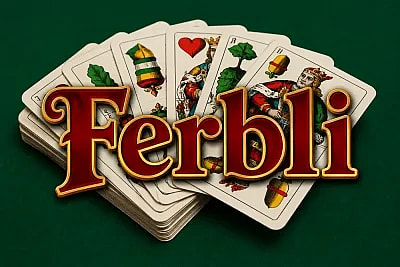
Ferbli is a classic Hungarian gambling card game that combines elements of poker, bluffing, and strategic betting. Although it was once one of Hungary’s most popular card games during the 19th and early 20th centuries, it is now primarily played by enthusiasts and in a few regions where traditional card games remain popular.
Unlike poker, Ferbli uses a unique ranking system based on four-card hands and includes several distinctive betting phases that allow players to pressure opponents before everyone has even seen all of their cards. Reading opponents, managing risk, and deciding when to bluff are just as important as the cards you hold.
This guide explains the standard rules of Ferbli in a clear, beginner-friendly format while preserving the traditional gameplay.
This post contains affiliate links. For more information, see our disclosures here.
How to Play Ferbli (Complete Rules and Variations)
Number of Players
- Players: 2-7
- Best with: 4-6 players
- Play direction: Counterclockwise
Cards Used
Ferbli traditionally uses a 32-card Hungarian (Magyar) deck with German suits.
The suits are:
- Acorns
- Leaves
- Gourds
- Hearts
Each suit contains:
- Ace
- King
- Over
- Under
- Ten
- Nine
- Eight
- Seven
Card Values
These values are used when counting suited combinations.
| Card | Value |
|---|---|
| Ace | 11 |
| King | 10 |
| Over | 10 |
| Under | 10 |
| Ten | 10 |
| Nine | 9 |
| Eight | 8 |
| Seven | 7 |
Objective
Your goal is to win the betting pot by either:
- Making the strongest four-card hand, or
- Convincing every other player to fold through strategic betting and bluffing.
Because players can fold during several betting rounds, many hands are won without ever revealing cards.
Hand Rankings
From strongest to weakest:
1. Four of a Kind
Four cards of the same rank.
Highest to lowest:
- Four Aces
- Four Kings
- Four Overs
- Four Unders
- Four Tens
- Four Nines
- Four Eights
- Four Sevens
2. Banda
Four cards of the same suit.
These are ranked by their total point value.
Possible totals range from:
- 41 (best)
- down to
- 34 (lowest)
3. Three of a Kind
Three cards of the same rank.
Ranking follows the normal card order:
Ace → King → Over → Under → Ten → Nine → Eight → Seven.
4. Three-Card Ferbli
Three cards of one suit.
The total value of those suited cards determines which hand is stronger.
Possible totals range from 31 to 24.
5. Two Aces
The only pair recognized in Ferbli.
No other pair has any value.
6. Two-Card Ferbli
Two suited cards.
Values range between 21 and 15.
7. High Card
If no other combination is made, compare the highest card.
If players remain tied, position around the table determines the winner.
Before the Deal
Before play begins, everyone agrees on:
- the minimum stake (called the vizi)
- any betting limits for the session
Most games use Limited Ferbli, where each raise may be between one vizi and twice the previous highest bet.
Dealing the Cards
The player to the dealer’s right begins by placing the compulsory vizi into the pot.
The dealer then:
- Shuffles the deck.
- Has the player to the left cut.
- Deals two cards face down to each player.
Players look only at these first two cards before the opening betting round begins.
First Betting Round
Starting with the player immediately after the compulsory bettor:
Each player chooses to:
- Match the vizi and stay in the hand
- Fold immediately
The compulsory bettor cannot fold during this opening stage because they have already entered the pot.
Minimum Players
The hand only continues if enough players participate.
- With four or fewer players, at least two players must stay.
- With five or more players, at least three players must stay.
Cukassza
If too few players enter the hand:
- The deal is canceled.
- Everyone contributes a vizi.
- The money stays in the pot.
- A new dealer begins another hand.
This growing carryover pot is called a cukassza, making later hands increasingly valuable.
Second Betting Round
After the opening round, the compulsory bettor decides whether to increase the stakes.
This raise is called besszer.
If no raise is made:
- everyone simply receives two additional cards.
If the player raises:
- remaining players must either
- match the raise
- or fold.
Charging (Kóstáltatás)
If the first player raises, the last active player gains a special privilege known as charging.
Instead of simply calling, this player may demand additional payments from opponents before they receive their remaining cards.
Players being charged may:
- pay the charge and continue
- or fold immediately.
Because charged players often see additional cards before deciding, charging is considered a risky tactic and is used selectively.
Completing the Deal
Once charging ends (or is skipped), every remaining player receives four total cards.
At this point everyone prepares for the final betting phase.
Final Betting Round
Players now have three basic options:
- Bet
- Check
- Fold
If everyone checks:
- nobody wins the pot,
- the money remains for the next hand,
- and another deal begins.
If someone bets:
Every remaining player must either:
- call,
- raise,
- or fold.
Betting continues until all raises are matched or only one player remains.
Blind Betting
One unique Ferbli rule allows players to bet without looking at their final two cards.
This is known as blind betting.
Blind bettors gain an important advantage:
As long as blind betting continues, later players are generally required to continue raising unless they fold.
Once someone who has seen all four cards makes a normal bet or raise, blind betting immediately ends.
This rule creates some of the game’s biggest pots because players commit money based purely on probability and nerve.
Showdown
If multiple players remain after betting finishes:
Players reveal their cards one at a time, beginning with the player to the dealer’s right.
The highest-ranking hand wins the entire pot.
If two hands are identical, the player who reveals first wins the tie.
Ferbli never splits the pot.
Betting Strategy Tips
Although luck always plays a role, experienced Ferbli players focus heavily on betting decisions.
Good habits include:
- Avoid charging without a strong reason.
- Fold early when your chances are poor.
- Use blind betting carefully.
- Bluff occasionally, but don’t become predictable.
- Watch betting patterns as closely as the cards.
Many pots are won through pressure rather than superior hands.
Popular Variations
Different regions play Ferbli with additional rules.
Common variations include:
- Grigáré, a special straight using four different suits.
- Sánta, where a designated wild card may substitute for others.
- Unlimited Ferbli, which removes betting caps.
- Majzli, where the opening stake remains hidden until players commit.
- Cuhhol, a version that replaces checking with mandatory hand declarations.
Many local groups also adjust the minimum number of active players required or recognize additional wild cards.
Frequently Asked Questions
No. Traditional Ferbli uses a 32-card Hungarian deck with German suits.
Each player finishes with four cards.
While card draws matter, betting decisions, bluffing, and reading opponents are often more important over the long run.
A Banda is four cards of the same suit. It is the second-highest hand in the game.
Yes. Many hands end when every other player folds before the showdown.
Conclusion
Ferbli is a fascinating blend of traditional card play and psychological warfare. Its multi-stage betting system, unique hand rankings, and opportunities for bluffing create a game that feels familiar to poker players while offering its own strategic depth. Once you become comfortable with the betting structure and learn when to apply pressure, every hand becomes an exciting battle of nerve and timing.
If you enjoy Ferbli, you may also like Poker, Three Card Brag, or Bouillotte, all of which combine strong hand rankings with strategic betting and bluffing.
Browse Related Games!
 Official Schnapsen Rules
 Official Tell Me Without Telling Me Rules
 Official Casting Shadows Rules
 Official Canadian Salad Rules
 Official A Little Wordy Rules
 Official Skull Rules
Official Twenty-Nine Rules
Official Skull Rules
Official Twenty-Nine Rules
 Official Coup Rules
 Official Dealer’s Choice Poker Rules
 Official Game Against Christmas Rules
Official Omaha Hi-Lo Poker Rules
Official Sergeant Major Rules
Official Game Against Christmas Rules
Official Omaha Hi-Lo Poker Rules
Official Sergeant Major Rules