

Last Updated on February 12, 2026 by The Official Game Rules Team
This page provides a basic overview of how poker is played. If you need more details on specific rules, such as hand rankings, betting procedures, or variations like Seven Card Stud, Texas Hold’em, Omaha, and Five Card Draw Poker, feel free to navigate to their respective pages.

This post contains affiliate links. For more information, see our disclosures here.
How to Play Poker – A Complete Guide
Players, Cards, and Objective
Poker is typically played with 2 to 7 players, with 6 or 7 being ideal, though some versions accommodate more or even just two (“heads-up”). The game moves clockwise, using a standard 52-card deck without jokers. Card rankings from highest to lowest are A, K, Q, J, 10, 9, 8, 7, 6, 5, 4, 3, and 2, with the ace sometimes serving as the lowest card. All suits are equal in value.
Poker is usually played for money, with chips representing cash during the game. Players buy chips before playing and cash them out afterward.
How Poker Works
- Players place an initial bet if required.
- The dealer distributes cards.
- Players review their hands and decide to bet, call, raise, or fold.
- Betting continues in rounds, with some games involving additional cards or exchanges.
- The game ends in one of two ways:
- A showdown, where the best five-card hand wins the pot.
- A player winning by making all opponents fold.
Bluffing is a key aspect of poker—convincing others to fold even if you don’t have the best hand can be just as effective as holding a strong one.
Poker Hand Rankings
Poker hands always consist of five cards. If a game gives players more than five cards, they must choose the best five. The standard ranking from highest to lowest is:
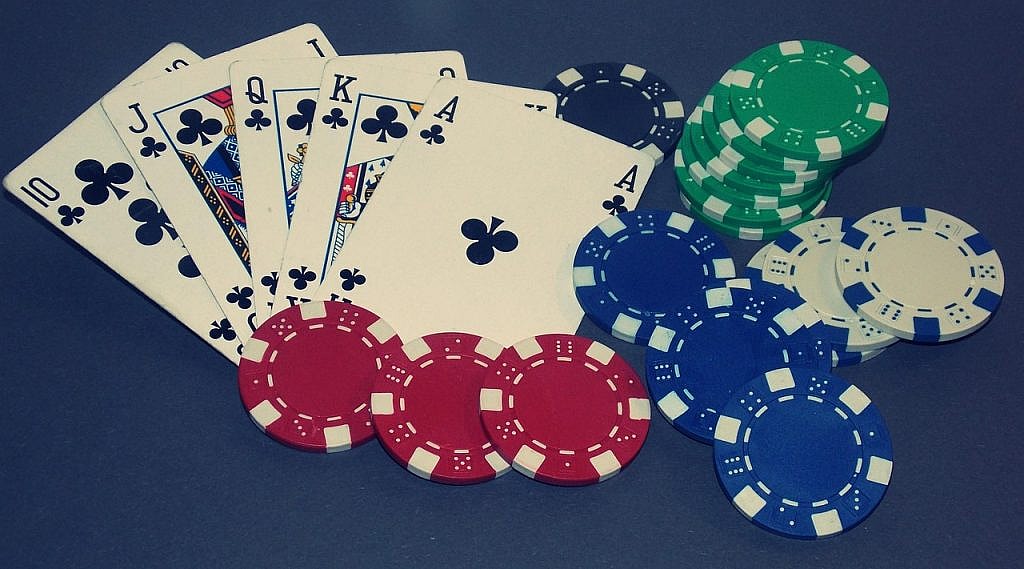
- Straight Flush – Five consecutive cards of the same suit (e.g., A-K-Q-J-10, called a Royal Flush).
- Four of a Kind – Four cards of the same rank (e.g., 9-9-9-9-Q).
- Full House – Three of one rank and a pair of another (e.g., 5-5-5-K-K).
- Flush – Five cards of the same suit, not in sequence.
- Straight – Five consecutive cards of any suit.
- Three of a Kind – Three cards of the same rank.
- Two Pair – Two cards of one rank and two of another.
- One Pair – Two cards of the same rank.
- High Card – No matching ranks or sequences; the highest card wins.
If two players have the same hand type, the highest-ranking individual cards determine the winner.
For more information on Poker Hand Rankings and Game Variations, click here.
Preparation
Before playing, players agree on the game variant and stakes. Casinos and online poker platforms set these in advance, while home games may involve discussions. Common factors to consider include:
- The initial amount required to play (antes or blinds).
- Betting limits—fixed, pot-limit, or no-limit.
- Rules on raising and re-raising.
The Deal and Betting
A dealer is chosen randomly, and cards are shuffled and cut before dealing. In some games, a “dealer button” rotates among players, determining who acts as the dealer for each round. The game proceeds with betting rounds, where players can check, bet, call, raise, or fold. The round ends when all active players have bet the same amount or only one remains.
If multiple players remain after the final betting round, they reveal their hands, and the best five-card hand wins. If a player bets and all others fold, that player wins the pot without showing their cards.
For more details on specific poker rules, check out the related pages on hand rankings, betting, and game variants.
Poker Variants
Below is a summary of some well-known poker variants.
Draw Poker
Five Card Draw is one of the oldest and most recognizable poker games, though its popularity has declined in favor of newer formats. Each player is dealt a private five-card hand. After reviewing their cards, a round of betting begins with the player to the left of the dealer. If all players check, the cards are discarded, and a new deal begins with another ante.
If betting occurs, players may discard and replace any number of cards after the first betting round. A second betting round follows, starting with the player who opened the first round (or the next active player if they folded). If multiple players remain, there is a showdown.
Variants include:
- Jacks or Better: A player must have at least a pair of jacks to open.
- Joker Wild: A 53-card deck is used, with the joker acting as a wild card or a “bug” (only usable as an ace or to complete a straight or flush).
Lowball (Low Poker) follows the same format as Five Card Draw, but the lowest-ranked hand wins. The best possible hands depend on the agreed rules:
- If aces are low and straights/flushes don’t count, the best hand is 5-4-3-2-A (also known as a “wheel”).
- If straights/flushes count, the best hand is 7-5-4-3-2 (no pairs).
Low versions of other poker games exist, and some games split the pot between the highest and lowest hands.
Stud Poker
In Stud Poker, players receive a mix of face-up and face-down cards over multiple betting rounds.
- Five Card Stud: Players receive one face-down (“hole”) card and one face-up card, followed by a betting round. Additional face-up cards are dealt, with a betting round after each, until all players have five cards. The player with the best five-card hand wins.
- Seven Card Stud: Each player receives two hole cards and one face-up card. Betting rounds follow as additional cards are dealt (four face-up, one final face-down). The best five-card hand wins.
Variants:
- Razz: A lowball version of Seven Card Stud where the lowest hand wins.
- Seven Card Stud Hi-Lo (Eight or Better): The pot is split between the highest and lowest hands. To qualify for the low half, a hand must have five cards ranked 8 or lower.
Shared Card Poker
In Shared Card (or Community Card) games, some cards are dealt face-up in the center and are shared by all players.
- Texas Hold’em: Players receive two private cards (“hole cards”) and use them along with five shared community cards to form the best five-card hand. Betting occurs after the flop (three community cards), turn (fourth card), and river (fifth card).
- Omaha: Similar to Texas Hold’em, but players receive four hole cards and must use exactly two hole cards with three community cards to form a hand.
- Omaha Hi-Lo (Eight or Better): The pot is split between the best high and low hands, with the low hand requiring five unpaired cards ranked 8 or lower.
Mixed and Rotational Games
Some players prefer a mix of poker variants rather than sticking to one.
- Dealer’s Choice: Each dealer selects a variant before the hand begins.
- H.O.R.S.E.: A structured rotation of five games—Hold’em, Omaha Hi-Lo, Razz, Seven Card Stud, and Seven Card Stud Hi-Lo.
Handling Irregularities
Poker rules do not cover every possible mistake, so fairness and minimal game disruption are key principles.
- Significant Action: Once two players have acted (bet, raise, check, or fold), the hand must continue.
- Misdeals: If an error occurs during the initial deal (wrong number of cards, missed players, etc.), the hand is redealt—unless significant action has already taken place.
- Hand Protection: Players must keep their hole cards private and separate from the discard pile (“muck”). If a hand touches the muck, it is considered folded.
- Exposed Cards: Any accidentally revealed card must be shown to all players.
- Out-of-Turn Action: A player who acts prematurely is committed to that action when their turn arrives.
- Cheating & Collusion: Players must play independently, without helping others. Collusion (playing to benefit another player) is considered cheating.
FAQ – Poker Rules
Poker is typically played with 2 to 7 players. Six or seven is ideal, but heads-up (2-player) games are also common.
A standard 52-card deck is used, with no jokers unless specified in a variant like Joker Wild.
Hands rank from highest to lowest as follows: Royal Flush, Straight Flush, Four of a Kind, Full House, Flush, Straight, Three of a Kind, Two Pair, One Pair, High Card.
The goal is to win chips by forming the best five-card hand or by making all opponents fold.
Bluffing is betting or raising with a weaker hand to make opponents fold stronger hands. It is a key strategic element.
Players can check, bet, call, raise, or fold in a clockwise order. Betting continues until all active players have matched the highest bet or all but one have folded.
If a misdeal happens before significant action, the hand is redealt. Once betting or other actions have taken place, the hand continues.
If two players have the same hand type, the winner is determined by the highest-ranking individual cards in the hand.
Conclusion
Poker is a versatile and strategic card game that combines skill, psychology, and chance. Whether playing Draw Poker, Stud Poker, or Texas Hold’em, understanding hand rankings, betting rounds, and bluffing strategies is essential. By mastering the rules and exploring different variants, players can enjoy endless excitement, whether in friendly home games or competitive tournaments.
Browse Related Games!
 Official Casting Shadows Rules
 Official Dealer’s Choice Poker Rules
 Official Twenty-Nine Rules
 Official Coup Rules
 Official Command of Nature Rules
 Official Tell Me Without Telling Me Rules
Official Panguingue (Pan) Rules
Official Tell Me Without Telling Me Rules
Official Panguingue (Pan) Rules
 Official Sergeant Major Rules
Official 2-7 Triple Draw Poker Rules
Official Sergeant Major Rules
Official 2-7 Triple Draw Poker Rules
 Official Canasta Rules
 Official Paco Rules
 Official The Fox in The Forest Rules