

Last Updated on September 2, 2025 by The Official Game Rules Team
Texas Hold’em is a widely popular and competitive poker variant that combines skill, strategy, and psychology. Players aim to make the best five-card hand by using two private cards and five community cards. This page provides the official rules of Texas Hold’em, guiding you through the key gameplay mechanics, betting rounds, and hand rankings needed to master the game.
This post contains affiliate links. For more information, see our disclosures here.
How to Play Texas Hold’em
Table of Contents
Objective
The main goal in Texas Hold’em is to win chips by either having the best hand at showdown or by forcing all other players to fold. You aim to make the best five-card hand possible using any combination of the two private cards dealt to you (hole cards) and the five community cards shared by all players.
Setup
- Players: Typically 2–10 players per table.
- Deck: A standard 52-card deck is used.
- Blinds: Texas Hold’em uses forced bets called “blinds” to initiate the action. The player to the left of the dealer posts the small blind, and the next player posts the big blind. In a casual setting you can decide before the game how much each is (this number can be raised throughout the game as more people go “out” and fewer remain).
- Dealer Button: The dealer button rotates clockwise after each hand, ensuring that every player has an equal chance to be in the dealer position.
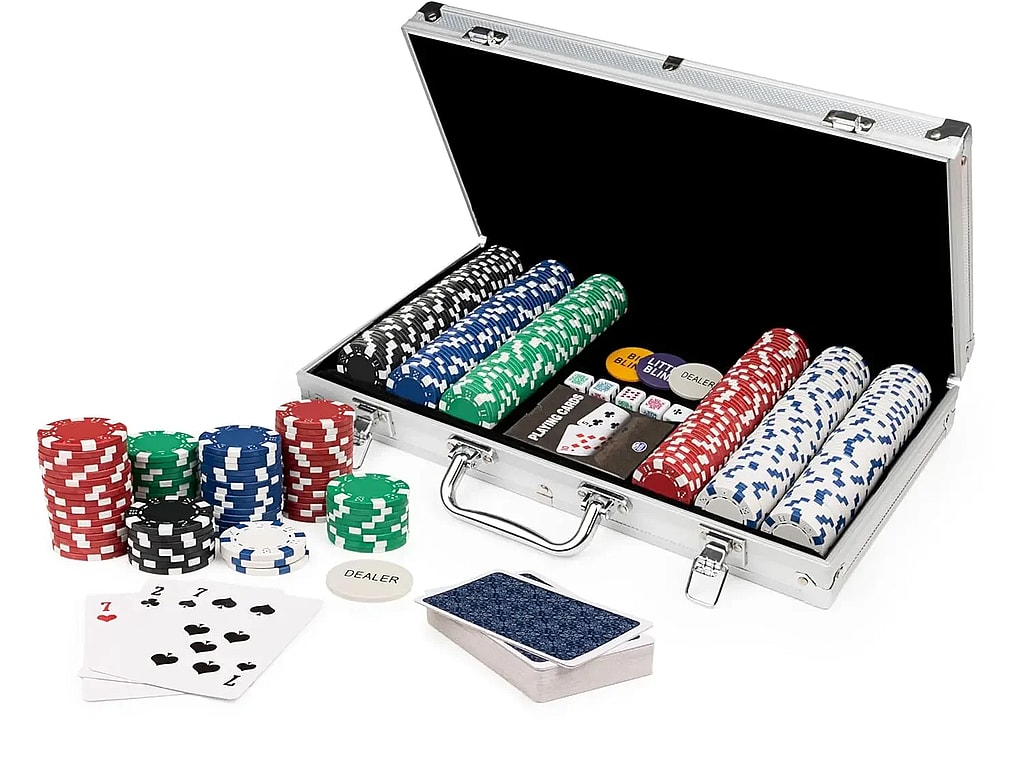
Texas Hold’em Gameplay
1. Pre-Flop
- Each player is dealt two private cards (hole cards) face down.
- The player to the left of the big blind starts the first betting round. They can fold, call (match the big blind), or raise.
- Betting continues clockwise, with each player making a decision to fold, call, or raise until everyone has either called the highest bet or folded.
2. The Flop
- After the pre-flop betting round, the dealer places three community cards face up on the board (the flop).
- Players now have the opportunity to use these cards in combination with their hole cards to form the best hand.
- A second round of betting begins with the player to the left of the dealer.
3. The Turn
- The dealer places a fourth community card face up (the turn).
- A third round of betting takes place, starting with the player to the left of the dealer.
4. The River
- The dealer places the fifth and final community card face up (the river).
- A final betting round takes place, where players can choose to bet, check, raise, or fold.
5. Showdown
- If more than one player remains after the final betting round, there is a showdown.
- Players reveal their hole cards, and the best five-card hand wins the pot. The hand must use a combination of the two hole cards and the five community cards.
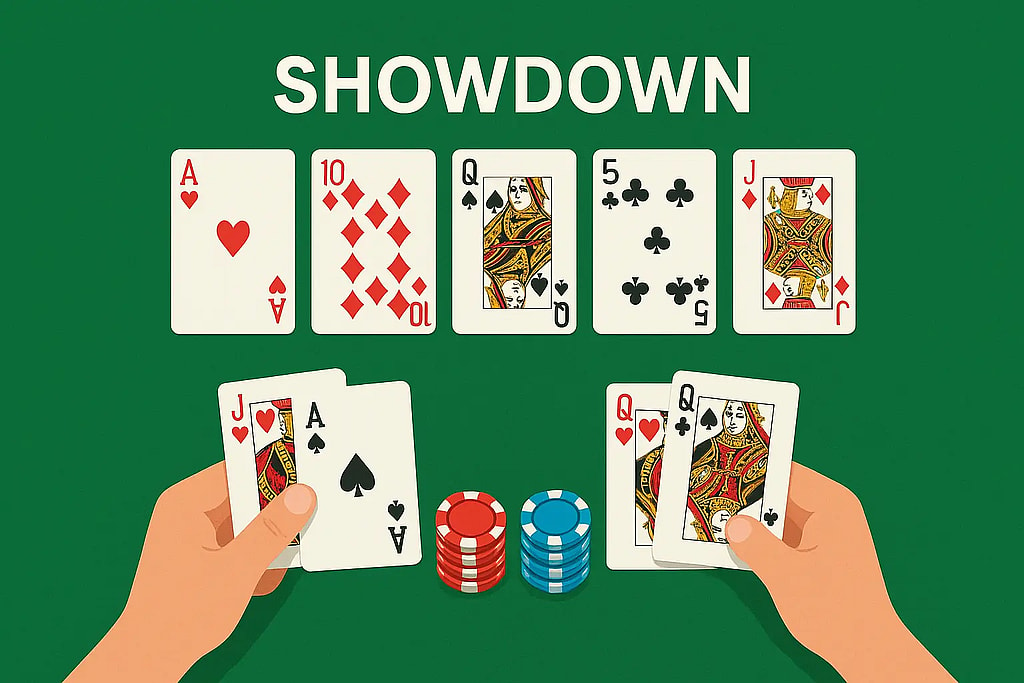
In the example, the player on the left has 2-pair (Jacks and Aces). The player on the right has three of a kind (Queens). The player on the right wins.
Hand Rankings
Understanding hand rankings is crucial in Texas Hold’em. Here’s the list of poker hands ranked from highest to lowest:
- Royal Flush
A, K, Q, J, 10, all of the same suit (e.g., A♠ K♠ Q♠ J♠ 10♠). - Straight Flush
Five consecutive cards of the same suit (e.g., 8♣ 9♣ 10♣ J♣ Q♣). - Four of a Kind (Quads)
Four cards of the same rank (e.g., 9♦ 9♠ 9♣ 9♥ 2♠). - Full House
Three cards of one rank and two cards of another rank (e.g., 3♠ 3♥ 3♦ 6♠ 6♣). - Flush
Five cards of the same suit, not in sequence (e.g., 2♣ 5♣ 8♣ J♣ K♣). - Straight
Five consecutive cards of mixed suits (e.g., 7♠ 8♦ 9♣ 10♠ J♥). - Three of a Kind (Trips)
Three cards of the same rank (e.g., 6♠ 6♦ 6♣ 9♠ 10♣). - Two Pair
Two sets of two cards of the same rank (e.g., 4♠ 4♦ 7♣ 7♥ K♠). - One Pair
Two cards of the same rank (e.g., 8♠ 8♦ 5♣ J♠ 10♥). - High Card
If no player has any of the above hands, the player with the highest card wins (e.g., A♠ 9♦ 8♣ 6♠ 3♥, in this example the Ace of spades is the highest card).
Betting Structures
Texas Hold’em can be played with several different betting structures:
- No-Limit
Players can bet any amount, up to the total amount of chips they have. This is the most common form of Texas Hold’em and allows for all-in bets. - Pot-Limit
Players can bet up to the current size of the pot. For example, if the pot is $100, the maximum bet is $100. - Fixed-Limit
Players can only bet or raise by a fixed amount during each betting round. For example, if the betting limit is $5, each player must raise or bet in increments of $5.
Basic Strategy Tips for Texas Hold’em
1. Starting Hand Selection
- Play Tight Early: In early position, play strong hands like pairs of Aces, Kings, Queens, and suited connectors (e.g., J♠ 10♠).
- Loosen Up Later: In late position, you can widen your range of hands, especially if the players before you have folded or bet weakly.
2. Position Matters
- Early Position: This is the first few seats after the big blind. You’ll be first to act in betting rounds, so it’s best to play tight and only bet with premium hands.
- Late Position: As you approach the dealer button, you get more information on how the other players are betting, which gives you a significant advantage. You can play a wider range of hands and act more aggressively.
3. Pay Attention to the Board
- Watch the community cards closely. If there are many suited or consecutive cards, players may have a flush or straight. Use this knowledge to decide whether to continue betting or fold.
4. Pot Odds and Implied Odds
- Pot Odds: This is the ratio of the current size of the pot to the cost of a contemplated call. You should only call if the pot odds justify the decision.
- Implied Odds: This involves considering the potential future betting rounds, not just the current pot. For example, if you’re on a draw to complete a straight or flush, the potential payout in future betting rounds might justify a call.
5. Bluffing and Semi-Bluffing
- Bluffing is a critical part of poker, but it should be used selectively. The key to successful bluffing is convincing your opponents that you have a stronger hand than you actually do.
- Semi-Bluffing is betting on a hand that may not yet be strong but could improve (e.g., holding a flush or straight draw). This gives you a chance to win even if your bluff is called.
6. Reading Your Opponents
- Watch for betting patterns. If an opponent raises a lot and plays aggressively, they may be holding a strong hand or bluffing. If they check or fold often, they might be playing weak hands.
- Keep track of how your opponents react in different situations and adjust your play accordingly.
Advanced Strategy
1. Aggression is Key
- Playing aggressively, particularly in no-limit Texas Hold’em, can put pressure on your opponents and force them to make tough decisions. Betting and raising builds pots and reduces the chances of being outdrawn by weaker hands.
2. Continuation Betting (C-Bet)
- After raising pre-flop, continue betting on the flop whether or not it helped your hand. This forces opponents to think you have a strong hand, which may cause them to fold.
3. Slow Playing
- Slow playing is pretending to have a weak hand when you have a strong one, in hopes that your opponents will bet more. This strategy works best with premium hands, like pocket Aces, when there are strong draw possibilities on the board.
4. The Power of Fold Equity
- When you raise or re-raise, your opponent has to consider the possibility that you could be bluffing, which is called “fold equity.” The more often you raise, the more likely your opponents are to fold, allowing you to win pots without showing your cards.
Texas Hold’em FAQ
Texas Hold’em is best played with 2 to 10 players. Heads-up (2 players) is faster and more strategic, while full tables (9–10 players) are more dynamic and competitive.
Hands are ranked from highest to lowest as follows: Royal Flush, Straight Flush, Four of a Kind, Full House, Flush, Straight, Three of a Kind, Two Pair, One Pair, and High Card.
The goal is to win chips by either having the best five-card hand at showdown or by convincing other players to fold before the showdown.
Blinds are forced bets to start the action in each hand. The small blind is placed by the player to the dealer’s left, and the big blind is placed by the next player. Blinds rotate clockwise each hand.
In Texas Hold’em, each player receives two hole cards, while in Omaha, players receive four hole cards and must use exactly two of them in combination with three community cards.
If players tie with identical hands, the pot is split equally among them.
Conclusion
Mastering Texas Hold’em involves understanding the rules, hand rankings, and betting structure, as well as developing solid strategies. By making informed decisions about starting hand selection, position, and betting, and by honing your skills in bluffing and reading opponents, you can greatly improve your chances of winning. Keep practicing, and remember, poker is as much about psychology and strategy as it is about luck.