

Last Updated on May 9, 2026 by The Official Game Rules Team
Solitaire, often known as Klondike, is one of the most recognizable single-player card games in the world. Like other solo card games such as Spider Solitaire and FreeCell, it blends luck with strategic movement of cards. Many versions can be played on a small surface, but those with larger layouts may require a floor or large table for more room. Here’s a breakdown of the official rules and how to play:

This post contains affiliate links. For more information, see our disclosures here.
How to Play Solitaire – Complete Guide
Components
- 1 standard 52-card deck (no Jokers)
Objective
Your goal is to build up four foundation piles—one for each suit—in ascending order, from Ace to King. To win, every card in the deck must end up in the appropriate foundation pile.
More of a visual learner? Checkout the video tutorial at the bottom of the page!
Card Rank
Cards are ranked from highest to lowest: King (K), Queen (Q), Jack (J), 10 through 2, and Ace (A).
Layout and Setup
Solitaire uses four types of card piles:
- Tableau – The main play area, consisting of seven columns.
- Foundations – Four piles that start with Aces and are built up in suit order.
- Stock – The remaining deck, used to draw new cards.
- Waste – A discard pile for stock cards that can’t be immediately played.
To set up the tableau:
- Deal seven piles from left to right.
- Place one card face up on the first pile.
- Then deal one card face down on each of the remaining six piles.
- Repeat this process, adding one more card face up each time to the next pile to the right, and face-down cards to the others, until the seventh pile has six cards face down and one card face up.
Place the rest of the deck face down above the tableau to form the stock pile. The foundation and waste piles will begin empty.
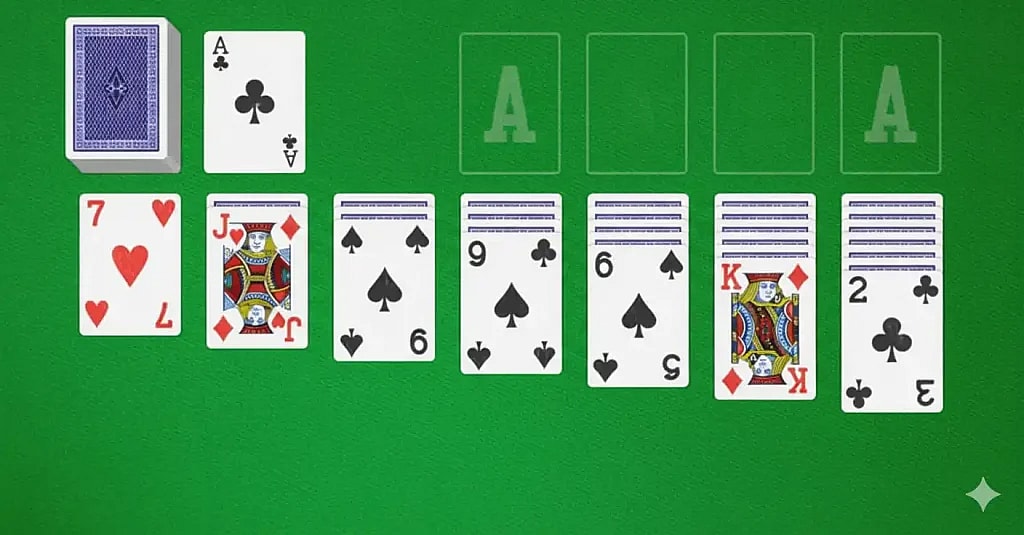
Gameplay
The game begins by building down in alternating colors (red on black, or black on red) within the tableau. Only face-up cards can be moved. If a move reveals a face-down card, flip it face up and it becomes available for play.
Examples of legal moves:
- Placing a red 6 onto a black 7 in the tableau.
- Moving an Ace to an empty foundation pile.
- Placing the next sequential card in the same suit on top of a foundation (e.g., 2♦ on Ace♦).
Cards may also be drawn one at a time from the stock pile. If the drawn card can be played onto the tableau or foundation, do so. If not, place it in the waste pile. Once the stock pile is exhausted, some versions allow you to reshuffle the waste into a new stock and try again.
Spaces in the Tableau
If a full column in the tableau is cleared, it becomes a “space.” Only Kings may be placed into a space. This rule is essential for revealing and moving blocked cards.
Winning the Game
You win when all cards have been moved to their foundation piles in proper suit order from Ace to King.
Video Tutorial
Solitaire FAQ
The goal is to move all cards to the foundation piles, organized by suit from Ace to King.
A standard 52-card deck is used.
Deal seven tableau piles: the first pile has one card, the second has two, and so on. Only the top card of each pile is face-up. The remaining cards form the stock.
Move cards between tableau piles in descending order and alternating colors (e.g., red 7 on black 8).
Four piles where cards are stacked by suit from Ace to King. The game is won when all cards are moved here.
Depends on the version. Classic Solitaire often allows drawing one card; many modern versions use three-card draws.
If no legal moves remain, draw from the stock. If the stock is empty, the game may be lost unless tableau moves are still available.
Solitaire can be a relaxing and satisfying game to play, offering opportunities for strategic thinking and planning. Enjoy your solitaire sessions!
Browse Related Games!
 Official Casting Shadows Rules
 Official Twenty-Nine Rules
 Official The Fox in The Forest Rules
 Official Kings Cup Extreme Rules
 Official Coup Rules
 Official Monopoly Buy Everything Rules
 Official Palace (Shithead) Rules
 Official Canasta Rules
 Official Command of Nature Rules
 Official South African Kaluki Rules
Official Speed Rules
Official South African Kaluki Rules
Official Speed Rules
 Official Mustachio Rules