

Last Updated on July 23, 2026 by The Official Game Rules Team
Bouillotte is a classic French gambling card game that enjoyed enormous popularity during the late 18th and throughout much of the 19th century. For decades it was one of the most popular betting card games in France before gradually being replaced by poker as that game spread across Europe.
Bouillotte evolved from an older French game called Brelan, which had been played since the 1600s. While Brelan also revolved around betting and three-card hands, Bouillotte introduced a more structured betting system and standardized rules. Like poker, players must decide whether to bet confidently on a strong hand, bluff weaker holdings, or fold before risking more chips.
Although rarely played today, Bouillotte remains an important part of card game history and is fascinating for anyone interested in traditional gambling games or the origins of modern poker.
This post contains affiliate links. For more information, see our disclosures here.
How to Play Bouillotte (Complete Rules and Strategy)
Players and Cards
Bouillotte is traditionally played with four players, though versions for three or five players also exist.
Standard Four-Player Game
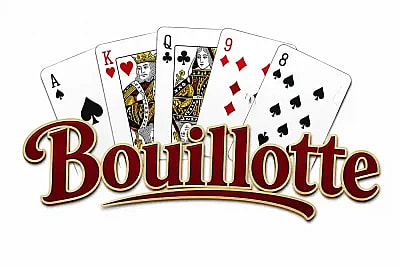
The game uses a 20-card deck consisting of:
- Ace
- King
- Queen
- 9
- 8
in each of the four suits.
Other Player Counts
Different deck sizes are used depending on the number of players.
- Three players: Remove the Queens, creating a 16-card deck.
- Five players: Add the Jacks, producing a 24-card deck. The Jack ranks below the Queen.
Chips and the Cave
Each player begins with an equal number of chips known as their cave.
Before play begins, everyone agrees on:
- The value of each chip.
- How many chips make up one cave (commonly around 100 chips).
A player’s betting is limited to the chips remaining in their cave. Once a player loses every chip, they may purchase another cave and continue playing.
This system prevents unlimited betting while keeping everyone on equal footing at the beginning of the game.
Choosing Seats
Seats are traditionally determined by drawing cards.
One card of each rank is shuffled, and each player draws one.
- The player drawing the King chooses their seat first.
- The remaining players sit in descending card order.
- Play then proceeds counter-clockwise throughout the game.
Antes and Initial Stakes
Before the cards are dealt, an opening pot is created.
Different groups use slightly different methods.
Common Method
Each player contributes one chip to the pot.
The dealer then adds one additional chip.
Alternative Method
Only the dealer contributes a single chip before the deal.
Both methods are historically correct and simply create the starting pot before betting begins.
The Straddle (Carre)
Before receiving cards, players have an opportunity to increase the pot with blind bets.
The player immediately to the dealer’s right may make a carre, which doubles the size of the pot before seeing any cards.
The next player may respond with a contre-carre, doubling the pot again.
This opportunity continues around the table until:
- A player declines to straddle.
- A player lacks enough chips to continue doubling.
Once someone passes, no further straddles are allowed and the cards are dealt.
Advantage of the Final Straddler
Making the last straddle provides an important positional advantage.
The final straddler becomes the last player to act during the first betting round.
This allows them to:
- Watch every opponent act first.
- Win immediately if everyone checks.
- Raise after seeing how many opponents remain interested.
This positional edge often justifies making a larger blind wager before seeing any cards.
Optional Buy-Back Rule
Some groups use an additional rule called the buy-back.
If the first player straddles and the second player immediately doubles it, the first player may double the pot again to reclaim the valuable last betting position.
If the first player declines, the opportunity passes to the next player.
This creates extra competition over betting position before any cards are even dealt.
Dealing the Cards
After straddling is complete:
- Every player receives three cards, one at a time.
- The dealer then turns the next card face up in the center of the table.
This exposed card plays a major role in determining the strongest possible hand.
Betting Round
The first bettor depends on whether anyone straddled.
- No straddle: Betting begins with the player to the dealer’s right.
- Straddle occurred: Betting starts with the player to the right of the final straddler.
The first player has two choices.
Pass
Passing means betting nothing while keeping the option to enter later if another player opens the betting.
Open
Opening begins the wagering.
The minimum opening bet must at least equal the highest amount already invested by any player, usually the dealer or the final straddler.
Players may wager more than the minimum, including every remaining chip in their cave. Going all-in is announced with “va-tout.”
Calling, Raising, and Folding
Once betting has been opened, every active player must choose one of three actions.
Call (Tenir)
Match the current highest wager and remain in the hand.
Raise (Relancer)
Increase the wager, forcing remaining players to either match the new amount or fold.
Fold (Filer)
Discard your hand and permanently leave the betting round, forfeiting any chips already committed.
Unlike the initial pass, once betting has begun, players may no longer check and wait.
When Does Betting End?
Betting continues until one of several situations occurs.
Everyone Except One Player Folds
The remaining player immediately wins the pot without revealing their cards.
Only Two Players Remain
Once one player calls the other’s final wager, betting immediately ends and the two players reveal their hands.
Three or More Players Remain
If every remaining player calls the latest wager, betting does not automatically end.
Instead, another betting opportunity begins.
Starting with the first surviving player to the right of the most recent bettor:
- Players may raise again.
- Or pass on raising.
Only after every remaining player declines another raise does the game proceed to the final showdown.
Running Out of Chips (Side Pots)
Bouillotte includes rules similar to modern poker side pots.
If a player cannot fully match a wager because they have too few chips, they place all of their remaining chips into the pot.
The pot is then divided.
Main Pot
Every player contributes only the amount matched by the all-in player.
The all-in player remains eligible to win only this portion.
Side Pot
Any additional betting between players with more chips forms a separate side pot.
Only those players compete for the extra chips.
This system allows players with short stacks to remain involved without risking money they do not have.
Hand Rankings
Bouillotte has only a few possible hand types, making the ranking system relatively straightforward.
1. Brelan Carré (Highest)
The strongest possible hand.
This consists of three cards matching the rank of the exposed card.
Example
- Turned card: 9
- Player holds three 9s
This effectively creates four of a kind.
2. Ordinary Brelan
Three cards of the same rank that do not match the exposed card.
If multiple players have three of a kind, they rank:
- Aces
- Kings
- Queens
- Nines
- Eights
3. Winning by Suit Points
If nobody has three of a kind, the winner is determined using suit values.
Every exposed card is counted using:
- Ace = 11
- King = 10
- Queen = 10
- Nine = 9
- Eight = 8
The suit showing the highest total points across every exposed card becomes the winning suit.
Among players who stayed in the hand, the player holding the highest card of that suit wins.
Breaking Ties
If multiple suits tie for the highest point total:
- Determine which surviving player owns each tied suit.
- The surviving player nearest the dealer’s right wins the tie.
This unusual scoring method gives Bouillotte a distinctive strategic flavor unlike most gambling card games.
Showdown
Whenever more than one player survives the betting:
- Every player reveals their cards, including those who folded.
- Only players still active compete for the pot.
- The highest-ranking hand wins.
Players holding special combinations also receive bonus payments from every opponent.
Bonus Payments
Brelan Carré
Every opponent pays the holder two chips, even if they folded earlier.
Ordinary Brelan
Every opponent pays one chip.
If multiple players have ordinary Brelans, they do not pay each other because the payments cancel out.
Side Pot Showdowns
When side pots exist:
- Resolve the main pot first.
- Determine the winning suit from that contest.
- Use that suit when resolving any remaining side pots if no Brelans are involved.
This ensures all wagers are distributed correctly when one or more players have gone all-in.
Common Variations
Many regional versions of Bouillotte developed over time.
Popular rule changes include:
- Different cave sizes and starting chip amounts.
- Different ante sizes before each hand.
- Recognizing the Brelan de Mistigri, consisting of the Queen of Clubs plus two matching cards of the same color. This hand ranks below an ordinary Brelan but above a points victory.
- High-stakes games that eliminate Brelans entirely, making suit-point scoring the only way to determine the winner.
Because Bouillotte was played throughout France for generations, local clubs often developed their own house rules while preserving the game’s core betting structure.
Strategy Tips
Although luck plays an important role, experienced players gain an advantage through careful betting.
Some useful strategies include:
- Value the last betting position after a successful straddle.
- Avoid overcommitting chips with ordinary point hands.
- Remember that bluffing is an important part of the game.
- Pay attention to opponents who repeatedly straddle before the deal.
- Manage your cave carefully since betting is limited by your remaining chips.
- Learn when preserving chips is more valuable than chasing marginal hands.
Conclusion
Bouillotte is one of the most influential gambling card games ever created, blending simple hand rankings with surprisingly sophisticated betting mechanics. Features such as blind straddles, raising wars, side pots, and bluffing make it feel remarkably modern despite being more than two centuries old. If you enjoy Bouillotte, you may also like classic vying games such as Poker, Brag, and Ferbli, all of which emphasize betting strategy, reading opponents, and deciding when to risk everything on the strength of your hand.
Browse Related Games!
 Official Casting Shadows Rules
 Official Schnapsen Rules
 Official A Little Wordy Rules
 Official Twenty-Nine Rules
 Official Skull Rules
Official Sergeant Major Rules
Official Canadian Salad Rules
Official Skull Rules
Official Sergeant Major Rules
Official Canadian Salad Rules
 Official Coup Rules
 Official Marjolet Rules
 Official Port Royal Rules
 Official Command of Nature Rules
 Official Oh Hell Rules