

Last Updated on June 1, 2025 by The Official Game Rules Team
Carolina Samba is a Canasta-style card game that expands on traditional rules by allowing sequences (sambas) as valid melds alongside standard sets.
In Carolina, Samba is often played with variations that combine elements of Hand and Foot and Canasta, including draw piles, required canastas, and red/black three mechanics. Played with eight decks, Samba offers a layered, strategic experience built around collecting sets, creating sambas, and managing your hand and foot effectively to go out.

This post contains affiliate links. For more information, see our disclosures here.
How to Play Carolina Samba
Table of Contents
- What is Samba?
- What is Canasta?
- What is “A Samba”?
- Requirements to “Go Out”
- Setup
- Building the Hand and Foot
- Player Roles
- Turn Sequence
- Discard Pile Rules
- Additional Rules
- Meld Requirements
- Card Values
- Keeper Responsibilities
- Going Out
- Scoring
- Winning
- Variations
- Organizing Your Cards
Thanks to Sharon Bennett for contributing.
What Is Samba?
Samba is an advanced version of Canasta and Hand and Foot. It adds runs (sequential cards of the same suit) as a new meld type and includes a few other changes:
- Players start with 15 cards in both their hand and foot (instead of 11).
- Red 3s are beneficial, not penalties.
- Scoring is different, with higher point values for special melds.
Samba is suitable for 2, 3, 4, or 6 players using eight decks of cards.
What Is a Canasta?
A Canasta is a set of seven cards of the same rank.
- Red Canasta (Clean): 7 natural cards → 500 points.
- Black Canasta (Dirty): Includes wild cards (2s or Jokers) → 300 points.
- A meld can never have more wild cards than naturals.
What Is a Samba?
There are two types of Sambas:
1. Set Samba
- A Canasta of 7s or wild cards.
- Samba of 7s (no wilds) → 2000 points.
- If wilds are used with 7s → value drops to 300 points.
- A wild card Samba (all wilds) → 2000 points.
2. Run Samba
- A sequence of 7 cards in the same suit.
- Valid runs include: 4–10, 5–J, 6–Q, 7–K, or 8–A.
Samba Limits
- Only one Run Samba per suit per team.
- Duplicate Set Sambas are allowed (e.g., multiple wild card or 7s Sambas).
Requirements to Go Out
To go out, a team must complete:
- 1 Samba of 7s
- 1 Samba of wild cards
- 1 Run Samba
- 5 Red Canastas
- 1 Black Canasta
Partnership Samba (4 Players)
Setup
- Partners sit opposite in Carolina Samba.
- Use 8 decks of cards with 2 Jokers per deck.
- Each player builds their hand and foot from 3+ draw piles.
- Our group often plays with 4, 5, then 6 piles across rounds.
- Draw pile structure is agreed upon before the game begins.
Cutting to Start
- Each player cuts to determine who goes first.
- Highest card wins (Joker > 2 > Ace > King…).
Building the Hand and Foot
- First player draws cards (without counting) from each pile aiming for 30 cards.
- Player adjusts their draw (without fanning) to get exactly 30.
- Create two piles of 15 cards, alternating between them.
- Left pile → pass left (this is that player’s Hand).
- Right pile → kept (this is the player’s Foot).
Players who cut exactly 30 cards earn 100 bonus points.
Roles: Active and Keeper
- Active: Manages all unfinished melds.
- Keeper: Holds completed Canastas, Sambas, and Red 3s.
- Partners decide who plays which role.
Turn Sequence
- Draw 1 card from each draw pile.
- Meld, build, or add to spreads.
- If playing a wild card, indicate which meld it belongs to.
- Communication must be general, not revealing specific cards.
- Discard to end the turn.
Discard Pile Rules
A player may pick up the top discard (instead of drawing) only if:
- They hold two matching cards of that rank or
- Two sequential cards in the same suit for a Run Samba.
Additional Rules:
- Must immediately play those 3 cards.
- Then draw 6 additional cards from the bottom of the discard pile, face down.
- Cannot view or use those 6 cards until after discarding.
- Minimum of 7 cards in discard required to make the move.
Meld Requirements
Varies by round or pile structure:
- Popular structures:
- 3 Deals: 50 / 90 / 120
- 4 Deals: 90 / 120 / 150 / 180
- Our group: meld = number of draw piles × 30
- Example: 3 piles → 90, 4 → 120, 5 → 150
Carolina Samba Card Values
- Jokers = 50 pts
- Aces & 2s = 20 pts
- 8–King = 10 pts
- 4–7 = 5 pts
- Red 3s = 100 pts (turned in and replaced immediately)
Going Into the Foot
After a player melds and discards, they immediately pick up their foot to use next turn. Any player may remind them.
Keeper Responsibilities
- Holds all completed Canastas, Sambas, and Red 3s.
- Must keep them clearly displayed and sorted:
- 2000-point Sambas (7s, wilds, runs)
- 500-point Red Canastas
- 300-point Black Canastas
- 100-point Red 3s
Going Out
- A team can go out only if:
- All required melds are completed.
- Both partners agree to go out.
- Discarding to go out is optional.
- If fewer than 3 cards (or 5 in Cut Throat) remain in the stock piles, the game ends immediately and no team gets 2000 bonus.
Special Case – Black 3s
- A player can go out while holding exactly three black 3s. No penalty.
- Place them as if starting a Canasta.
Red 3 on Final Draw
- If a player draws a red 3 on the final turn, they give it to the Keeper for scoring and do not replace it.
Scoring
| Action | Points |
|---|---|
| Going Out | +2000 |
| Samba (Run, 7s, Wilds) | +2000 ea. |
| Red Canasta | +500 ea. |
| Black Canasta | +300 ea. |
| Red 3 | +100 ea. |
| Exact 30-card cut | +100 |
Once those values are recorded, each team does a card count.
- Joker = 50
- Ace / 2 = 20
- 8–K = 10
- 4–7 = 5
- Black 3s = –5
Subtract card values left in hand from the team total.
Winning
The team with the highest cumulative score at the end of all hands wins.
TIP:
In Hand and Foot, it’s often better to extend a meld from 3 to 4 cards—but not to 5 or 6—to avoid forming an incomplete canasta. Why? A 4-card meld allows a teammate to add up to three wild cards to help complete it. But once there are 5 or more cards, that flexibility disappears.
For example, if a player holds two cards of that rank but the team already has 5 on the table, they can’t play them or pick up a discard of that rank—because two canastas of the same rank are not allowed. Also, red threes aren’t a concern in Samba, so there’s no risk of picking up a 500-point penalty like in traditional Hand and Foot.
Variations
6-Player Carolina Samba
- Two teams of three players.
Cut Throat (2–3 Players)
- Each player plays solo with their own spread.
- Each draws 5 cards per turn instead of 1 per pile.
Organizing Your Cards
- Samba requires managing more cards than Hand and Foot.
- Group cards by suit and purpose (runs, 7s, wilds, canastas).
- Consider using card holders or boards.
- Prioritize Run Sambas due to high point value.
- Recommended rack width: 18 inches (more than the standard 12).
Carolina Samba combines the tactical depth of classic Canasta with the added excitement of sambas and foot-hand transitions. Mastering the balance between melding quickly and holding cards for bigger combinations is key to success. Whether you’re aiming for red canastas, sneaking in wild melds, or playing the long game to build sambas, this version of Samba keeps every hand engaging. With clear rules and well-defined partnerships, it’s a rewarding game for experienced players and dedicated card groups.
Browse Related Games!
 Official Monopoly Buy Everything Rules
 Official Command of Nature Rules
 Official Hanabi Rules
 Official Camping with Sasquatch Rules
 Official Casting Shadows Rules
 Official Triple Threes! Rules
 Official Coup Rules
 Official Twenty-Nine Rules
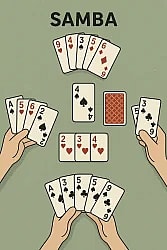 Official Samba (Canasta) Rules
 Official Crazy Eights Rules
 Official South African Kaluki Rules
Official Panguingue (Pan) Rules
Official South African Kaluki Rules
Official Panguingue (Pan) Rules