Last Updated on August 5, 2025 by The Official Game Rules Team
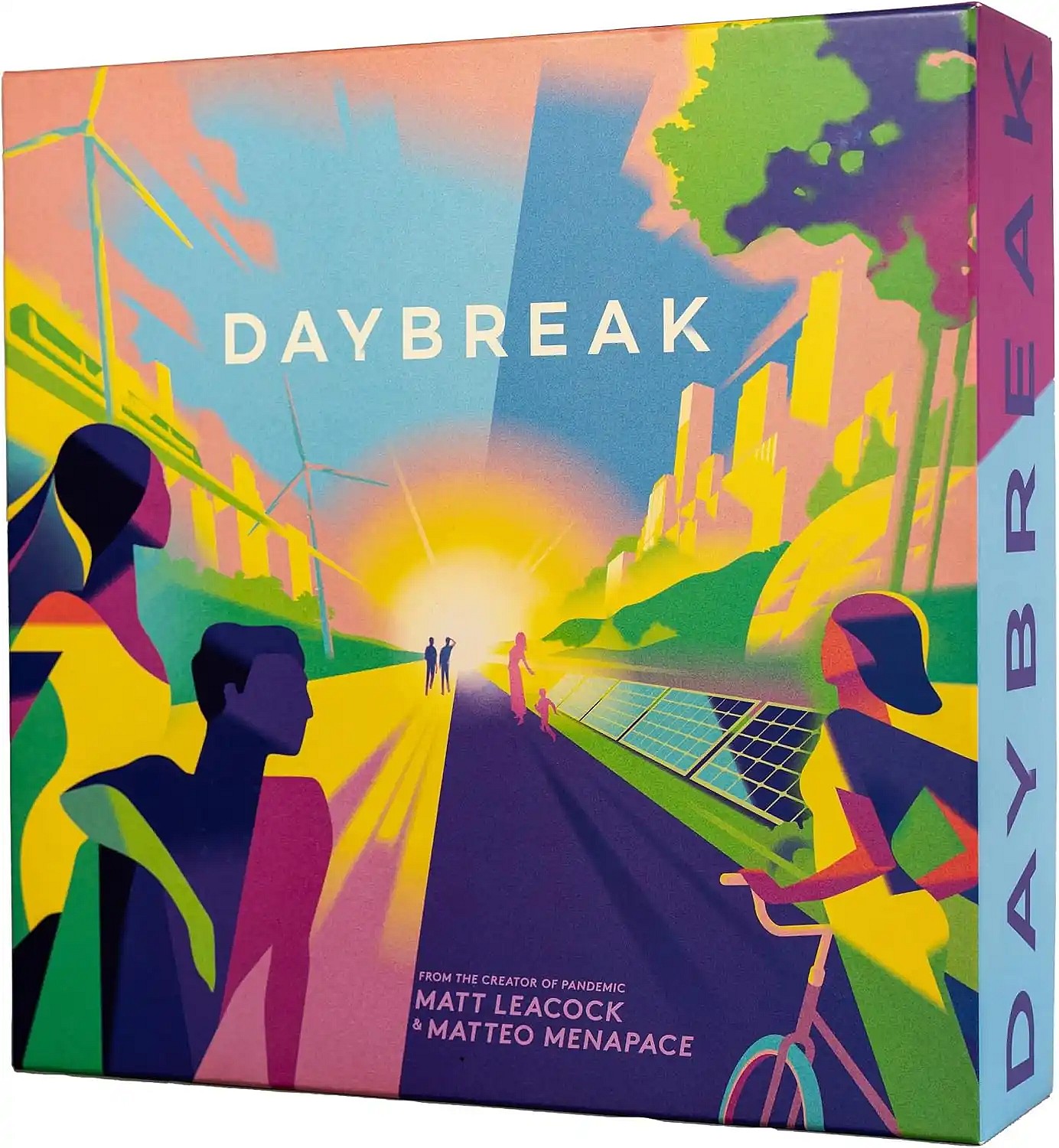
Daybreak is a cooperative, engine building board game about stopping climate change, from the creator of Pandemic. Here’s a breakdown of the rules and how to play! Click here for the video tutorial.
This post contains affiliate links. For more information, see our disclosures here.
How to Play Daybreak
Game Overview
Daybreak is a fully cooperative, climate-focused board game where players take the roles of global powers working together to stop global warming. Each player represents one of four World Powers:
- China
- Europe
- The United States
- The Majority World
The shared objective is to reduce global carbon emissions to reach Drawdown – the point where more carbon is removed from the atmosphere than is emitted. However, players must also avoid escalating global temperatures and prevent their communities from falling into crisis. If the temperature rises beyond 2.0°C or any player has 12 or more Communities in Crisis, the game ends in a collective loss.
Game Components
Central Board Setup
- Current Round Token (placed on Round Tracker at space 1)
- 6 Planetary Effects Tokens
- 8 Temperature Bands
- Planetary Effects die
- Geoengineering die
- Tree & Ocean Tokens based on player count:
- 4 players: 24 Trees / 16 Oceans
- 3 players: 16 Trees / 12 Oceans
- 2 players: 11 Trees / 7 Oceans
Card Decks
- Local Project Cards (unique starting hands per player, and a general deck)
- Global Project Cards
- Crisis Cards
- Challenge Cards (not used in the first game)
Player Components
- Player Board (with Energy, Resilience, and Community in Crisis tracks)
- Reference Card (indicates starting values and growth)
- Starting Local Project Cards (5 per player)
- Dirty Energy Tokens
- Clean Energy Tokens
- Emissions Tokens (Industry, Transportation, Building)
- Resilience Tokens (Social, Ecological, Infrastructure)
- Energy Demand Token
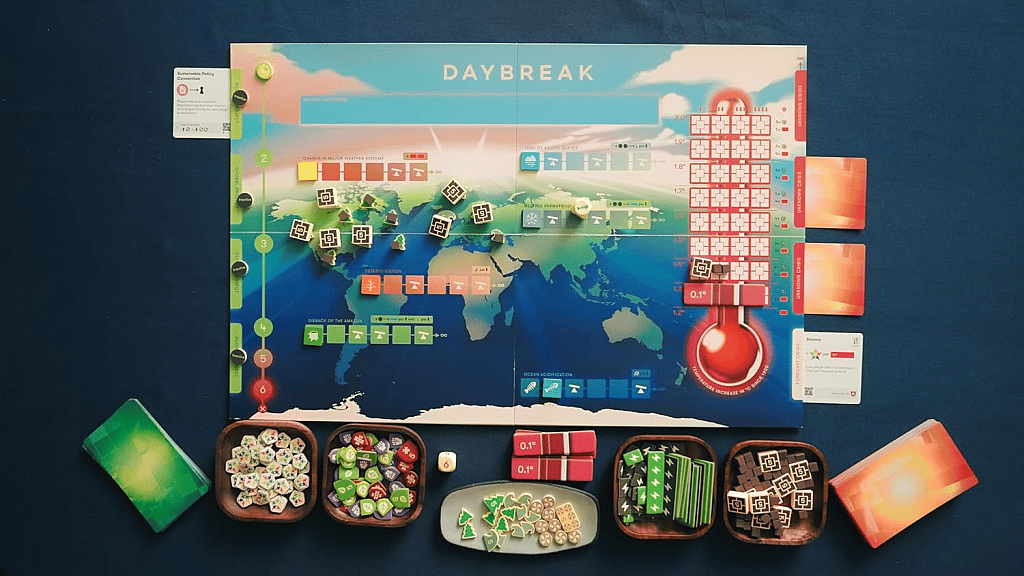
Daybreak Setup
- Choose World Powers: Distribute player boards, Reference cards, and starting Local Project cards based on chosen powers.
- Assemble Player Boards: Add starting values as indicated:
- Dirty Energy, Clean Energy, and Emissions tokens
- Initial Energy Demand
- Starting Resilience tokens
- Communities in Crisis tokens
- Central Board:
- Place Tree and Ocean tokens per player count
- Place Planetary Effects, Temperature Bands, and dice
- Shuffle and place the decks of Local Projects, Global Projects, and Crisis cards

Daybreak Gameplay
Daybreak is played over a series of rounds, with five main stages per round:
- Global Stage
- Local Stage
- Emissions Stage
- Crisis Stage
- Growth Stage
1. Global Stage
- Add Crisis Cards: Draw cards based on the number of Temperature Bands:
- 0.5°C = 2 cards
- 1.0°C = 3 cards, etc.
- One card is placed face up as the Forecast Crisis, others go face down in Unknown Crisis slots
- Start a Global Project:
- Draw 2 Global Project cards and select one to keep
- Place in an empty slot on the left of the board
- Once its requirements are met, it activates and applies to all players
- Only 4 Global Projects can be active at once
2. Local Stage
Players act simultaneously, using cards to:
- Remove Dirty Energy or Emissions tokens
- Add Clean Energy tokens to meet Demand
- Increase Resilience
- Help other players or support Global Projects/Crisis cards
Actions:
- Take a Local Action: Perform the printed action on a card in your Play Area, using stacked tags to power up effects
- Start a Local Project: Play a card from your hand in front of a stack
- Support a Card:
- Support Local Project: Tuck a card behind another in your Play Area to add tags
- Support Global Project: Tuck cards to meet its requirements
- Reduce Crisis Effects: Tuck cards under a Forecast Crisis to mitigate impact
Note: Cards can be played and covered strategically. Covering a card means its action is no longer available, but its tags can still support the card in front.
3. Emissions Stage
- Check Energy Demand:
- Your total Clean + Dirty Energy must match or exceed your Demand
- If not, gain Communities in Crisis equal to the shortfall
- Add Emissions:
- Each Dirty Energy and Emissions token = 1 Carbon cube
- Place cubes in the Recent Emissions area
- Sequester Carbon:
- Use Trees, Oceans, and Direct Air Capture (DAC) tokens to sequester cubes
- Sequestered cubes are returned to the supply
- Check for Drawdown:
- If all Carbon from the Recent Emissions area is sequestered and sequestration capacity remains, begin removing cubes from the Thermometer
- Flip the round marker to show you’re on track to win
- Adjust Temperature:
- Move remaining Carbon cubes to the Thermometer
- When a row is full, replace with a Temperature Band
- More bands = more Crisis cards and die rolls
- 8 Bands = game over (2.0°C warming)
4. Crisis Stage
- Roll Planetary Effects Die: One roll per Temperature Band.
- Advance corresponding token on its track
- Trigger effects at Tipping Points
- If a Planetary Effect adds a Band, roll again
Planetary Effects Include:
- Major Weather Systems: Draw 2 extra Crisis cards
- Desertification: Remove 1 Tree per player
- Amazon Dieback: Add 1 Carbon and remove 1 Tree per player
- Arctic Sea Ice Loss: Add 2 Carbon per player to Thermometer
- Permafrost Thaw: Add 2 Carbon per player to Emissions
- Ocean Acidification: Remove 1 Ocean token per player
- Resolve Crisis Cards:
- Start with Forecast Crisis, resolve in reverse draw order
- Determine affected player(s)
- If tied, roll Geoengineering die
- Apply effects
- Can be reduced by Resilience or supported cards
- Add Communities in Crisis as directed
Important Notes:
- 4-7 Crisis tokens = draw 1 fewer Local card per round
- 8-11 Crisis tokens = draw 2 fewer cards per round
- 12 Crisis tokens = immediate loss
5. Growth Stage
- Check for Victory:
- If you reached Drawdown last Emissions stage and survived this Crisis stage, you win
- Advance Round:
- Move Round token to next space
- If Round 6 ends without victory, you lose
- Increase Energy Demand:
- US & Europe: +1
- China: +2
- Majority World: +3
- Solo game: +2
Challenge Cards
Use Challenge cards to modify difficulty or add variety:
- Red (-): Harder (individual or group)
- Green (+): Easier (individual or group)
- Gray (?): Varied effects
Use one card per group or player as desired, mix and match freely.
Reminders & Advanced Strategy
- Local Actions can be taken multiple times unless restricted
- No hand size limit; hands are public
- Up to 5 stacks allowed in Play Area
- Resilience tokens help reduce Crisis effects; aim for 1 of each per Band
- New Temperature Bands during a round immediately add Crisis cards and die rolls
- Starting Local Project cards are tailored to each World Power
- Tucked cards remain visible for tag support
Game End
Victory:
- Reach Drawdown in the Emissions Stage
- Survive the following Crisis Stage
Loss:
- End of Round 6 without achieving victory
- 8 Temperature Bands (2.0°C warming)
- Any player has 12 Communities in Crisis
Video Tutorial
Conclusion
Daybreak offers a deeply collaborative experience where players must strategize together to steer the world away from climate catastrophe. Its gameplay blends thematic immersion with challenging cooperative mechanics, making every decision feel urgent and impactful. Fans of Arkham Horror will find familiar elements in the way Daybreak structures global crises, character abilities, and event-driven tension — but instead of battling cosmic horrors, players are racing against climate collapse. If you enjoy high-stakes teamwork and emergent narrative arcs, Daybreak will feel right at home on your game shelf.