

Last Updated on February 1, 2026 by The Official Game Rules Team
Type: Building | Players: 2-4 Players | Length: 20 minutes
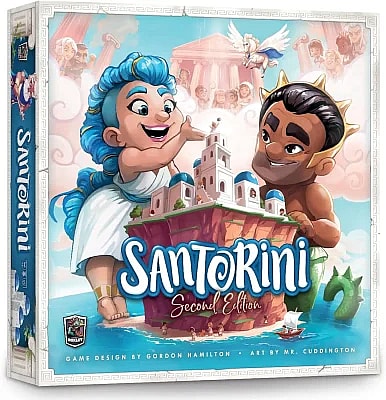
In Santorini, players compete to construct magnificent towers on the island of Santorini — a fast, strategic, and highly visual game of movement, building, and divine powers. At its core, the game is simple: move, build, and climb to the top. But with over 50 unique God and Hero Powers, Santorini quickly evolves from a simple abstract puzzle into a deep tactical experience where no two games are the same.
This detailed guide explains everything you need to know about how to play Santorini, including setup, base rules, God Power setup, Hero Power mode, and advanced variants like the Golden Fleece.
This post contains affiliate links. For more information, see our disclosures here.
How to Play Santorini (Complete Rules Guide)
Table of Contents
Components | Game Setup | Gameplay | Winning the Game | God Powers | Simple Gods | Advanced Gods | Golden Fleece Gods | Hero Powers | End of the Game | Strategy | FAQ | 3-4 Player Rules
Components
- 1 Cliff Pedestal
- 1 Ocean Board
- 1 Island Board
- 30 God Power Cards
- 10 Hero Power Cards
- 6 Worker Figures (2 per player, in 3 colors)
- 18 Domes
- 22 Level 1 Blocks
- 18 Level 2 Blocks
- 14 Level 3 Blocks

Game Setup
- Assemble the Island
- Place the Cliff Pedestal on the Ocean Board, matching the long and short tabs.
- Set the Island Board on top of the pedestal using the same tabs for alignment.
- Place Workers
- The youngest player becomes the Start Player.
- The Start Player places two Workers of their color on any unoccupied spaces.
- The other player(s) place their Workers afterward.
Basic Gameplay
The Start Player takes the first turn. Each turn, you must:
- Move one of your Workers.
- Then build using that same Worker.
If at any time you are unable to move or build, you lose the game.
Phase 1: Move
- Choose one of your Workers and move it into any of the 8 neighboring spaces (orthogonal or diagonal).
- A Worker may move:
- Up one level higher,
- Down any number of levels, or
- Across the same level.
- A Worker cannot move up more than one level at a time.
- You cannot move into a space already occupied by another Worker or a Dome.
Phase 2: Build
After moving, your selected Worker must build on any unoccupied space adjacent to it.
- You may place:
- A Level 1 Block on the ground,
- A Level 2 Block atop a Level 1 Block,
- A Level 3 Block atop a Level 2 Block, or
- A Dome atop a Level 3 Block (completing the tower).
Note: You cannot build out of sequence — each level must be built in order.
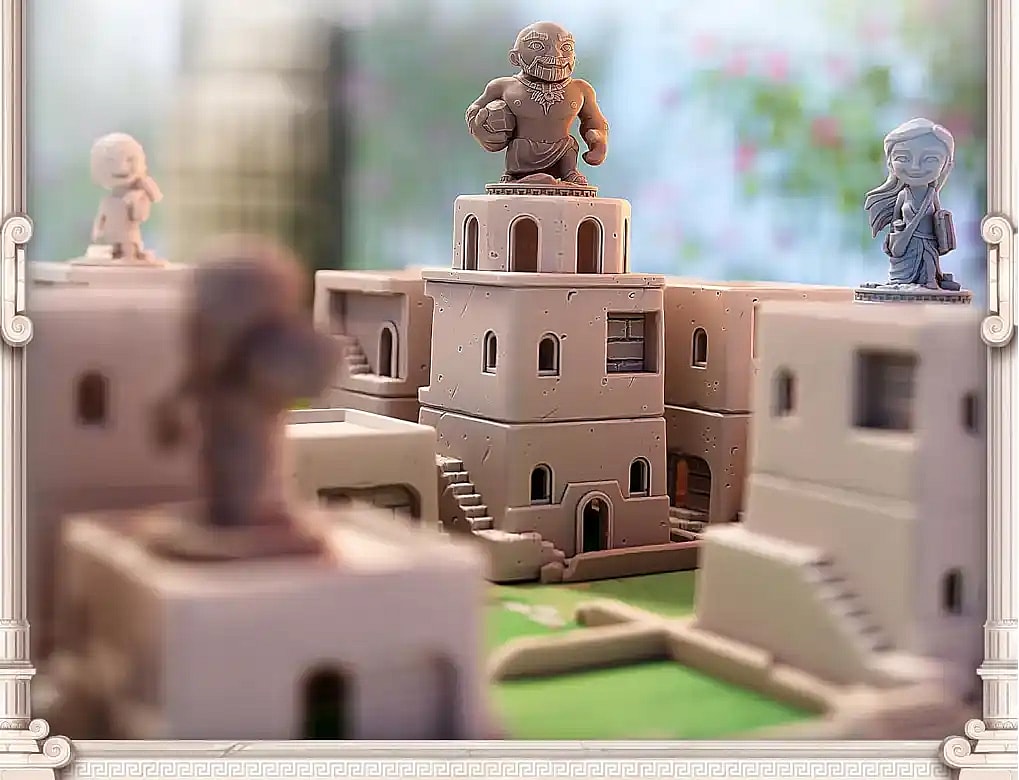
A tower with three blocks and a dome is called a Complete Tower and cannot be climbed.
Winning the Game
- You instantly win if one of your Workers moves up onto a Level 3 space during your turn.
- If you are ever unable to complete a full turn (move + build), you lose.
- Once you’ve mastered these base rules, you can introduce God Powers to add new strategic dimensions.
Using God Powers
After playing several games with the base rules, add God Power cards to introduce divine abilities that modify how you move, build, or win.
God Power Setup
- Choose the Challenger:
The player who seems most “god-like” is designated the Challenger. - Select God Powers:
The Challenger selects one God Power per player from the available deck. - Read Aloud:
The Challenger reads each selected God Power’s description aloud from the rulebook. - Choose Powers:
In clockwise order, each player chooses one of the revealed God Powers.
The Challenger takes the remaining one. - Place Workers:
Starting with the Challenger, each player places their Workers on unoccupied spaces on the Island Board. - Start the Game:
The Challenger chooses who takes the first turn.

Using Your God Power
- You must always follow the base move and build rules, except where your God Power says otherwise.
- If your card says you “cannot” or “must” do something, it overrides the normal rules.
- Domes are not considered “blocks.”
- “Forced” movement caused by God Powers does not count as a normal “move” and cannot trigger a win.
Some powers add:
- Additional Win Conditions
- Special Setup Instructions
- Advanced restrictions or exceptions
Simple Gods (Recommended for Beginners)
| God | Title | Power Description |
|---|---|---|
| Apollo | God of Music | Move into an opponent’s space by forcing their Worker to the space you left. |
| Artemis | Goddess of the Hunt | Move one additional time, but not back to your starting space. |
| Athena | Goddess of Wisdom | If one of your Workers moved up last turn, opponents cannot move up this turn. |
| Atlas | Titan Shouldering the Heavens | May build a dome on any level. |
| Demeter | Goddess of the Harvest | May build one additional time, but not on the same space. |
| Hephaestus | God of Blacksmiths | May build a second block (not dome) on top of your first build. |
| Hermes | God of Travel | If your Workers don’t move up or down, they may each move any number of times, then build. |
| Minotaur | Bull-Headed Monster | Move into an opponent’s space by forcing them one space straight back if unoccupied. |
| Pan | God of the Wild | Also win if your Worker moves down two or more levels in one move. |
| Prometheus | Titan Benefactor of Mankind | If your Worker doesn’t move up, it may build both before and after moving. |
Advanced Gods (Expert Powers)
| God | Title | Power Description |
|---|---|---|
| Aphrodite | Goddess of Love | If an opponent’s Worker starts its turn next to yours, its last move must end adjacent to your Worker. |
| Ares | God of War | At the end of your turn, you may remove an unoccupied block (not dome) next to your unmoved Worker. |
| Bia | Goddess of Violence | Setup: Place your Workers first. If your Worker moves into an opponent’s space and the next space is occupied by another Worker, that Worker is removed. |
| Chaos | Primordial Nothingness | Use the top God Power from a shuffled deck of unused Simple Gods; replace it each time a dome is built. |
| Charon | Ferryman to the Underworld | Before moving, force a neighboring opponent Worker to the opposite space if unoccupied. |
| Chronus | God of Time | You also win when there are at least five complete towers on the board. |
| Circe | Divine Enchantress | If opponents’ Workers don’t touch, you may use their God Power until your next turn. |
| Dionysus | God of Wine | When you complete a tower with a dome, take an extra turn controlling an opponent’s Worker. |
| Eros | God of Desire | Win if your Workers meet on the same level along opposite edges of the board. |
| Hera | Goddess of Marriage | Opponents cannot win by moving into perimeter spaces. |
| Hestia | Goddess of Hearth and Home | May build an additional time, but not on a perimeter space. |
| Hypnus | God of Sleep | If one of your opponent’s Workers is the highest, it cannot move this turn. |
| Limus | Goddess of Famine | Opponents cannot build on spaces next to your Workers unless completing a dome. |
| Medusa | Petrifying Gaze | At the end of your turn, any lower neighboring opponent Workers are removed and replaced with domes. |
| Morpheus | God of Dreams | Collect blocks and domes on your God Power card and use them to build instead of normal building. |
| Persephone | Goddess of Spring | If possible, opponents must move up this turn. |
| Poseidon | God of the Sea | If your unmoved Worker is on ground level, it may build up to three times. |
| Selene | Goddess of the Moon | Your female Worker may build a dome at any level instead of a normal build. |
| Triton | God of the Waves | Each time your Worker moves into a perimeter space, it may move again. |
| Zeus | God of the Sky | Your Worker may build a block under itself. |
Golden Fleece Gods (Expansion Powers)
| God | Title | Power Description |
|---|---|---|
| Aeolus | God of the Winds | Workers cannot move directly into the wind; you may change the wind’s direction each turn. |
| Charybdis | Whirlpool Monster | Place two whirlpool tokens; when both are in play, a Worker stepping into one teleports to the other. |
| Clio | Muse of History | Mark your first three builds with coins; opponents treat those spaces as domes. |
| Europa & Talus | Queen & Guardian Automaton | Place the Talus token each turn; spaces it occupies count as domes. |
| Gaea | Goddess of the Earth | Whenever you complete a dome, place an extra Worker on a neighboring ground-level space. |
| Graeae | The Gray Hags | Choose which of your Workers builds each turn. |
| Hades | God of the Underworld | Opponents cannot move down. |
| Harpies | Winged Menaces | When an opponent moves, they automatically continue one extra space in the same direction unless blocked. |
| Hecate | Goddess of Magic | Hide your Workers on a secret map; cancel illegal opponent actions that target hidden Workers. |
| Morcae | Goddesses of Fate | Secretly mark a 2×2 grid of fate spaces. If an opponent moves into one, they win instead. |
| Nemesis | Goddess of Retribution | If no opponent Worker is adjacent to yours, swap all positions at the end of your turn. |
| Siren | Alluring Sea Nymph | Instead of taking a normal turn, force opponent Workers one space toward your chosen direction. |
| Tartarus | God of the Abyss | Secretly choose one “Abyss” space. Any Worker entering it immediately loses. |
| Terpsichore | Muse of Dancing | Both of your Workers must move, then both must build. |
| Urania | Muse of Astronomy | The board wraps around—opposite edges and corners count as adjacent. |
Golden Fleece Power Setup
- Choose one God Power showing the Golden Fleece icon.
- Place the Ram figure on an unoccupied space on the board.
- Players do not have personal God Powers — only the Golden Fleece power.
How it Works
- Any player with a Worker adjacent to the Ram gains the Golden Fleece ability for their entire turn.
- This includes any “End of Turn” effects the power may trigger.

Hero Powers (2-Player Mode)
Hero Powers are one-time-use abilities marked with a purple card back and a helmet icon (Ω).
Setup
- Follow the “God Power Setup” rules.
- Each player selects one Hero Power card instead of a God Power.
Rules
- You may use your Hero Power once per game.
- Components you remove or spend to activate it are permanent.
- Hero Powers cannot be used in the Golden Fleece variant.
- Designed for 2-player play only.
Tip: For balanced matches between players of unequal skill, let the stronger player take a Hero Power and the weaker player take a God Power.
Hero Powers (One-Time Abilities)
| Hero | Title | Power Description |
|---|---|---|
| Achilles | Volatile Warrior | Once per game, your Worker may build both before and after moving. |
| Adonis | Demigodly Handsome | Once per game, choose an opponent’s Worker—it must end its next turn next to yours. |
| Atalanta | Swift Huntress | Once per game, your Worker may move any number of times in a single turn. |
| Bellerophon | Tamer of Pegasus | Once per game, move up two levels in one move. |
| Heracles | Doer of Great Deeds | Once per game, both Workers may build any number of domes (even zero). |
| Jason | Leader of the Argonauts | Once per game, place an extra Worker on a perimeter ground-level space and immediately build. |
| Medea | Powerful Sorceress | Once per game, remove a block from beneath any Workers next to your unmoved Worker. |
| Odysseus | Cunning Leader | Once per game, force two adjacent opponent Workers to new spaces. |
| Polyphemus | Gigantic Cyclops | Once per game, build up to two domes anywhere on unoccupied spaces. |
| Theseus | Slayer of the Minotaur | Once per game, remove a neighboring opponent Worker exactly two levels above yours. |
End of the Game
- You win immediately if one of your Workers moves onto Level 3.
- Some God Powers add alternative win conditions (e.g., Chronus or Pan).
- If you cannot move and build on your turn, you lose.
Record your victories and divine triumphs in your Santorini logbook or track ongoing duels among gods.
Strategy Tips
- Control elevation. Prevent opponents from gaining access to Level 3 towers — blocking is as powerful as building.
- Use both Workers. Keep one to pressure the board and another to climb.
- Learn your God. Play to your ability’s strength — e.g., Athena controls movement, Hermes dominates mobility.
- Don’t overextend. Early tower building gives opponents opportunities to climb; timing matters.
- Adapt constantly. Every God matchup is different — test synergies and anticipate how others may counter your power.
Santorini FAQ
A Worker only “moves up” when climbing to a space one level higher than its current position.
No. You can only win by moving yourself onto a Level 3 space during your turn.
No. Domes complete towers and cannot be affected by powers that specify “blocks.”
No. Every turn requires both a move and a build. If you cannot complete both, you lose.
No, unless using a specific God Power like Urania, which treats edges as adjacent.
Some are not. Refer to Roxley’s banned matchups chart for balance recommendations.
3- and 4-Player Rules
While Santorini is designed and balanced primarily as a 2-player strategy game, there are official variants for 3 and 4 players when you want to include more people at the table. These versions follow the same core rules, with a few important adjustments.
General Setup
For games with 3 or 4 players, God Powers are required. When selecting powers, make sure they are compatible with your player count:
- Use God Powers marked with a three-player icon for 3-player games.
- Use God Powers marked with a four-player icon for 4-player games.
All other standard setup rules remain the same unless noted below.
3-Player Game
Each player controls their own color and God Power. Gameplay proceeds in turn order as normal.
- If a player loses, immediately remove their Workers, Tokens, and God Power card from the game.
- The remaining players continue play without resetting the board.
- The last surviving player is declared the winner.
This format creates a tense, elimination-style match where timing and positioning are crucial to survival.
4-Player Team Game
In the 4-player variant, players compete in teams of two. Each team controls two shared Workers and must coordinate carefully to win.
- Teammate Seating: Partners sit opposite each other, alternating turns between teams.
- Individual Powers: Each player has their own God Power but may only use their own—you cannot activate your teammate’s ability.
- Setup Order: The first player on a team places both Workers during setup. The second player on that team takes the first turn.
- Winning and Losing:
- If any player on a team wins, the entire team wins.
- If any player on a team loses, the entire team loses.
Team play adds a cooperative twist, requiring communication and foresight while maintaining Santorini’s tactical depth.
Conclusion
That covers the essential Santorini rules and all the unique God and Hero Powers that enhance the game. To effectively learn how to play Santorini, remember the core loop: move one of your two workers, then build with that same worker, aiming to be the first to move onto a third-level building to claim victory, all while strategically using your chosen God’s special ability to gain an edge or foil your opponent’s plans. This simple yet deep foundation is what makes every game a unique and engaging challenge.
Browse Related Games!
 Official Clue Escape: The World’s Fair Rules
 Official Jinx Rules
 Official Mancala Rules
 Official Grand Austria Hotel Rules
 Official Codenames: Pictures Rules
 Official Everdell Rules
 Official Paint The Roses Rules
 Official Gaia Project Rules
 Official The Lord of The Rings: Duel for Middle-Earth Rules
 Official Magnetic Chess Game with Stones Rules
 Official Concordia Rules
Official Mycelia Rules
Official Concordia Rules
Official Mycelia Rules