

Last Updated on January 20, 2026 by The Official Game Rules Team
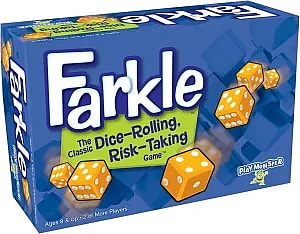
Farkle is a fast-paced, fun dice game that blends luck, risk-taking, and smart decision-making. Known by many as one of the most popular farkle games, it’s easy to learn yet surprisingly tense once points start stacking up. Whether you’re new to dice games or already familiar with classics like Yahtzee, the farkle dice game offers quick turns, dramatic swings, and plenty of laughs.
In this guide, you’ll learn exactly how to play Farkle, including scoring rules, what happens during a player’s turn, common variations, and helpful tips to avoid costly mistakes. If you’re looking for clear, accurate Farkle rules, you’re in the right place.
This post contains affiliate links. For more information, see our disclosures here.
How to Play Farkle
What You Need to Play
- 6 standard six-sided dice
- A shaker cup (optional but recommended)
- A score sheet and pencil
- 2 or more players (ages 8 and up)
Game length is usually around 30 minutes, depending on how aggressive players are during their turns.
Objective of the Game
The objective of the game is to be the first player to reach 10,000 points, then finish with the highest score after all opponents take one final turn.
Setup
- Choose one player to act as the scorekeeper and manage the score sheet.
- All players roll a single die.
- The player with the highest roll becomes the first player.
- Play continues clockwise, passing to the next player after each turn.
Gameplay
Overview of a Player’s Turn
Each player’s turn consists of one or more rolls, sometimes called throws. On your turn, you’ll roll dice, set aside scoring dice, and decide whether to keep rolling or stop and bank your points.
Step 1: First Roll
At the start of your player’s turn, place all six dice into the cup and make your first roll. Any dice that fall off the table must be rerolled.
After the first roll, look for any scoring combination. Only certain dice score points, and those dice must be set aside before continuing.
Step 2: Scoring Dice and Remaining Dice
After each roll:
- You must set aside at least one scoring die or scoring combination.
- All scoring dice are removed from play for that turn.
- The remaining dice may be rolled again in the next throw.
You keep a running total of points during your turn, but those points are not safe until you choose to stop rolling.
Step 3: Next Throw
If you choose to continue, roll only the remaining dice. This next throw follows the same rules:
- Identify scoring dice
- Set aside at least one
- Add points to your running total
You may continue rolling until you either stop voluntarily or roll a Farkle.
What Is a Farkle?
A Farkle happens when you roll and none of the remaining dice score points. When this occurs:
- You lose all points accumulated during that turn
- Your turn ends immediately
- Play passes to the next player
A Farkle can happen on your first roll, a single roll later in the turn, or when rolling just one remaining die.
Hot Dice
If you manage to set aside all six dice as scoring dice during your turn, you’ve earned hot dice. This means:
- You may roll all six dice again
- Your running total continues to grow
- You are not forced to stop
Hot dice can lead to massive scores, but also come with increased risk.
Ending Your Turn
You may stop rolling at any time after you have set aside scoring dice, provided:
- You have already entered the game with at least 500 points in a single turn
- You choose to bank your running total
Once you stop, the scorekeeper records your points on the score sheet, and they are safe from being lost.
Getting on the Score Sheet
To record points for the first time, a player must score at least 500 points in a single turn. If you Farkle before reaching 500 on your first scoring attempt, your score remains zero.
After your initial score is recorded, you may bank any amount of points on future turns.
Scoring Rules
Single Dice
- Single 1 = 100 points
- Single 5 = 50 points
Triplets (Three of a Kind)
- Three 1s = 300 points
- Three 2s = 200 points
- Three 3s = 300 points
- Three 4s = 400 points
- Three 5s = 500 points
- Three 6s = 600 points
Only dice rolled in a single roll count toward triplets. Dice from different rolls cannot be combined to form a scoring combination.
Important Scoring Notes
- Scoring dice must be removed after every roll.
- You cannot save dice to complete triplets across multiple rolls.
- Each roll is evaluated independently for scoring purposes.
Click to see examples in many printed score sheets or reference cards if your group prefers visual aids.
Winning the Game
Once a player reaches 10,000 points or more, all other opponents get one final turn to try to beat that total. After the last round:
- The player with the highest score wins
- If no one surpasses the leader, they remain the winner
Tips for Playing Farkle
- Know when to stop: Greed causes more losses than bad luck.
- Watch remaining dice: Rolling fewer dice increases the risk of a Farkle.
- Use hot dice wisely: They offer huge potential but can wipe out big turns.
- Pressure opponents: Aggressive scoring can force others into risky decisions.
- Adapt preferences: Some players are conservative; others thrive on risk. Adjust your strategy accordingly.
Common Variations
Many groups use house rules or variations, such as:
- Straight scoring (1–6)
- Three pairs scoring
- Four, five, or six of a kind bonuses
- Lower or higher winning score thresholds
Before starting, agree on which variations you’ll use to avoid confusion later.
FAQ: Farkle Rules and Gameplay
Farkle works with 2 or more players and scales well for larger groups.
Yes. If your first roll produces no scoring dice, you immediately Farkle and score zero for that turn.
A single throw with one remaining die follows the same rules. If it doesn’t score, you Farkle.
10,000 is standard, but some variations use lower or higher targets.
Yes. Triplets must appear in the same roll and cannot be built across multiple rolls.
It’s a mix of both. Dice rolls create opportunity, but deciding when to stop is pure strategy.
Conclusion
Farkle is a classic fun dice game that rewards bold decisions and punishes hesitation just as often as recklessness. With simple rules, quick turns, and limitless variety, it’s easy to see why the farkle game has remained popular for decades. Whether you’re chasing hot dice, protecting a narrow lead, or trying to avoid one last Farkle, every turn delivers tension and excitement.
Now that you know the full Farkle rules and exactly how to play Farkle, grab some dice, pass around the score sheet, and let the next player roll.
Browse Related Games!
 Official Gaia Project Rules
 Official Mancala Rules
 Official Panda Royale Rules
 Official The Lord of The Rings: Duel for Middle-Earth Rules
 Official Root Rules
 Official Magnetic Chess Game with Stones Rules
 Official The Night Cage Rules
 Official Fakin’ It All Night Long Rules
 Official Bamboo Rules
Official Mycelia Rules
Official Minute of Fun Rules
Official Bamboo Rules
Official Mycelia Rules
Official Minute of Fun Rules
 Official TOSY Flying Ring Rules