

Last Updated on May 8, 2026 by The Official Game Rules Team
Mancala is a popular two-player strategy board game with ancient origins in Africa. The game involves moving pebbles or ‘seeds’ around a board of pits, aiming to capture more pieces than the opponent. The board typically consists of two rows of pits, with each player controlling a set of six pits and a larger “store” pit at each end.
What most people don’t know is the play the game wrong! When we were taught mancala as kids, we were taught the much simpler “PG” version. However, the real way to play involves a lot more strategy, stealing opponents pieces, and overall is a much better game.
Here’s a complete breakdown of the official rules and how to play:

This post contains affiliate links. For more information, see our disclosures here.
How to Play Mancala (Complete Guide)
What You Need:
- Mancala board
- 48 seeds (sometimes referred to as “stones”)
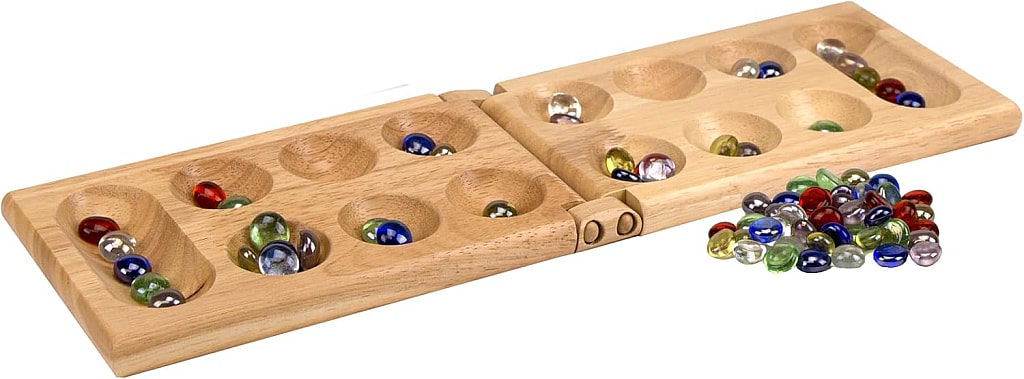
Note: If you don’t have a Mancala game board, you can use the bottom half of a 12-egg carton. This gives you 12 small pits (six for each player), and 2 bowls on either side for your “stores”. For the stones you can use buttons, small pieces of pasta, or dried beans/peas.
More of a visual learner? Checkout our simple video tutorial!
Objective
Collect as many seeds as possible in your store. The player with the most seeds in their store at the end of the game wins.
Setup
Place four seeds in each of the six pits on your side of the board. Your opponent does the same on their side. The color of the seeds doesn’t matter. (Tip: For a shorter game, use three seeds per pit.)
Basic Rules of Play
- Players take turns, moving counter-clockwise around the board.
- Each player has six pits and one store (the larger cup on their right).
- Your store is only for you—never place seeds in your opponent’s store.
- Always use one hand to pick up and place seeds.
- Once you touch the seeds in a pit, you must move them.
- You may place seeds in your own pits, your opponent’s pits, and your own store—but not in your opponent’s store.

Taking a Turn
On your turn:
- Choose one of your pits and pick up all the seeds in it.
- Starting with the pit to the right, drop one seed in each subsequent pit or store.
- If you pass your own store, place a seed in it.
- Skip your opponent’s store.
Play alternates back and forth, with each player picking up seeds from one of their own pits and sowing them counter-clockwise.
Example:
The pink player (bottom row) starts the game by picking up all seeds from their third pit. They place one seed in each of the next pits to the right, ending with their last seed landing in their store. Because the last seed landed in their store, they take another turn.
Special Rules (Almost no one knows this!!!)
- Extra Turn: If the last seed you place lands in your store, you get to take another turn.
- Capture Rule: If the last seed lands in one of your empty pits and your opponent’s pit directly across holds seeds, you capture those seeds. Move both the captured seeds and your last seed into your store.
Ending the Game
The game ends when one player has no seeds left in any of their pits. The remaining player moves all remaining seeds on their side into their store. Count the seeds in each store. The player with the most seeds wins!
Terminology
- Store: Also called a Mancala or capture pit
- Seeds: Also referred to as stones
- Pits: Also known as holes, hollows, or cups
Video Tutorial
Mancala FAQ
Mancala is traditionally played with two players, though some modern variations allow more.
If the last stone you drop lands in an empty pit on your side, you capture that stone and all stones in the opposite pit on your opponent’s side. These captured stones go into your store.
A standard two-player game usually lasts 15–30 minutes, depending on player skill and the variation being played.
The goal is to collect the most stones in your Mancala (store) by the end of the game.
On your turn, you pick up all the stones from one of your pits and sow them one by one into the following pits in a counterclockwise direction, including your store but skipping your opponent’s store.
Mancala Strategy Tips
1. Control the First Move
The first move can set the pace of the game. If possible, choose a pit that allows you to end your turn in your Mancala to gain an extra move.
2. Plan Multiple Moves Ahead
Think ahead and anticipate your opponent’s moves. Leaving certain pits open can force your opponent to feed your Mancala or prevent them from capturing your stones.
3. Keep Your Mancala Protected
Avoid leaving stones in pits that allow your opponent to capture them. Focus on maintaining a safe setup while gradually moving stones toward your Mancala.
4. Utilize Captures Wisely
Capture your opponent’s stones when the opportunity arises, but only when it improves your overall position. Avoid risky captures that could give them a counter advantage.
5. Maintain Balance Across Pits
Distribute stones carefully to keep multiple options open. Don’t overload a single pit early, as it can limit your flexibility in later turns.
6. Force Extra Turns
Whenever possible, end a move in your Mancala to earn an extra turn. Chaining multiple turns can quickly swing the game in your favor.
Conclusion
Mancala is a timeless and strategic game that challenges players to think ahead and plan their moves carefully. By mastering the art of distributing seeds, capturing your opponent’s pieces, and outwitting your rival, you can claim victory. The game’s simple yet deep mechanics make it accessible for beginners while offering enough complexity to keep experienced players engaged. Whether you’re playing for fun or aiming to dominate the board, it’s enjoyable and rewarding experience for all ages.
Browse Related Games!
 Official Gaia Project Rules
 Official The Lord of The Rings: Duel for Middle-Earth Rules
 Official Mahjong Rules
 Official Codenames: Duet Rules
 Official Magnetic Chess Game with Stones Rules
 Official Root Rules
 Official The Night Cage Rules
 Official Panda Royale Rules
 Official Rajas of The Ganges Rules
 Official Rococo Rules
 Official Pilgrim Rules
Official Mycelia Rules
Official Pilgrim Rules
Official Mycelia Rules