

Last Updated on May 8, 2026 by The Official Game Rules Team
Mahjong is a popular tile-based game that originated in China and is played with four players. The objective is to build a complete hand of 14 tiles, using a combination of sets (such as Pongs, Chows, and Kongs) and a pair. The game is typically played with 136 or 144 tiles, which include numbered tiles in three suits (Bamboos, Characters, and Dots), honor tiles (Winds and Dragons), and bonus tiles (Flowers and Seasons). Here’s how to play:

This post contains affiliate links. For more information, see our disclosures here.
How to Play Mahjong
Table of Contents
Tiles in Mahjong | Chinese Mahjong | British Mahjong | Two-player Mahjong | Three-Player Mahjong | Video Tutorial | Strategy | FAQ
Tiles in Mahjong
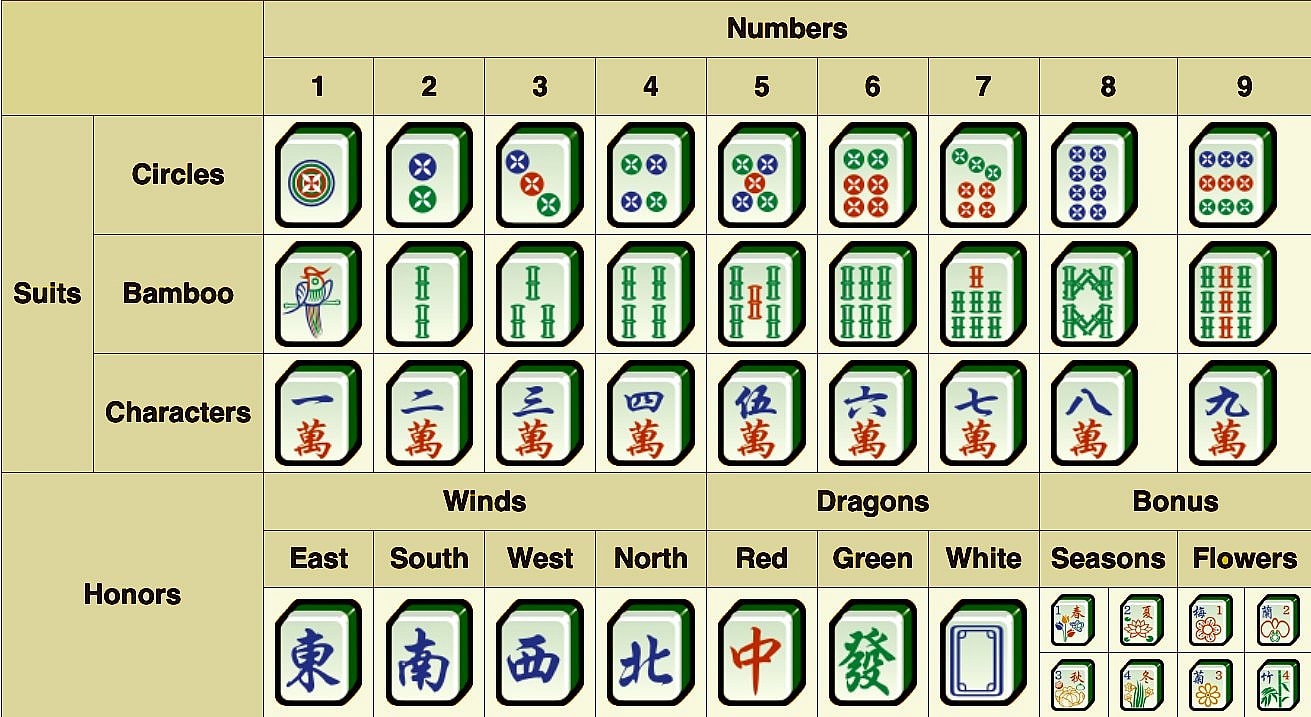
Mahjong is played with a set of 144 tiles, traditionally divided into several categories:
- Suits: These are the main numbered tiles and come in three suits—Bamboo, Characters, and Dots—each numbered from 1 to 9.
- Winds: There are four Wind tiles—East, South, West, and North—used for scoring and seat positions.
- Dragons: Three Dragon tiles exist—Red, Green, and White—which often carry special scoring bonuses.
- Bonus Tiles (optional): These include Flowers and Seasons, which grant extra points but are not used in all game versions.
Understanding the role and value of each tile group is essential for building valid hands, forming combinations, and scoring effectively in Mahjong.
Mahjong – Chinese Version
Seating
One of each of the the four wind tiles are placed face-down, shuffled and each player takes one. The players seat themselves according to this draw in the clockwise order N – W – S – E. Notice that these are NOT the standard compass positions. East the prevailing wind and the key position since this player starts, scores double and pays double for the round. For the each subsequent round, the positions change in one of two ways:
- If East wind went out in the previous round, then the positions stay the same and the player who was East wind remains the same for another round
- If one of the other winds went out in the previous round, the wind positions rotate in an anti-clockwise fashion so that the player who was South wind in the previous round becomes East wind.
In a complete session of Mah Jong, which might take a number of hours to complete, once each player has been East wind, South becomes the prevailing wind. Once South is finished, the prevailing wind becomes West and finally North. The session ends when each player has played as the prevailing North wind. Obviously, it isn’t necessary to complete a session – playing a set number of rounds or to a target score is just as good.
Building the Wall
The Flowers and Seasons are not normally used in the Chinese game and these rules assume that they are not used. All the tiles are shuffled thoroughly face down by South and North in a ritual that is called “The twittering of the sparrows”. Once done, each player takes 34 tiles and positions them in a wall, 2 tiles high and 17 tiles long. The tiles should have the long sides and be face down. Each wall should lie in front of each player running from left to right. The four walls are then pushed together to form a square symbolising the Great Wall of China. It is important to ensure that the walls have no gaps and that they touch at the corners so that any lurking dragons or evil spirits are prevented from entering.
Breaking the Wall
Next, East throws the dice to decide who breaks the wall. East counts the players, starting with East, and working anti-clockwise according to the number thrown. The player who sits where the count ends, throws the dice again and adds the total of both throws and then uses this total to count along his wall from right to left. Where the count ends, is where the player breaks the wall, which is done by removing the pair of tiles at that point and placing the top tile on top of the previous tile and the lower tile in a position two positions further anti-clockwise. These two tiles are called “loose tiles”.
So, by example, if East throws an 11, West will be the chosen player. If West throws the dice again and gets 8, the total thrown will be 19 in which case West will count along all 17 of the tile pairs in the West wall and then finish on the second pair of tiles in the South wall. West would then remove these two tiles and place the top one on the first (right-most) pair of tiles in the South wall. The lower tile would be placed on the 16th tile in West wall.
The Deal
Starting after the break (i.e. continuing in a clockwise direction around the wall), four tiles are dealt to each player in turn starting with East and working anti-clockwise until each player has 12 tiles.
Next, and continuing in the same direction around the wall, the first and third tiles on the top row are dealt to East, the first on the bottom row to South, the next tile on the top row to West and the next lower tile to North. That completes the deal. East finishes with fourteen tiles while the other players have thirteen tiles each.
Objective
A player generally tries to collect sets of tiles. The 3 basic sets are as follows:
- A Pung – a set of 3 identical tiles e.g. 3 x Red Dragons, 3 x Two circles
- A Kong – a set of 4 identical tiles. e.g. 4 x Eight of Bamboos or 4 x North Winds.
- A Chow – a run of 3 tiles in the same suit. A Chow does not score and so is only helpful because it can contribute to a hand that allows a player to call Mah Jong.
The primary aim of the game is to collect such tiles that allow a player to call “Mah Jong” and go out. In order to do this, a player must achieve one of the following:
- A pair, and 4 Pungs, Kongs or Chows
- A special hand
However, the overall aim of the game is to amass a greater score than one’s opponents and it should be remembered that it is possible to do this over a series of rounds without ever calling Mah Jong.
The Play
The first turn, is made by East who discards one tile by placing it face-up on the table inside the remainder of the walls. Each subsequent turn is made by a player taking a tile, optionally playing a tile combination and then discarding a tile. However, which player takes the turn and from where the tile is taken, varies.
- After each discard, any player who has 2 or 3 tiles that match the discarded tile may take the next turn by calling Mah Jong, Pung or Kong. Such a player, takes the discard and plays the resulting Pung or Kong on the table in front of him or, in the case of Mah Jong, takes the discard and declares all tiles in hand, thus finishing the game.
- If no player calls Mah Jong, Pung or Kong, then the player to the right of the player who just discarded takes the next turn. This player may, if he has 2 tiles that can be matched with the discarded tile to form a Chow, call a Chow (the player must then take the discard and play the resulting Chow). Otherwise, this player simply takes a tile from the open end of the wall. If possible and desired, he can then declare a make a Pung, Kong or Chow by laying the combination face down in front of him.
The player always finishes a turn by discarding one tile, placing it face-up on the table inside the remainder of the walls.
- Whenever a Kong is declared, the player must lay all the tiles forming the Kong on the table and immediately take a tile from the wall.
- A declared Pung can can be converted into a Kong but only using a tile taken from the wall. A Kong can only be made using a discarded tile, if the other three tiles are in hand (concealed).
- Tiles that have been discarded, unless they are picked up in the following turn, are dead tiles and take no further part in the game.
Finishing
If all the tiles from the wall are drawn then the game is declared a draw and no scores are made. The tiles are shuffled again and game is restarted with the same player as East wind.
Once a player has reached the point where a player needs one more tile go out, that player declares “one for Mah Jong”. This alerts the other players to be more careful with their discards and the player in question is said to be “calling” or “fishing”.
A player who takes a tile from the wall that makes a completed Mah Jong and, declares Mah Jong and lays down all tiles. Any player who can form a finished Mah Jong hand with the tile just discarded can call Mah Jong, take the discarded tile and go out.
It can happen that one player can call Mah Jong with the discarded tile and another can call Pung or Kong with the discarded tile. In this case the player with Mah Jong takes precedence. It can also happen that more than one player can make Mah Jong with the discarded tile. In this case, the player nearest the right of the player who discarded, wins the dispute, takes the tile and goes Mah Jong.
A player cannot declare a Kong and make Mah Jong because a replacement tile must always be taken when declaring a Kong. A player cannot declare Mah Jong and then discard a tile.
In the case where a player takes a tile from the wall and plays it on an already exposed Pung to form a Kong, if another player can use that tile to go out, this player can “Rob the Kong” in order to go Mah Jong. The player simply takes the tile just played and uses it to play a set of his own tiles to go out. Robbing the Kong is only allowed on exposed Kongs with one exception – a player can Rob a hidden Kong in order to complete the “Thirteen Unique Wonders” special hand.
Special Hands
Special hands are alternative target sets of tiles that a player can go Mah Jong with. The original Chinese game allowed only a few special hands but some Western derivatives controversially include many more. Below is a list of special hands, including their name, description and award.
- Buried Treasure – Concealed Pungs in one suit with Winds/Dragons and a pair = Limit
- Heads and Tails – Pungs/Kongs of Ones and Nines = Limit
- The Wriggling Snake – A pair of Ones and a run from Two to Nine in the same suit, with each of the winds = Limit
- Three Great Scholars – Pungs/Kongs of all three Dragons, another Pung/Kong and a pair = Limit
- Four Blessings Hovering Over The Door – Pungs/Kongs of each of the four Winds with any pair = Limit
- The Thirteen Unique Wonders – One of each Dragon, one of each Wind, one of each One and one of each Nine. Any one of these tiles must be paired = Limit
- Heaven’s Blessing – Mah Jong immediately made by East with the original fourteen tiles dealt to that player = Limit
- Earth’s Blessing – Mah Jong immediately made by West, North or South using the first discard made by East = Limit
- Gathering the Plum Blossom from the Roof – The Plum Blossom is the Five of Circles. This is made by a player who draws a loose tile (the roof) as a replacement for a Kong, a Flower or a Season and that tile is the Plum Blossom which allows the player to go Mah Jong = Limit
- Plucking the Moon from the Bottom of the Sea – The Moon is the One of Circles. This is made by a player who upon drawing the last tile from the wall finds that it is the Moon which allows the player to go Mah Jong = Limit
Scoring
Since a score can become ridiculously large, a limit is usually applied. In England, the limit is usually 2000 points although tournament limits tend to be 1000 points.
Scoring can be complicated. If a player went Mah Jong with a special hand or a player was Calling on a special hand at Mah Jong, the scores in the Special Hand table apply. Otherwise, the value of each hand is calculated, bonus points are added and, if appropriate, any doubling then takes place. The values of each hand is calculated as per the following two tables:
- Minor tile Pung = 2 exposed (declared on table), 4 concealed (held in hand because completed by drawing from the wall)
- Major tile Pung = 4 exposed, 8 concealed
- Minor tile Kong = 8 exposed, 16 concealed
- Major tile Kong = 16 exposed, 32 concealed
- Pair of Dragons = 2 exposed, 2 concealed
- Pair of prevailing Wind = 2 exposed, 2 concealed
- Pair of player’s own Wind = 2 exposed, 2 concealed
- For going Mah Jong = 10
- For drawing the winning tile from the wall = 2
- For going Mah Jong with the only possible tile = 2
Once the basic scores have been evaluated, each player’s score is doubled for each item in the following table:
- Pung or Kong of the player’s own Wind (concealed or exposed) = Double
- Pung or Kong of the prevailing Wind (concealed or exposed) = Double
- Pung or Kong of Dragons = Double
Finally, there are some additional doubles that apply to the hand that went Mah Jong only:
- No Chows = Double
- Non-scoring hand (4 chows and a pair) = Double
- All one suit and some Dragons and/or Winds = Double
- All major tiles and some Dragons and/or Winds = Double
- All Dragons and/or winds = Double
- All 4 Winds (3 sets and 1 pair) = Double
- All 3 Dragons (2 sets and 1 pair) = Double
- Going Mah Jong with a loose tile = Double
- Going Mah Jong with the last tile from the wall = Double
- Going Mah Jong by Robbing the Kong = Double
- Rarely, a player may be Calling after his first discard. This is called an “Original Call”. A Mah Jong made with those same 13 tiles plus a tile discarded or taken from the wall in subsequent turns = Double
- Pungs/Kongs of any one suit and a pair. No Winds, Dragons or Chows = Double three times
The player who went Mah Jong is then paid by the other players the amount scored by his hand. This means that the player who gets Mah Jong always wins the round, even if other players have scored greater amounts. If East wins, the others pay double. If not, East pays double.
Each losing player pays any other losing player with a greater value hand, the difference between the two hands, with East paying and/or receiving double the difference.
Mahjong – British Version
The following is based on the game rules published by the British Mah Jong Association.
Game Play
The game is played in the same way as the Chinese game with the following changes:
- Flowers and Seasons are part of the rules (see below) although expert players may prefer to omit them.
- Each player may declare only one Chow per round.
In addition to the 10 special hands shown for the Chinese game, the following special hands are also legitimate:
- All Pair Honours – Seven pairs of Ones/Nines/Winds/Dragons = Half Limit
- Fourfold Plenty – Four Kongs and a pair = Limit
- Knitting – Seven pairs of tiles in any two out of the three suits. No Winds or Dragons = Half Limit
- Triple Knitting – Four sets of the three tiles in the different suits and a pair. No Winds or Dragons = Half Limit
- The Gates of Heaven – A concealed Pung of Ones, a concealed Pung of Nines, a run from Two to Eight with one pair in the same suit = Limit
- Imperial Jade – Pungs/Kongs of the green tiles and a pair. Green tiles are Green Dragons and Twos, Threes, Fours, Sixes and Eights of Bamboos = Limit
- Twofold Fortune – Made by a player who declares a Kong, draws a tile which allows the declaration of another Kong and then draws a tile which allows the declaration of Mah Jong = Limit
- All Winds and Dragons – Pungs/Kongs of Winds/Dragons. No Suit tiles = Limit
Scoring
Going Mah Jong counts 20 points instead of 10. Then two extra double possibilities exist for for the player who went Mah Jong:
- All concealed hand = Double
- Going Mah Jong with the last discard = Double
The following Mah Jong doubles are omitted (being replaced by “All Winds and Dragons” Special Hand):
- All 4 Winds (3 sets and 1 pair) = Double
- All 3 Dragons (2 sets and 1 pair) = Double
Playing with Flowers and Seasons
Use of the Flower and Season tiles is optional. Flowers and Seasons are rarely used by the Chinese or expert players because they increase the element of luck and decrease the element of skill.
The Kong Box
During the preparation stage, an additional step occurs after the The last preparatory action is to create the “Kong Box”, sometimes known as the “Dead Wall”. Starting from the break in the wall, and this time counting anti-clockwise, the first six piles of tiles, making a total of fourteen tiles including the loose tiles, are separated slightly from the remainder of the wall. These tiles are the Kong Box and are used exclusively to provide replacements for Flower, Season and Kong declarations.
Building The Wall
The wall built in front each player should be 18 tiles long, and consist of 36 tiles.
During the game
If a Flower or a Season tile is dealt to a player, then that player immediately declares this and replaces it from the Kong Box.
Scoring
Each Flower or Season counts 4 points.
The following also double the basic score for any player:
- Holding player’s own Flower (1=E,2=S,3=W,4=N) = Double
- Holding player’s own Season (1=E,2=S,3=W,4=N) = Double
- Holding complete set of Flowers = Double twice
- Holding complete set of Seasons = Double twice
Two-Player Mahjong
This is good practice for beginners although not quite such a good game as the more typical version with 4 players. One player plays East, the other West. The preliminaries are conducted in the same way as for the 4 player game, 4 walls are built and the game starts with East’s discard. The game continues as with the standard game but with the following differences:
- No chows are allowed. So to go Mah Jong, a player must gather four Pungs or Kongs plus a double. Or collect a limit or half-limit special hand.
- When scoring, East Wind neither pays nor receives double.
- When scoring, if the player going Mah Jong has a lower score than the player’s opponent, the player with the Mah Jong receives the normal total score plus the difference between the scores.
Three-Player Mahjong
There are two main ways to play three-player Mah Jong. One common way to play is with four walls but to have the North wind position as a ‘dummy’. The alternative is to play with 3 walls in a triangle. The ‘dummy’ method results in a satisfactory game but there are a number of special rules that are required and Masters Traditional Games believes that the triangular game for three players is simpler and more elegant and so that is our recommendation.
- In South East Asia, Triangular Mah Jong is so popular that there are companies who make special triangular Mah Jong tables.
- Triangular Mah Jong for 3 players eliminates the North position completely and the 4 North wind tiles are removed from the set before starting so that a set of 132 tiles are used.
- The walls therefore consist of 22 stacks (44 tiles) in a triangle shape and there are 3 hands in each round and 3 or 4 rounds as agreed. Other than that, the game is played in the same way as for 4 player Mah Jong.
- If flowers and seasons are included, one season and one flower is removed, usually Winter and Bamboo tiles so that 138 tiles are used and each wall consists of 23 stacks (46 tiles).
Video Tutorial
Mahjong Strategy Tips
- Plan Your Hand Early: Decide whether to focus on sequences (Chows) or triplets (Pungs) based on your starting tiles. Adapt as new tiles are drawn.
- Watch Opponents’ Discards: Keep track of tiles your opponents discard. Avoid discarding tiles they clearly need to complete sets.
- Prioritize Flexibility: Keep multiple options open instead of committing too early to one set. This increases your chances of completing a hand.
- Use Kongs Wisely: Declaring a Kong can earn bonus points but also exposes your hand. Time it strategically to maximize benefit.
- Pay Attention to the Wall: Tiles near the end of the wall are limited. Adjust your strategy if key tiles are unlikely to appear.
- Discard Safely: If unsure about which tile to discard, prioritize tiles that are less likely to help opponents form sets.
- Mind the Winds and Dragons: These honor tiles often give high points but can clog your hand. Decide early whether to aim for them.
- Endgame Awareness: As the wall thins, evaluate which tiles you need urgently. Sometimes taking calculated risks near the end can secure a win.
Mahjong FAQ
Mahjong is traditionally played with 4 players, but there are 3-player variations in some regions.
The main goal is to form a complete hand of sets (Pungs, Chows, and Kongs) and a pair, achieving Mahjong before your opponents.
Players draw a tile from the wall or the discard pile and then discard one tile each turn. The order of play moves clockwise.
Pung: Three identical tiles, Chow: A sequence of three tiles in the same suit, Kong: Four identical tiles.
Yes. You can claim a tile to complete a Chow, Pung, or Kong, but the rules depend on whether it was your turn or not.
Scoring varies by Mahjong variation, but points are generally awarded for completed sets, special hands, and Mahjong declarations. Some tiles or combinations are worth bonus points.
The round ends in a draw (sometimes called a “washout”), and no player scores.
While tile draws involve luck, strategic decisions—like discarding, forming sets, and reading opponents—greatly influence your chances of winning.
With practice, you’ll master Mahjong’s mechanics and enjoy its strategic gameplay!
Browse Related Games!
 Official Farkle with Friends Rules
 Official Gaia Project Rules
 Official The Lord of The Rings: Duel for Middle-Earth Rules
 Official Root Rules
 Official Axis and Allies 1942 Rules
 Official Panda Royale Rules
Official Mycelia Rules
Official Panda Royale Rules
Official Mycelia Rules
 Official Bamboo Rules
 Official Rajas of The Ganges Rules
 Official The Night Cage Rules
 Official DCeased: Gotham City Outbreak Rules
 Official Labyrinth Rules