

Last Updated on October 9, 2025 by The Official Game Rules Team
2–4 Players | 45–90 Minutes | Ages 12+
In Rajas of the Ganges, players assume the role of influential nobles in 16th-century India, striving to expand their provinces and gain both Wealth and Fame. By wisely managing dice, workers, and resources, you’ll develop your region, build markets and palaces, and advance along the River Ganges to claim prosperity.
Victory is achieved not by a single score, but when your Fame and Money markers meet (or cross) on the game board — symbolizing the perfect balance between prestige and riches

This post contains affiliate links. For more information, see our disclosures here.
How to Play Rajas of The Ganges
Components
- 1 Double-Sided Game Board (2-player / 3–4-player sides)
- 4 Province Boards
- 4 Kali Statue Boards
- 24 Workers (6 per color)
- 4 Fame Markers
- 4 Money Markers
- 48 Dice (12 per color: blue, orange, green, purple)
- 1 Starting Player Elephant
- 20 Cubes (4 Upgrade + 1 Karma per color)
- 64 Province Tiles (16 per color)
- 30 Yield Tiles (8 white, 9 yellow, 6 red, 7 brown)
- 8 River Tiles (for advanced play)
- 4 Bonus Markers (for money track)
- 2 Cover Tiles (used in 3-player games)

Object of the Game
Your goal is to develop your province, gain Fame through building and upgrading, and earn Money through markets and trade.
As your Fame marker moves clockwise and your Money marker counterclockwise around the board, the game ends when the two markers meet or pass. The first player to achieve this balance — and maintain the lead — wins.
Setup
- Board Setup:
Place the main board in the center, using the side that matches your player count. In a 3-player game, cover the marked spaces with cover tiles. - Dice and Tiles:
Place all 48 dice in a central supply. Sort the 64 Province Tiles by color and symbol (snake, cow, tiger), shuffle each of the 12 stacks separately, and place them face up beside the board.
Shuffle the 8 white Yield Tiles and stack them face-down on the temple. - Player Setup:
Each player receives:- 1 Kali Statue board
- 1 Province board
- 6 Workers
- 5 Cubes (4 Upgrade + 1 Karma)
- 1 Fame marker
- 1 Money marker
- 1 Bonus marker for the money track
- 1 Boat
- Place 3 workers below your Kali statue and 3 on the board: one each on the Fame Track (space 15), Money Track (space 20), and River Bridge.
- Place your boat on the starting space of the River.
- Put your Fame marker on space 0 and Money marker on your starting money value (based on turn order: 3, 4, 5, or 6).
- Set Karma to level 1.
- Place upgrade cubes on value “2” for each building type (Temple, Palace, Fort, Mill).
- Place the Money Track bonus marker on space 12.
- Starting Dice:
Each player rolls one die of each color and places them on any of Kali’s hands (your personal dice supply). - Starting Player:
Roll all four dice. The player with the lowest total begins. In case of a tie, whoever most recently ate Indian food starts. Place the Elephant marker in front of this player.
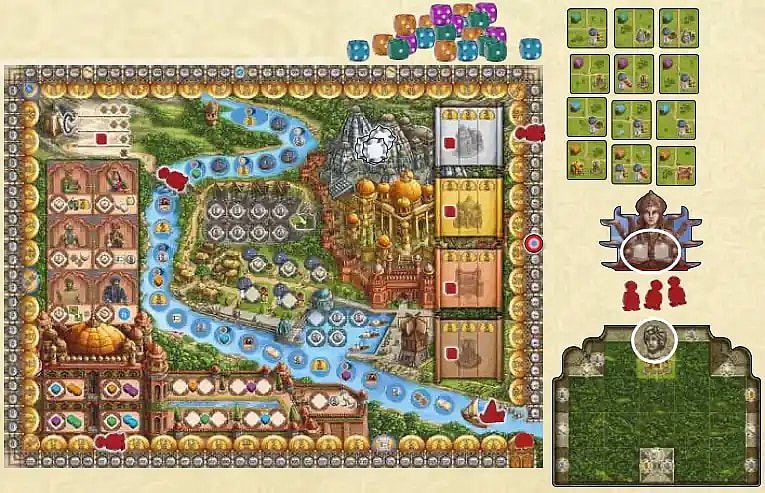
Gameplay
Rajas of the Ganges is played over several rounds. Each round, players take turns clockwise placing one worker, paying any costs, and immediately performing the action. The round continues until no player can place a worker, after which all workers are retrieved and a new round begins.
Worker Placement Areas
You may place workers in any of four areas:
- The Quarry – Build tiles in your province to earn Fame and Money.
- The Market – Earn Money by activating your market tiles.
- The Palace – Perform special actions, gain upgrades, or bonuses.
- The Harbor – Advance along the River for rewards.
Each Quarry and Harbor row is filled from left to right. At the Market and Palace, you may choose any unoccupied space.

Taking an Action
- Place a Worker.
- Pay any required cost (money and/or dice).
- Carry out the action immediately.
Each space can hold only one worker. Dice are never placed on the board; they remain on your Kali statue or in the general supply.
Paying Money
For each coin required, move your Money marker back one space. You cannot perform actions that cost more money than you have.
Dice Management
Dice represent resources.
- Whenever you gain dice, roll them immediately and place them on your Kali statue.
- You may store up to 10 dice (8 in the advanced game).
- You may voluntarily return dice to the supply to make room for new ones.
- If a color is unavailable in the supply, you cannot take that die.
Quarry (Building Actions)
Send workers to the Quarry to take and place Province Tiles.
- Pay the cost in Money (1–4) depending on which Quarry space you choose.
- Pay the Dice Cost shown on the tile (matching color and total value requirement). You may overpay.
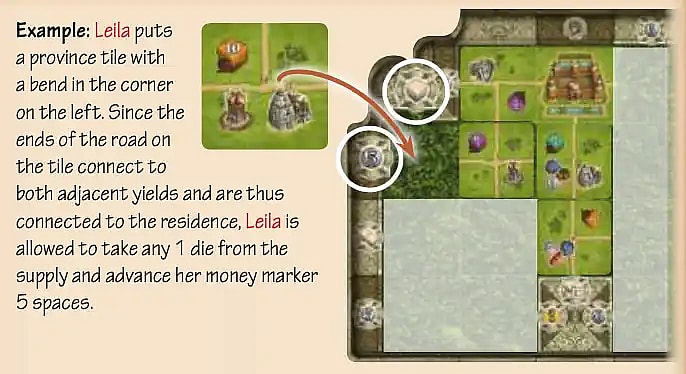
Then place the tile in your province, connecting at least one road to your residence. The tile may be rotated in any direction but must connect through a continuous road network.

Tile Scoring
Each tile provides immediate rewards:
- Markets → Earn the printed amount of Money.
- Buildings → Gain Fame points according to your current upgrade level for that building type (Temple, Palace, Fort, Mill).
- Mixed Tiles → Gain both Fame and Money.
Special Yields
Your Province board includes yield icons along its edges. When your road network connects one to your residence, you immediately gain its bonus (extra dice, Money, Karma, or upgrades).
Upgrading Buildings
You start with each building type at Level 2 (worth 2 Fame per building).
Upgrades increase their Fame value to 3 or 4 points.
You can upgrade in three ways:
- By visiting Raja Man Singh in the Palace (cost: a die showing “4”).
- By landing on a River space with an upgrade reward.
- By reaching the Upgrade bonus space (5) on the Fame Track.
Upgrades affect only buildings placed after the upgrade is made.
Market (Market Actions)
Earn Money by selling goods from your markets.
Two Market Spaces
- Assorted Goods:
Score one market of each type (Silk, Tea, Spices). Example:
You have three Tea markets and one Silk market. You score the Silk market and one Tea market for 5 Money. - Single Good:
Pay one die of any color. Score up to as many markets of one good as the value of the die used. Example:
Spend a die showing “4” → score up to 4 markets of one type.
In 3–4 player games, each player may occupy only one “Assorted Goods” space per round.
Palace Actions
Place a worker in the Great Mogul’s Palace to gain various benefits. Costs depend on the specific space.
Outer Terrace (Free)
- Gain 2 Money.
- Optionally reroll any number of your dice.
Inner Terrace (Free)
- Take 1 die of the color shown from the supply and roll it.
Balconies (Cost: 1 die of a specific color)
- Trade 1 die of the required color for 2 dice of another color.
Chambers (Cost: 1 die with exact number)
| Chamber | Die Value | Reward |
|---|---|---|
| Great Mogul | 1 | Gain 2 Fame & become next starting player |
| Dancer | 2 | Take any 2 dice & draw a White Yield Tile (resolve immediately) |
| Yogi | 3 | Gain 2 Karma & 1 die of your choice |
| Raja Man Singh | 4 | Upgrade one building & gain 3 Money |
| Master Builder | 5 | Cover a tile in your province with a more expensive one (pay difference in dice) |
| Portuguese | 6 | Move your boat forward exactly 6 unoccupied river spaces and take the reward |
Harbor (River Actions)
Spend a die showing 1, 2, or 3 to advance your boat that many unoccupied river spaces.
- A “1” moves 1 space
- A “2” moves 1–2 spaces
- A “3” moves up to 3 spaces
Each subsequent Harbor worker costs 1 or 2 Money to place.
Take the reward of the space you land on.
River rewards include:
- Gain 2 dice of any colors
- Gain 2 Karma
- Gain Money
- Perform a Palace action (without paying or using a worker)
- Upgrade a building
- Gain Fame
- Conduct a Market scoring
- Earn Money per Market
- Earn Fame per Upgrade or Karma
Only one boat may occupy each River space (except the starting and final spaces).

Karma
Karma lets you alter dice results.
- Spend 1 Karma to flip a die to its opposite face (1↔6, 2↔5, 3↔4).
- Max Karma: 3
- Gain Karma through Yogi (Palace), River spaces, or Fame Track bonus (space 24).
- Decrease Karma each time you use it.
Gaining New Workers
You start with 3 active workers. You can earn up to 2 more:
- Money Track (space 20)
- Fame Track (space 15)
- River Bridge
When you gain your second inactive worker, remove the remaining one of your color from the board permanently. Once activated, workers are never lost, even if your marker moves backward.
Bonus Spaces
Fame Track Bonuses
- Space 5: Upgrade a building type.
- Space 24: Gain +2 Karma.
- Space 31: Move your boat to the next unoccupied River space and take its reward.
Money Track Bonuses
- Spaces 12 & 44: Move your boat to the next River space and take its reward.
- Spaces 33 & 55: Gain 2 dice from the supply.
Use your personal Bonus Marker to track which Money Track bonus comes next.
End of a Round
After all players have placed their workers, retrieve them.
- The new starting player is whoever visited the Great Mogul.
- If not, the Elephant passes clockwise.
Begin a new round.
End of the Game
When any player’s Fame and Money markers meet or cross, the endgame is triggered.
Finish the current phase so all players take an equal number of turns.
If multiple players meet the condition, the one with the greatest overlap (difference between the two markers) wins.
In case of a tie, the player who triggered the end first wins.

Advanced Variant: Navaratnas
Once familiar with the base game, try the Navaratnas (Nine Gems) version:
- Use the back of the Province and Kali boards.
- Each player can use up to 6 workers and store up to 8 dice.
- Special Yields are weaker at first but can be upgraded with yield tiles.
- Introduces brown yield tiles and enhanced scoring conditions based on your progress (e.g., Fame per tile, Money per building, etc.).
- River Tiles can also modify specific River rewards for extra variety.
Strategy Tips
- Balance is everything: Advancing both Fame and Money is essential — favor one too much, and you’ll stall before crossing.
- Upgrade early: Stronger buildings yield significantly more Fame later.
- Dice economy: Avoid overpaying with high dice early; efficiency is key.
- Plan your roads: Connect special yields strategically to maximize bonuses.
- River timing: Prioritize spaces that align with your needs — Karma early, upgrades midgame, Fame late.
- Market chains: Build markets of one type for explosive scoring rounds.
- Use Karma wisely: Saving it for critical high-value tiles can change your trajectory.
Rajas of the Ganges FAQ
No. Bonuses already earned remain. You only trigger bonuses when reaching them the first time.
Yes, but never underpay. Overpaying can help manage unused dice.
Only at the starting and ending River spaces.
No. Only new tiles placed after upgrading gain the benefit.
No — 10 in the base game, 8 in Navaratnas.
You cannot take that color die until one returns to the supply.
Conclusion
Understanding the basic Rajas of the Ganges rules is the first step; the key to mastering how to play Rajas of the Ganges is timing your two scoring tracks. Remember, the game ends instantly when any player’s Fame track and Money track markers cross each other. Therefore, you must focus on efficient worker placement to acquire resources (dice), build valuable provinces and markets, and sail the river, all while managing the race between your two personal tracks. Strategize to build your engine, then push for the win by making your Fame and Money meet!
Browse Related Games!
 Official Paint The Roses Rules
 Official Daybreak Rules
 Official Jinx Rules
 Official Grand Austria Hotel Rules
 Official Meadow Rules
 Official Creature Caravan Rules
 Official Mycelia Rules
 Official Everdell Rules
 Official The Lord of The Rings: Duel for Middle-Earth Rules
Official Star Wars: Rebellion Rules
Official The Lord of The Rings: Duel for Middle-Earth Rules
Official Star Wars: Rebellion Rules
 Official TOSY Flying Ring Rules
 Official Santorini Rules