

Last Updated on September 2, 2025 by The Official Game Rules Team
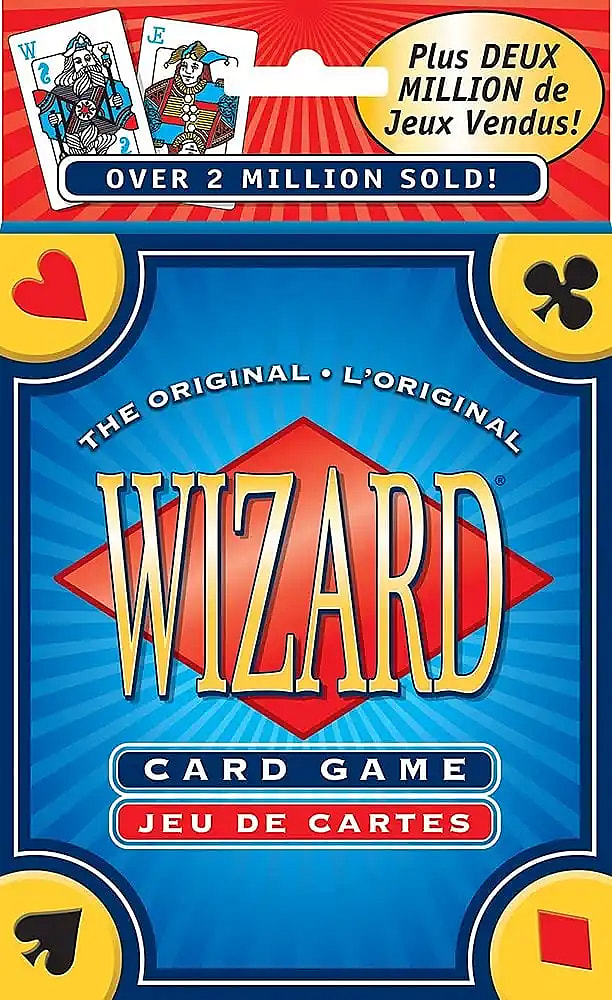
Wizard is a clever trick-taking card game for 3 to 6 players, created by Ken Fisher in 1984. The game is similar to Oh Hell but adds special cards—Wizards and Jesters—that completely change the dynamics. The goal is to predict exactly how many tricks you’ll win each round. Correct bids earn points, while incorrect ones cost you.
Games usually last 10–20 rounds, depending on the number of players, and the player with the highest score at the end wins.
This page contains affiliate links. For more information, see our disclosures here.
How to Play Wizard Card Game
The Deck
A Wizard deck has 60 cards:
- 52 standard cards (Aces high, 2s low)
- 4 Wizard cards (the strongest cards, always win a trick)
- 4 Jester cards (the weakest cards, always lose a trick unless only Jesters are played)
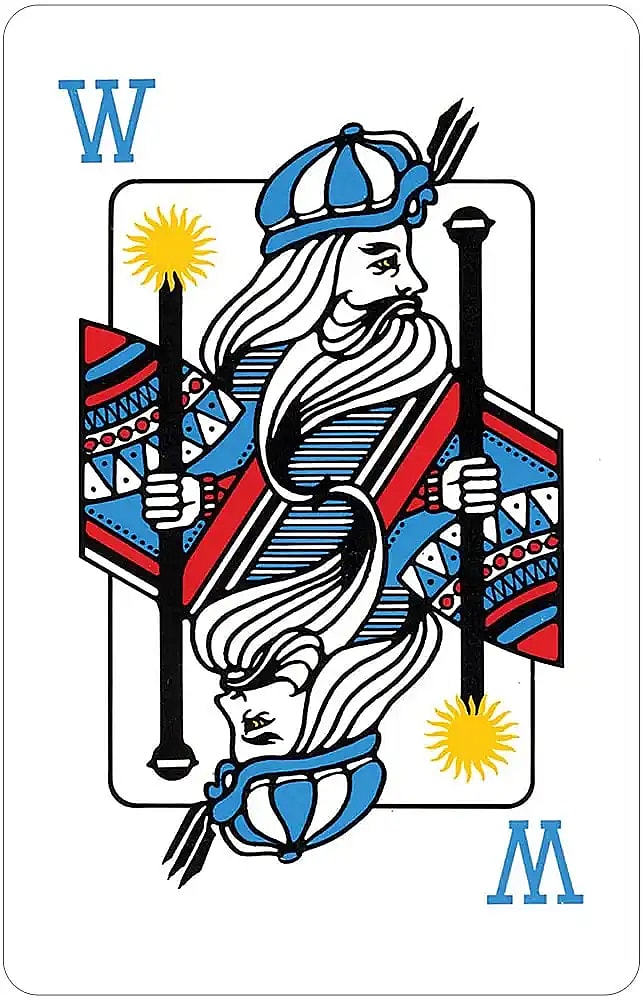
A wizard card
Setup & Dealing
- Round 1: each player gets 1 card.
- Round 2: each player gets 2 cards.
- This continues, increasing by one card each round until the maximum hand size is reached (depends on the number of players).
- After dealing, the top card of the remaining deck is flipped to reveal the trump suit.
- If a Wizard is revealed → the dealer chooses the trump.
- If a Jester is revealed → there is no trump that round.
Game length depends on the number of players:
- 3 players → 20 rounds
- 4 players → 15 rounds
- 5 players → 12 rounds
- 6 players → 10 rounds
Bidding
Starting with the player to the dealer’s left, each player declares how many tricks they believe they will take that round. Bids can range from 0 up to the number of cards in their hand. All bids are recorded.
Playing Tricks
- The player to the dealer’s left leads the first trick.
- Play continues clockwise. Players must follow suit if possible.
- Wizards and Jesters can be played at any time:
- Wizard: Beats all other cards in the trick. If multiple Wizards are played, the first Wizard wins.
- Jester: Always loses unless only Jesters are played; then the first Jester wins.
- If a Jester is led, the first non-Jester card played determines the lead suit.
- The winner of each trick leads the next.
Scoring
- Correct bid: 20 points + 10 points per trick taken.
- Incorrect bid: Lose 10 points for each trick over or under your bid.
Example:
- You bid 2 and win 2 tricks → 20 + (10×2) = 40 points.
- You bid 3 but win 1 trick → lose 20 points.
The player with the highest total score after the final round wins.
Strategy Tips for Wizard
Winning Wizard isn’t just luck—it’s about sharp bidding and smart play.
- Use Wizards Wisely: Don’t waste them too early unless you need to secure a critical trick.
- Jesters Are Shields: Great for dodging tricks when you bid low or zero.
- Track the Trump Suit: Keep count of high cards and Wizards left in play.
- Bid Zero Strategically: Risky but rewarding if you can avoid winning any tricks. Jesters are your best allies here.
- Plan for Endgame: In later rounds with large hands, anticipate how many tricks you can realistically win.
Wizard FAQ
Wizard is best with 3–6 players.
The dealer chooses the trump suit.
Yes, Wizards and Jesters can be played at any time, regardless of the lead suit.
The hook prevents the bids from perfectly matching the total number of tricks in play. This guarantees at least one player will miss their bid, adding tension and strategy.
You only get points equal to the number of tricks you actually won (no bonus).
Oh Hell is similar to these trick-taking games but unique in its variable hand sizes and the emphasis on exact bidding.
Depending on deal pattern and number of players, an Oh Hell game usually takes 30–60 minutes
Traditionally, no. But house rules can include them if you’d like (often used as high trumps).
Yes! Replace Wizards with jokers and Jesters with deuces (2s). It’s not perfect, but it works.
Theoretically, if you predict correctly every round, you’ll rack up maximum points. With six players, that’s over 600 points depending on the sequence.
Often yes. A correct bid of 1 is worth 30 points (20 base + 10 trick), while a 0 only yields 20. Statistically, bidding 1 is stronger if your card has a fair chance of winning.
Browse Related Games!
 Official Get ChurchED Rules
 Official Casting Shadows Rules
 Official Truc Rules
 Official Five Crowns Rules
 Official Twenty-Nine Rules
 Official Where Should We Begin? Rules
 Official Paco Rules
 Official Eleusis Rules
Official Belote Rules
Official Eleusis Rules
Official Belote Rules
 Official Piles Rules
 Official Coup Rules
Official Broken Ladder Rules
Official Coup Rules
Official Broken Ladder Rules