

Last Updated on January 13, 2026 by The Official Game Rules Team
Betrayal at the House on the Hill is a modular horror board game that combines cooperative exploration, random storytelling, and sudden betrayal. Players begin as a team of explorers uncovering a mysterious mansion. Midway through the game, one explorer turns against the others, triggering a unique horror scenario known as a Haunt. From that moment on, the game becomes a race between opposing objectives.
This guide explains every rule, phase, system, and exception, from the first step into the house to the final confrontation.

This post contains affiliate links. For more information, see our disclosures here.
How to Play Betrayal at the House on the Hill
Game Objective:
Before the Haunt
All players work together to:
- Explore the house
- Discover rooms
- Gain items
- Survive events
- Delay or prepare for the Haunt
There is no winner during this phase.
After the Haunt
The game becomes asymmetric:
- Heroes must complete a specific objective defined by the scenario.
- The Traitor must stop the heroes or fulfill a competing goal.
The first side to complete its objective immediately wins.
Player Count
- 3–6 players
- The game does not scale down below 3 players.
- Best balance is generally found at 4–5 players.
Game Components
House Tiles
- Divided into three floors:
- Ground Floor
- Upper Floor
- Basement
- Tiles are placed dynamically as players explore.
- Each tile has:
- Doorways (walls, doors, or open passages)
- A symbol (Event, Item, Omen, or none)
- Sometimes special text or rules
Cards
Event Cards
- One-time effects
- Often require trait rolls
- Can heal, damage, reposition, or alter stats
Item Cards
- Persistent equipment or consumables
- May modify traits, combat, or movement
- Some are lost after use; others remain permanently
Omen Cards
- Powerful and dangerous
- Advance the game toward the Haunt
- Each Omen increases Haunt probability
Character Cards & Figures
Each explorer has:
- A unique trait distribution
- A starting position on each trait track
- A plastic figure matching the character
Traits:
- Might – physical strength and melee combat
- Speed – movement distance
- Sanity – mental resistance and psychic combat
- Knowledge – intelligence, puzzle-solving, spellcasting
Each trait track includes:
- A skull icon indicating death if reached
- A highlighted starting value
Dice
- 8 custom dice
- Each die has faces showing:
- 0
- 1
- 2
- Dice are rolled for:
- Events
- Combat
- Haunt rolls
Setup
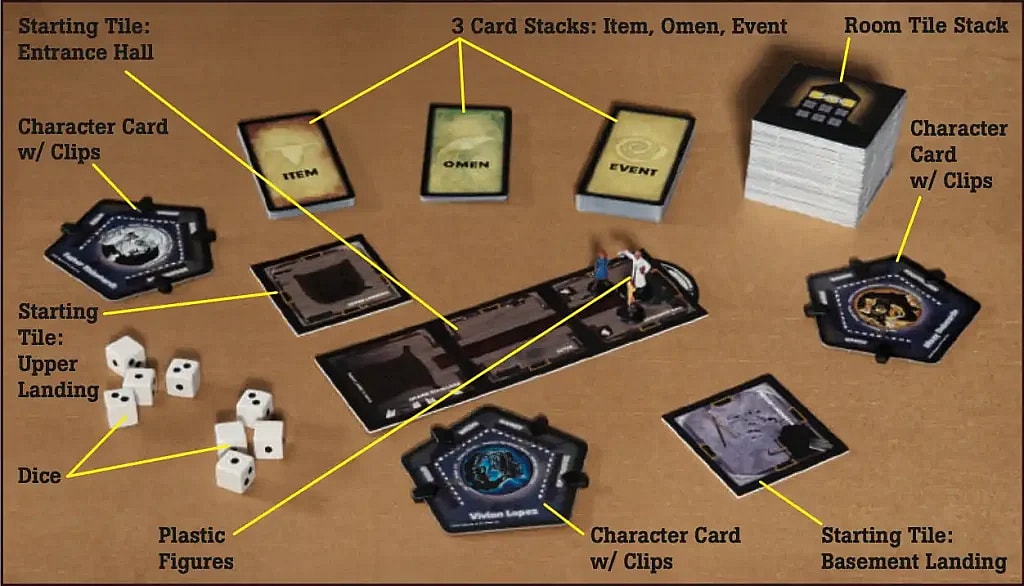
- Place the Entrance Hall tile in the center of the table.
- Separate room tiles into three stacks by floor and shuffle each.
- Shuffle Event, Item, and Omen decks separately.
- Each player:
- Chooses a character
- Places their figure in the Entrance Hall
- Sets trait sliders to starting values
- Place dice, tokens, and rulebooks nearby.
Exploration Phase (Pre-Haunt)
Players take turns clockwise. During this phase, all players are allies.
Turn Structure
Each turn consists of:
- Move
- Discover Rooms
- Resolve Symbols
- Optional Combat
- End Turn
1. Movement Rules
- You may move up to your current Speed value.
- You may move fewer spaces if you choose.
- Each room entered counts as one space.
- You may move back and forth freely unless restricted.
- You may not pass through:
- Blocked doorways
- Locked paths
- Missing connections
Floor Transitions
Movement between floors is only possible via special rooms:
- Staircases
- Elevators
- Chutes
- Collapses (one-way)
If a room allows vertical movement, follow the room’s text exactly.
2. Discovering Rooms
When entering a doorway with no tile:
- Draw the top tile from the correct floor stack.
- Rotate it so at least one doorway connects legally.
- Place it permanently.
- Immediately resolve its symbol, if any.
If no legal placement is possible, draw another tile.
3. Resolving Room Symbols
Event Symbol
- Draw an Event card
- Read aloud
- Follow instructions exactly
- Perform required trait rolls
Item Symbol
- Draw an Item card
- Keep it face up
- Items may be traded later
Omen Symbol
- Draw an Omen card
- Resolve its effect
- Perform a Haunt Roll
Trait Rolls Explained
Many effects require rolling dice equal to a trait.
Steps:
- Determine which trait is used.
- Roll dice equal to that trait’s current value.
- Sum results.
- Compare to the card’s chart.
Results may:
- Increase traits
- Decrease traits
- Move players
- Cause death or transformation
Haunt Roll (Critical System)
After resolving an Omen:
- Count total Omen cards revealed by all players.
- Roll that many dice.
- If the result is less than the number of Omens → Haunt begins.
This roll is skipped until at least one Omen is in play.
Transition to the Haunt Phase
When the Haunt triggers:
- Stop the game immediately.
- Identify:
- Which Omen caused it
- The room where it occurred
- Consult the Haunt Chart.
- Determine:
- Which Haunt number applies
- Who becomes the Traitor
Information Split (Critical Rule)
- The Traitor reads the corresponding entry in the Traitor’s Tome.
- The Heroes read the matching entry in Secrets of Survival.
- No information may be shared between sides unless explicitly allowed.
The Traitor (Deep Dive)
The Traitor:
- Is now an enemy of the Heroes
- May gain:
- New traits
- Special powers
- Monster control
- Immunities or restrictions
Some Haunts:
- Use multiple traitors
- Transform the traitor
- Allow traitor resurrection
The Traitor must follow their book exactly, even if it contradicts base rules.
Heroes (Deep Dive)
Heroes:
- Work together openly
- Share all information
- May trade items freely if in the same room
- May coordinate movement and attacks
Heroes often face:
- Limited time
- Dangerous monsters
- Environmental hazards
- Knowledge gaps
Haunt Phase Gameplay
Turn Order
- Heroes continue taking individual turns clockwise.
- The Traitor takes turns as specified.
- Monsters may act:
- On the traitor’s turn
- Or after each hero, depending on the scenario
Combat System (Fully Explained)
Combat occurs when hostile figures share a room.
Physical Combat
- Uses Might
- Both sides roll dice equal to Might
- Higher roll deals damage equal to the difference
- Damage reduces Might (unless stated otherwise)
Mental Combat
- Uses Sanity
- Same resolution method
- Damage reduces Sanity
Ranged & Special Attacks
- Only allowed if specified
- May ignore distance or walls
- Follow Haunt text precisely
Damage & Death
- When a trait reaches the skull:
- The character dies
- Remove figure unless scenario overrides
- Death may:
- Remove the player entirely
- Transform them
- Spawn a monster
Healing:
- Cannot exceed printed maximum
- Cannot heal past death
Monsters & Minions
Monsters:
- May be controlled by the Traitor
- May move independently
- Often ignore standard movement rules
Monster rules include:
- Speed
- Attack type
- Special immunities
- Spawn conditions
Always follow the Haunt description over base rules.
Special Conditions & Overrides
Many Haunts introduce:
- New movement rules
- Hidden information
- Environmental hazards
- Time limits
- Win condition changes
Haunt rules always override base rules.
Winning the Game
The game ends immediately when:
- Heroes complete their objective, OR
- The Traitor completes theirs
There are:
- No shared victories
- No points
- No tiebreakers
Strategy (Advanced)
Exploration Phase
- Spread out, but not recklessly
- Balance Omens vs preparation
- Avoid stacking damage on one player
As the Traitor
- Control information
- Delay hero objectives
- Use monsters to block paths, not just fight
As Heroes
- Identify objective quickly
- Assign roles
- Protect key players
Conclusion
Betrayal at the House on the Hill is not a single game, but a framework for dozens of horror stories. Its strength lies in uncertainty, shifting roles, and narrative chaos. By fully understanding both the exploration systems and the Haunt structure, players can embrace the tension rather than fight the rules.
Every visit to the house tells a different story—but someone always betrays you.
Browse Related Games!
 Official Clue Escape: The World’s Fair Rules
 Official Gaia Project Rules
 Official Concordia Rules
 Official The Lord of The Rings: Duel for Middle-Earth Rules
 Official TOSY Flying Ring Rules
 Official Mycelia Rules
 Official Codenames: Pictures Rules
Official Mastermind Rules
Official Codenames: Pictures Rules
Official Mastermind Rules
 Official Panda Royale Rules
 Official Castle Panic Rules
 Official House of Danger Rules
 Official Herd Mentality Rules