

Last Updated on February 3, 2026 by The Official Game Rules Team
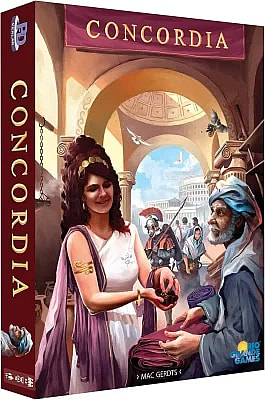
Concordia is a strategic Eurogame where players expand trade networks, establish colonies, and build economic power across the Roman Empire. Players use a deck of personality cards to perform actions such as moving colonists, constructing houses, trading goods, and expanding influence. Victory comes from efficiently managing resources, timing actions, and earning favor from ancient Roman gods.
If you’re learning how to play Concordia, this detailed guide covers setup, gameplay, personality cards, scoring, and strategy so you can fully understand and master the Concordia game rules.
Type: Economic | Players: 2-5 Players | Length: 45-90 minutes
This post contains affiliate links. For more information, see our disclosures here.
How to Play Concordia
Game Components
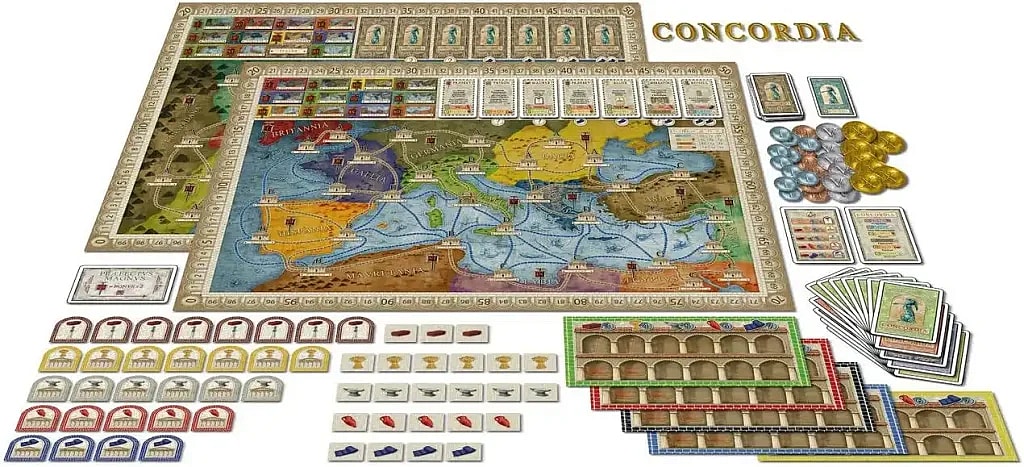
- Game Board: Double-sided (Imperium for 3–5 players / Italia for 2–4 players)
- 5 Player Storehouses
- 110 Wooden Pieces (in 5 colors) — Each player gets:
- 3 Land Colonists
- 3 Sea Colonists
- 1 Scoring Marker
- 15 Houses
- 80 Wooden Goods Tokens: Brick, Food, Tools, Wine, Cloth
- 72 Personality Cards:
- 35 Starting Cards (7 per player)
- 30 Cards for Sale (Decks I–V)
- 7 Concordia personality cards
- 30 City Tokens
- Coins (1, 2, 5, and 10 sestertii)
- 1 Concordia Card
- Praefectus Magnus Tile
- Rulebook
Game Setup
- Choose Board & Player Count:
- Use Imperium (3–5 players) or Italia (2–4 players).
- Distribute Components:
Each player receives:- 1 Storehouse
- 6 Colonists (3 land, 3 sea)
- 15 Houses
- 1 Scoring Marker
- 7 Starting Personality Cards (their hand)
- Prepare Goods & Coins:
Place all goods tokens and coins in separate supply piles. - Set Up Deck Display:
- Create the five decks of cards for sale (Decks I–V).
- Reveal the top four cards into the market display.
- Determine Starting Player:
Randomly select the start player. The player to their right receives the Praefectus Magnus tile. - Place Starting Colonists & Goods:
Each player places two colonists in Roma (one land, one sea) and begins with starting goods and coins as indicated in the quick setup guide.
Gameplay Overview
Turn Structure
Players take turns clockwise. On your turn:
- Play one Personality Card from your hand.
- Perform the corresponding action described on the card.
- Place the card face up in your personal discard pile.
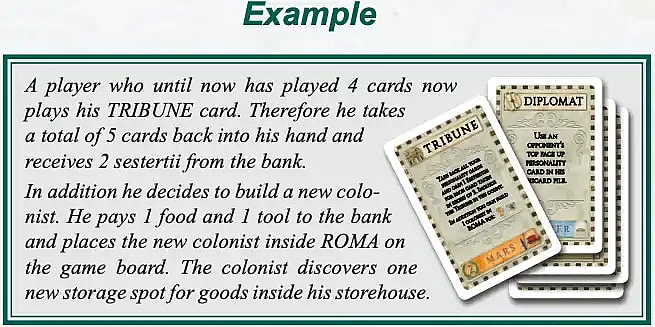
When your hand is empty or nearly empty, play the Tribune card to recover all previously played cards.
Personality Cards and Actions
Tribune
- Recover Cards: Take all previously played cards back into your hand.
- If you recover more than 3 cards (including the Tribune), gain 1 sestertius per additional card.
- Optional Colonist Purchase: Pay 1 food + 1 tool to place a new colonist (land or sea) in Roma.
Architect
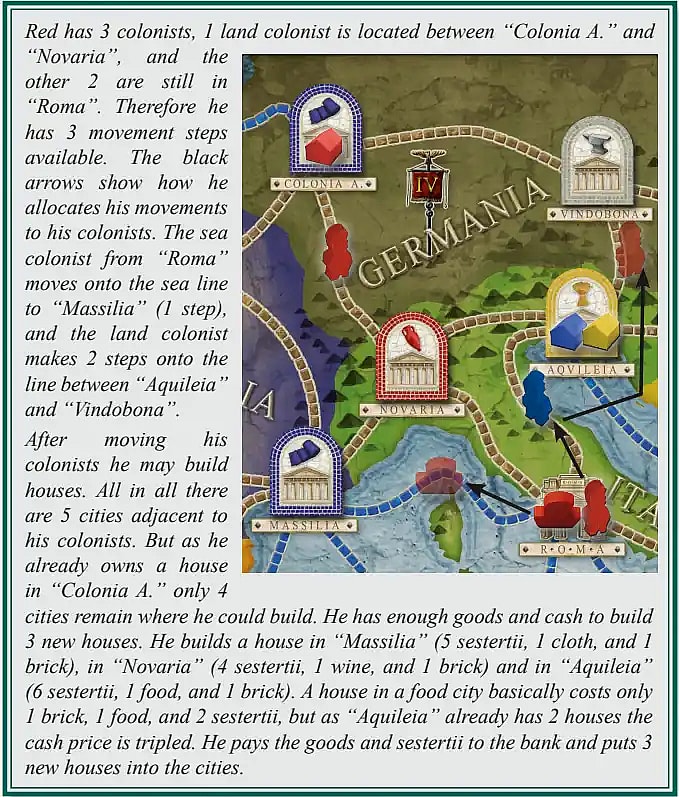
- Move Colonists:
You can move each colonist a number of steps equal to your total number of colonists on the board.- Land colonists move along brown lines, sea colonists along blue lines.
- You may move through occupied paths but not end on one.
- Build Houses:
After moving, build in cities adjacent to your colonists.- Goods Cost: 1 brick + the city’s specific good (except brick cities, which require only 1 food).
- Coin Cost:
- Brick city: 1 sestertius
- Food city: 2 sestertii
- Tool city: 3 sestertii
- Wine city: 4 sestertii
- Cloth city: 5 sestertii
- The coin cost is multiplied by the total number of houses in that city (yours + others) after construction.
- You can never build more than one house per city or in Roma.
Prefect
Choose one of two options:
a) Produce Goods in a Province
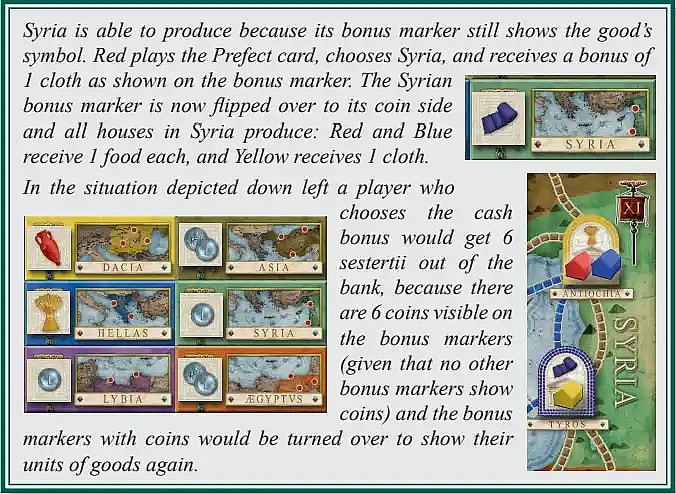
- Select a province whose bonus marker still shows its good symbol.
- Gain 1 of that good from the bank.
- Every house in the province (any player’s) produces 1 of its local good.
- Flip the province’s marker to its coin side.
b) Collect Cash Bonus
- Gain 1 sestertius per visible coin on flipped markers.
- Then, flip all province markers back to their goods side.
Praefectus Magnus: If you hold this tile, your chosen province produces double goods. After your turn, pass the tile to the player on your right.
Colonist
Choose one of two options:
a) Recruit Colonists:
- Pay 1 food + 1 tool per colonist placed.
- Colonists may be placed in Roma or in any city where you have a house.
b) Collect Income:
- Gain 5 sestertii plus 1 sestertius per colonist already on the board.

Mercator
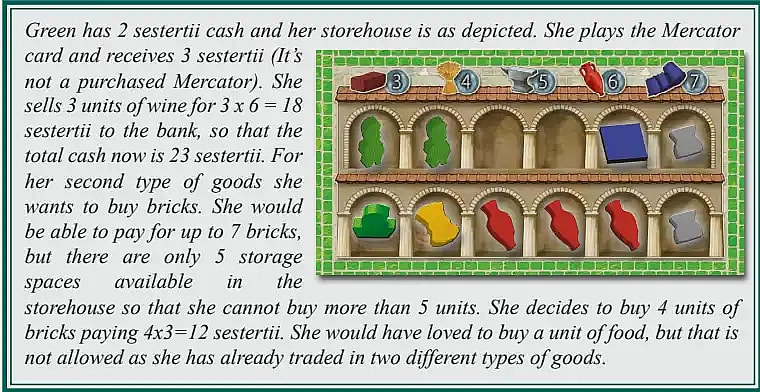
- Gain 3 sestertii (or 5 if you have multiple Mercator cards).
- Trade up to two types of goods with the bank:
- Buy or sell goods at fixed prices shown on the storehouses.
- Limited by available space in your storehouse (12 total slots).
Diplomat
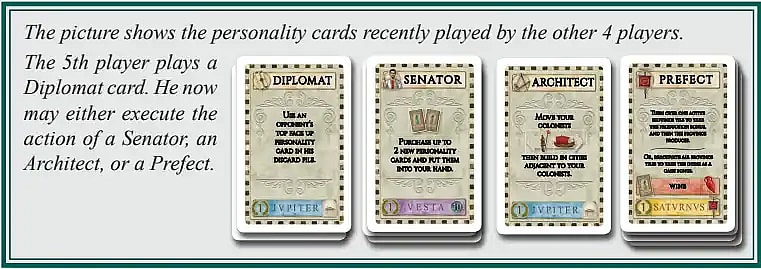
Copy the top card from another player’s discard pile (not their hand).
- You perform that card’s action as if it were your own.
- You cannot copy a player who just used Diplomat or Tribune this turn.
Senator
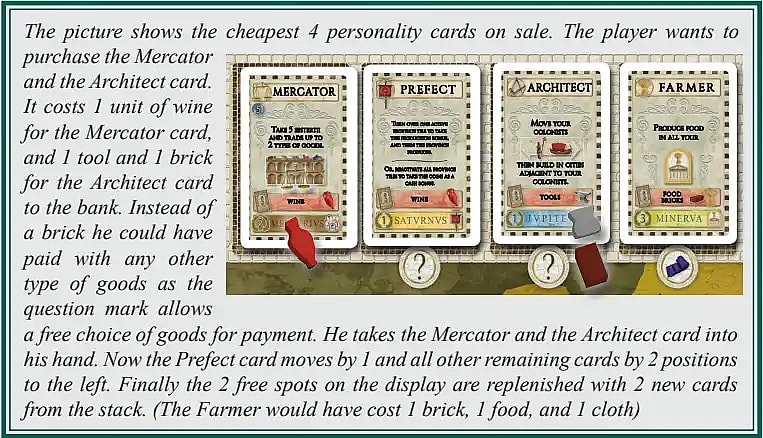
- Purchase up to two new personality cards from the market.
- Pay the cost shown on the card plus the goods below its market slot.
- Question mark symbols (?) represent any good of your choice.
- Refill the display afterward by sliding cards left and revealing new ones.
Consul
- Buy one personality card from the display.
- Pay only the cost printed on the card (ignore the cost below its position).
- Slide cards left and refill the display after the purchase.

Specialists (Mason, Farmer, Smith, Vintner, Weaver)
Each specialist produces one good for each of your houses that produces that resource.
For example:
- Mason → bricks
- Farmer → food
- Smith → tools
- Vintner → wine
- Weaver → cloth
The player has a total of 4 houses inside wine cities and plays the Vintner. She receives 4 units of wine and puts them on 4 empty storage spaces inside her storehouse. The other players do not receive any goods.
Storehouse Rules
- Each player’s storehouse holds 12 total spaces for goods or colonists.
- When colonists are placed on the board, their space becomes available for goods again.
- Players cannot discard goods voluntarily to make room, except when receiving excess.
Intermediate Scoring (Optional)
When a player uses their Tribune for the first time, they may trigger Intermediate Scoring.
- Score points according to the same rules as Final Scoring.
- After all players have done so, award bonuses:
- Highest scorer: 2 sestertii
- Second place: 1 sestertius
- Reset scoring markers to 0 afterward.
This step is optional for experienced players.
Game End
The game ends when either:
- A player builds their 15th house, or
- A player buys the last personality card from the display.
That player takes the Concordia Card (worth 7 VP). All other players take one final turn before final scoring.
Final Scoring
Each personality card represents a Roman god, who grants victory points based on your accomplishments.
| God | Condition | Points |
|---|---|---|
| Vesta | 1 VP per 10 sestertii (cash + goods value) | Variable |
| Jupiter | 1 VP per house in non-brick cities | Max 15 |
| Saturnus | 1 VP per province with your houses | Max 12 |
| Mercurius | 2 VP per type of good you produce | Max 10 |
| Mars | 2 VP per colonist on the board | Max 12 |
| Minerva | Points per city type, as shown on specialist cards | Varies |
Add the 7 VP Concordia Card bonus (if earned).
The player with the highest total wins.
Ties go to the player with the Praefectus Magnus, or to the next eligible player clockwise.
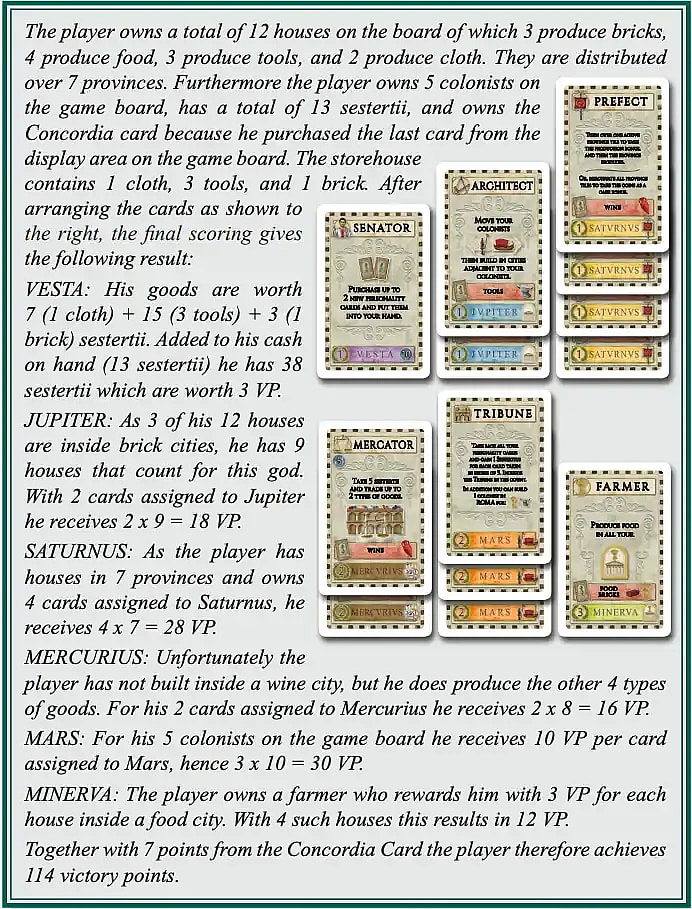
Scoring Example:
Strategy Tips
- Diversify Provinces: Expanding into multiple provinces maximizes your Saturnus scoring.
- Efficient Movement: Use your Architect wisely — plan builds where you can use the same movement for multiple cities.
- Balance Your Deck: Buy cards that complement your current strategy and scoring gods.
- Use the Diplomat: Copy strong plays, like Prefect or Senator, to benefit without spending your own cards.
- Manage Storehouse Space: Keeping room for high-value goods can make late-game trades far more profitable.
Concordia FAQ
Yes. You can move through, but not stop on, lines occupied by other colonists.
No. You may only build if there’s at least one open house slot.
You must have all required goods and coins before constructing.
No, Tribunes and recently used Diplomats cannot be copied.
Yes, their value is added to your Vesta scoring total (1 VP per 10 sestertii equivalent).
Conclusion
To successfully play Concordia, mastering the Concordia rules and the core mechanics of personality cards is essential. By strategically utilizing your colonists, carefully managing your resources, and efficiently building houses, you will expand your influence across the Roman provinces.
Understanding how to play Concordia revolves around selecting the most advantageous personality cards each turn to optimize production, trade, and settlement. Ultimately, the path to victory lies in accumulating the most diverse set of scoring opportunities provided by the various Roman gods and the final bonus from the Concordia card.
Browse Related Games!
 Official Everdell Rules
 Official Settlers of Catan Rules
 Official Minute of Fun Rules
 Official Mancala Rules
 Official Gaia Project Rules
 Official Power Grid Rules
 Official The Lord of The Rings: Duel for Middle-Earth Rules
 Official Creature Caravan Rules
 Official Rajas of The Ganges Rules
 Official Aquatica Rules
 Official Pilgrim Rules
 Official TOSY Flying Ring Rules