

Last Updated on August 20, 2025 by The Official Game Rules Team
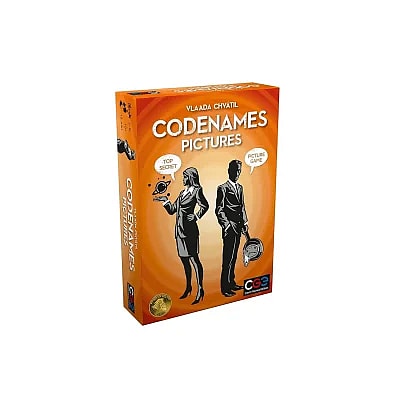
Codenames: Pictures is a variant of the original Codenames game. Instead of using words as secret codenames for agents, this version uses pictures. The objective is the same: your team must identify all your agents based on clues from your spymaster while avoiding the assassin.
This post contains affiliate links. For more information, see our disclosures here.
How to Play Codenames: Pictures
OVERVIEW
Players: 4 or more (two teams of at least 2 players each)
Ages: 10+
1. Components
- 20 picture cards (selected for each game from a larger deck)
- Key cards showing agent assignments
- Agent cards: red and blue for each team
- Innocent bystander cards
- Assassin card
- Stand for the key card
- Instructions
2. Game Setup
2.1 Team Formation
- Divide players into two teams of roughly equal size and skill.
- Each team selects a spymaster, who will give the clues.
- The remaining players are field operatives, tasked with guessing the pictures.
- Spymasters sit on the same side of the table; field operatives sit across from them.
Minimum 4 players (2 per team) are required for standard gameplay.
2.2 Preparing the Picture Grid
- Randomly draw 20 picture cards.
- Place the pictures in a 5 × 4 grid on the table.
- Orient all cards correctly using the upper-left corner marker to ensure consistency with the key card.
2.3 Choosing the Key
- Shuffle the key cards and randomly select one.
- Place the key on the stand visible only to the spymasters.
- The key corresponds exactly to the grid, showing which pictures belong to:
- Red team agents
- Blue team agents
- Innocent bystanders
- The assassin
Field operatives must not see the key under any circumstances.
2.4 Agent Cards and Starting Team
- Place red agent cards in front of the red spymaster and blue agent cards in front of the blue spymaster.
- The starting team receives one extra agent card since they have 8 agents to find instead of 7.
- Place the innocent bystander and assassin cards between the spymasters for easy access.
- The starting team is indicated by lights on the sides of the key card.
3. Objective
- Be the first team to correctly identify all your agents.
- Avoid selecting innocent bystanders, enemy agents, or the assassin.
- Using logic, deduction, and the spymaster’s clues, field operatives try to reveal their team’s agents while the spymaster provides one-word clues paired with a number.
4. Game Turn Overview
Each team alternates turns. A turn consists of one clue from the spymaster and one or more guesses by the field operatives.
4.1 Giving Clues
- The spymaster thinks of a word that relates to one or more of their team’s pictures.
- The spymaster also provides a number, indicating how many pictures relate to the clue.
- Example: “Evolution: 2” → two pictures are related to evolution.
- Clues should not include hyphens or spaces, though proper nouns, abbreviations, and wordplay may be allowed if agreed upon by the group.
- Spymasters cannot give hints beyond the word and number, make facial expressions, or point at pictures.
Tips for Clues:
- Linking multiple pictures with a single word is encouraged.
- Avoid clues that reference card position, color, or layout.
- Clues may be abstract (e.g., “Night: 2” for pictures related to darkness or evil).
4.2 Field Operatives’ Guesses
- Operatives discuss the clue and touch the picture they believe matches.
- The spymaster reveals the identity by placing the corresponding card:
- Team agent: Cover with team’s agent card. Operatives may guess again.
- Innocent bystander: Cover with bystander card. Turn ends immediately.
- Enemy agent: Cover with enemy agent card. Turn ends immediately.
- Assassin: Cover with the assassin card. Team immediately loses the game.
Rules for Guessing:
- Operatives may make guesses up to the number given by the clue plus one additional guess.
- They may choose to stop guessing at any time.
- The extra guess allows teams to catch up on missed pictures from previous turns.
4.3 Ending the Turn
A team’s turn ends when:
- A wrong guess occurs (innocent bystander, enemy agent, or assassin).
- Operatives voluntarily stop guessing.
- Operatives reach the maximum number of guesses allowed (clue number + 1).
5. Winning the Game
- The first team to have all their agent pictures covered wins.
- A team touching the assassin before covering all their agents loses immediately.
- It is possible to win during the opponent’s turn if they complete your last remaining picture.
6. Advanced Gameplay Options
6.1 Assassin Ending Variant
- Teams must identify all agents and the assassin to win.
- If the assassin is contacted and your team still has uncovered agents, operatives get unlimited guesses on that turn.
- Wrong guesses during this sudden-death turn result in immediate loss.
6.2 Expert Clues
- Unlimited: The number in the clue can be “unlimited,” letting operatives guess as many pictures as they want.
- Zero (0): Indicates none of your pictures relate to that clue. Operatives may still make guesses freely.
6.3 Two-Player Variant
- Play cooperatively on a single team against a simulated opponent.
- Spymaster controls which enemy agents are covered on the opponent’s turns.
- Scoring can be based on remaining enemy agent cards.
6.4 Three-Player Variant
- Two spymasters compete while one operative works for both teams.
- The operative must balance guessing for both sides.
- The winning spymaster is determined as usual.
7. Strategy Tips
7.1 For Spymasters
- Avoid nonverbal hints or giving away information accidentally.
- Link multiple agents to a single clue when possible.
- Balance safe clues with risky, high-reward connections.
7.2 For Field Operatives
- Discuss clues thoroughly but avoid overthinking unrelated pictures.
- Remember previous clues to identify missed agents.
- Focus on the table; avoid eye contact with the spymaster.
8. Setup for Subsequent Games
- Remove agent, bystander, and assassin cards.
- Flip the 20 picture cards face-up again.
- Select a new key card for the next round.
- Teams may rotate spymasters to give everyone a chance.
9. Combining with Original Codenames
- You can play mixed games with both words and pictures.
- Either the 5 × 4 or 5 × 5 grid may be used.
- The Assassin Ending can be applied in all setups.
Codenames: Pictures FAQ
A team may guess up to the number indicated by the spymaster plus one extra guess. For example, if the clue is “Evolution: 2,” the team can make up to three guesses. This extra guess allows teams to attempt pictures missed in previous turns.
By default, no. The clue must be a single word without hyphens or spaces. Some groups allow exceptions for proper nouns (e.g., James Bond) or compound words (e.g., scuba diver), but all players should agree on any modifications before the game begins.
No. Clues must relate to the meaning of the pictures, not their layout, color, or letters. For instance, “3” for the three cards closest to your operatives is not valid. However, abstract associations like “Night” for dark or evil-themed pictures are valid.
Standard game: The team immediately loses. Assassin Ending variant: The team may continue guessing unlimited times on that turn to try and cover all their remaining agents. Any wrong guess ends the turn and results in a loss.
Yes, operatives may debate and discuss the clue among themselves, but the spymaster must remain neutral, showing no reaction or guidance.
No. Once the key card is revealed to the spymaster, they must not touch any pictures or make gestures that hint at their locations.
Two-player variant: One player acts as spymaster, the other as field operative. The opponent team is simulated by the spymaster covering enemy agent cards strategically. Three-player variant: One operative works for both spymasters. The spymasters compete normally.
Yes. You may use either the 5 × 4 or 5 × 5 grid with words, pictures, or a combination. Clues must be valid for the format you are using.
Yes. If a previous clue was missed, operatives may guess those pictures during their next turn. The extra “+1 guess” rule allows teams to attempt one more picture beyond the current clue’s number.
Unlimited: Field operatives may guess as many pictures as they believe relate to the clue.
Zero (0): Indicates that none of your team’s agents relate to that clue. Operatives may still guess freely. Both variants require strategic thinking and are recommended for experienced players.
The lights on the sides of the key card indicate the starting team. The starting team has 8 agents to find, while the other team has 7.
No. Clues must only relate to your team’s agents. Associating a clue with the assassin or opposing team’s agents is not allowed.
Operatives may stop guessing at any time during their turn. This can be strategic if they are unsure and want to avoid hitting an innocent bystander, enemy agent, or assassin.
Browse related games!
 Official Clue: Conspiracy Rules
 Official 3 Ring Circus Rules
 Official Mancala Rules
 Official Aquatica Rules
 Official Gaia Project Rules
 Official Creature Caravan Rules
 Official Pilgrim Rules
 Official Guess Who? Rules
 Official TWANGLED Rules
 Official Mycelia Rules
 Official Crocodile Dentist Rules
 Official Telestrations After Dark Rules