

Last Updated on January 12, 2026 by The Official Game Rules Team
Carcassonne is a modern tile-laying board game designed by Klaus-Jürgen Wrede. Players build a shared medieval landscape using tiles that form roads, cities, monasteries, and fields, then place meeples to claim and score those features. The player who scores the most points by the end of the game wins.
Players: 2–5
Age: 7+

This post contains affiliate links. For more information, see our disclosures here.
How to Play Carcassonne
Components
- 84 Land tiles showing roads, cities, monasteries, and fields
- 40 meeples (8 each in yellow, red, green, blue, and black)
- 5 abbots (1 per color, not used in the first game)
- 1 scoreboard
Some tiles have a darker back, including the start tile and River tiles. Set River tiles and abbots aside for your first few games.
Setup
- Place the start tile face up in the center of the table.
- Shuffle all remaining land tiles and place them face down in several stacks within reach of all players.
- Each player chooses a color and takes 7 meeples as their personal supply.
- Place each player’s remaining meeple on space 0 of the scoreboard to track points.
- Return unused colors and abbots to the box.
- Choose a starting player, often the youngest player.
You are now ready to begin.
Goal of the Game
Players take turns placing tiles to expand the landscape. By placing meeples onto features, players claim roads, cities, monasteries, and later fields. Points are scored during the game when features are completed, and again at the end for unfinished features. The player with the highest score wins.
Turn Structure
On your turn, you always follow these steps in order:
- Place a tile
- Optionally place a meeple
- Score any completed features
Then play passes clockwise to the next player.
1. Placing a Tile
Draw one land tile and place it face up so that all edges match the surrounding landscape.
- Roads must connect to roads
- City walls must connect to city walls
- Fields must continue fields
If a tile cannot be legally placed anywhere, return it to the box and draw a new one.
2. Placing a Meeple
After placing a tile, you may place one meeple from your supply onto that tile.
Meeples can be placed as:
- Highwaymen on roads
- Knights in cities
- Monks in monasteries
You may only place a meeple if that feature does not already contain another meeple, even if it belongs to another player. Placing a meeple is optional.
3. Scoring Features
Scoring happens immediately after tile placement if your tile completes a feature.
Roads
A road is complete when both ends are closed by a city, village, monastery, or by looping back on itself.
- Score 1 point per tile in the road
- The player with the most highwaymen scores the points
- Ties share full points
- Meeples return to their owner’s supply
Cities
A city is complete when it is fully enclosed by walls with no gaps.
- Score 2 points per tile
- Each coat of arms adds 2 bonus points
- The player with the most knights scores the city
- Ties share full points
- Meeples return to supply
Monasteries
A monastery is complete when it is surrounded by all 8 adjacent tiles.
- Score 1 point for the monastery tile plus 1 point for each surrounding tile, up to 9 points
- The monk returns to the player’s supply
Multiple Meeples in One Feature
Even though you cannot place a meeple into an occupied feature, multiple meeples can end up in the same road or city later if tiles connect them together.
When this happens:
- The player with the most meeples scores the feature
- If tied, all tied players score full points
- All meeples involved return to their owners after scoring
This creates opportunities for clever takeovers and shared scoring.
Game End and Final Scoring
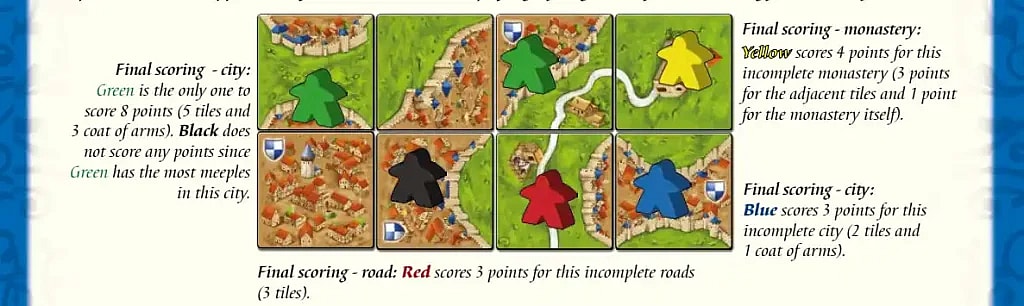
The game ends after the player who placed the final tile finishes their turn. Then all remaining incomplete features are scored.
Final Scoring Rules
- Incomplete roads: 1 point per tile
- Incomplete cities: 1 point per tile and 1 point per coat of arms
- Incomplete monasteries: 1 point for the monastery plus 1 point per adjacent tile
- Fields: 3 points per completed city bordering the field
Field scoring uses farmers, which are best introduced after a few learning games.
Winning the Game
After final scoring, the player with the highest total score wins. In case of a tie, the tied players share the victory.
Final Thoughts
Carcassonne is easy to learn but offers deep strategic choices as players compete for control of shared features. Once you are comfortable with roads, cities, and monasteries, adding farmers and expansions opens up even more tactical depth.
Browse Related Games!
 Official Rajas of The Ganges Rules
 Official Nemesis Rules
 Official Magnetic Chess Game with Stones Rules
 Official Calico Rules
 Official Gaia Project Rules
 Official Root Rules
 Official Everdell Rules
Official Star Wars: Rebellion Rules
Official Everdell Rules
Official Star Wars: Rebellion Rules
 Official DCeased: Gotham City Outbreak Rules
 Official The Lord of The Rings: Duel for Middle-Earth Rules
 Official Mancala Rules
 Official Jinx Rules