

Last Updated on February 26, 2026 by The Official Game Rules Team
1–4 Players | 40–100 Minutes | Ages 10+
In Everdell, players take on the role of forest creatures building their own woodland city beneath the towering Ever Tree. Across the seasons, you’ll collect resources, construct buildings, invite charming critters, and complete grand events. When winter returns, the player with the most prosperous city wins.

This post contains affiliate links. For more information, see our disclosures here.
How to Play Everdell
Components
- 1 Game Board
- 1 Ever Tree
- 24 Workers (6 per player)
- 4 Basic Event Tiles
- 11 Forest Cards
- 16 Special Event Cards
- 128 Critter & Construction Cards
- 20 Occupied Tokens
- 30 Berries
- 30 Twigs
- 25 Resin
- 20 Pebbles
- 30 Point Tokens (20 × 1-point, 10 × 3-point)
- 1 Victory Card
- 1 Eight-Sided Die (for Solo Play)
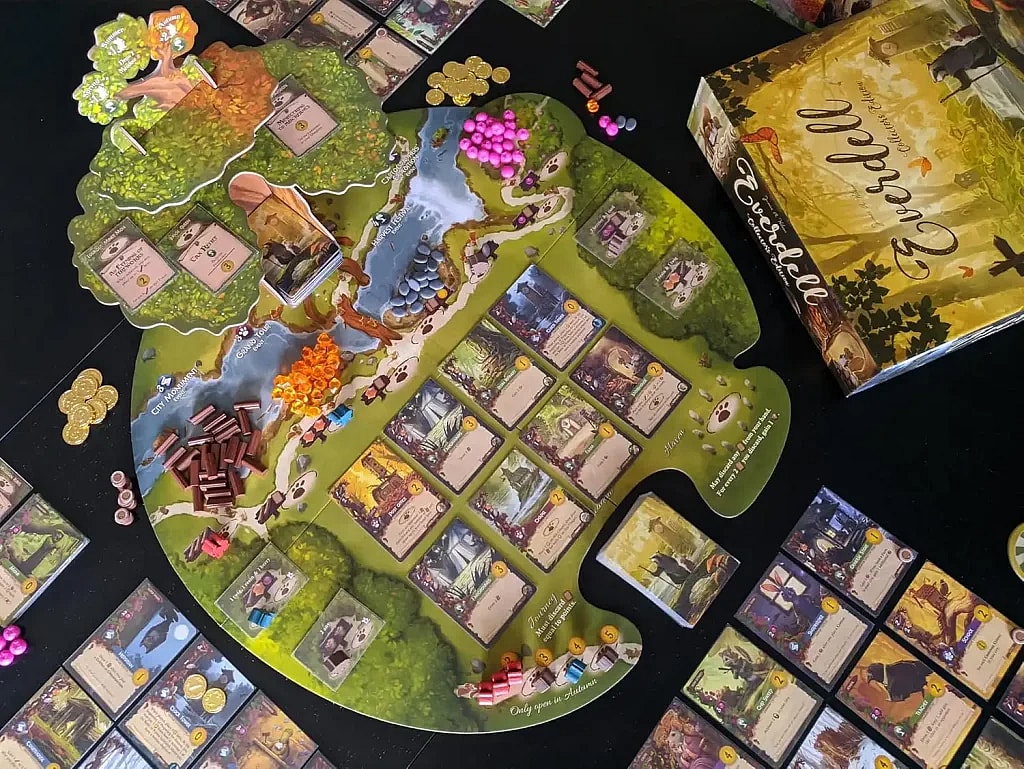
Setup
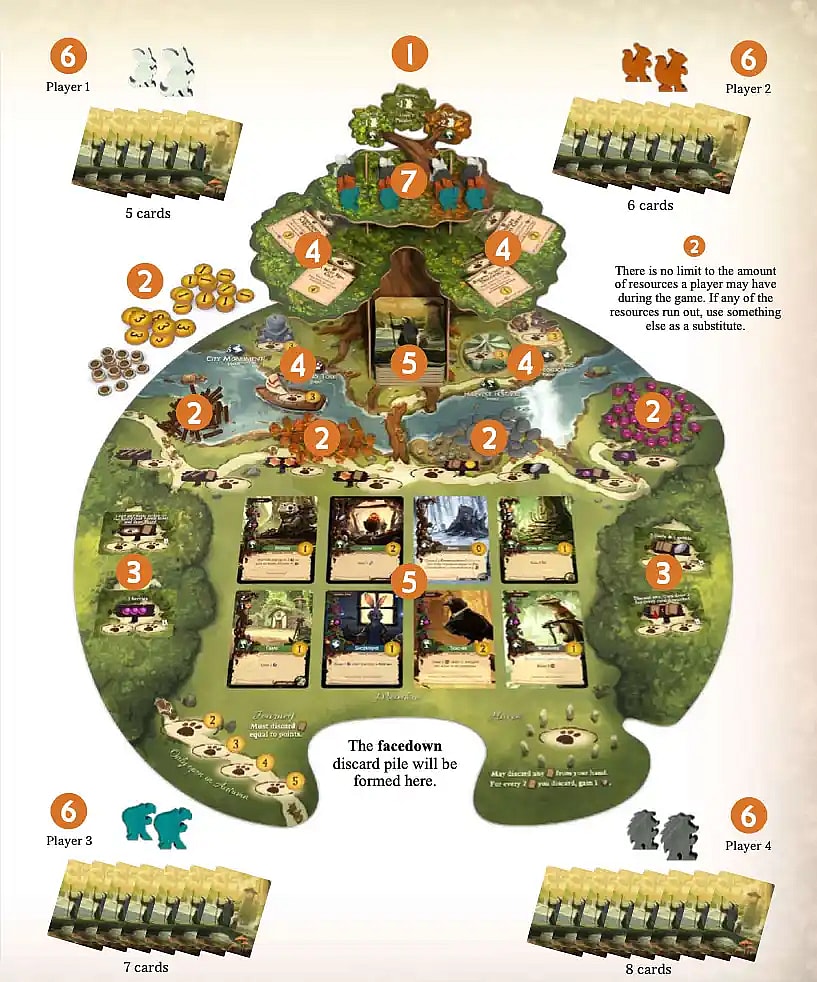
- Board and Ever Tree:
Place the board in the center of the table and assemble the Ever Tree, positioning it in the slot at the top of the board. - Resources and Tokens:
Place the Twigs, Resin, Pebbles, and Berries in piles along the riverbank. Keep Point Tokens and Occupied Tokens beside the board. - Forest Cards:
Shuffle the Forest Cards and place them on the forest clearings.- 2 Players → Use 3 Forest Cards.
- 3–4 Players → Use 4 Forest Cards.
Return any unused cards to the box.
- Events:
Place the 4 Basic Event Tiles along the river. Shuffle the Special Event Cards and reveal 4 on the lower branches of the Ever Tree. Return the remaining Special Event Cards to the box. - Meadow and Deck:
Shuffle the Main Deck and place it inside the Ever Tree. Reveal 8 cards face-up to form the Meadow. - Player Setup:
Each player chooses a color and takes 2 workers.- 1st player draws 5 cards
- 2nd player draws 6
- 3rd player draws 7
- 4th player draws 8
- 1 on Spring
- 1 on Summer
- 2 on Autumn
- Starting Player:
The most humble player goes first.
Objective
Your goal is to build the most prosperous woodland city before the end of the year. Points are earned from cards in your city, Events, Journey spaces, and tokens.
Gameplay
Play proceeds clockwise. On your turn, you must perform one of the following actions:
- Place a Worker
- Play a Card
- Prepare for Season
1. Place a Worker
Workers are used to gather resources, activate abilities, and achieve Events.
Location Types
- Basic Action Spaces: Found along the board’s riverbank; provide common resources or cards.
- Forest Locations: Provide special combinations of resources. Only used in games with 4 players unless otherwise stated. You may not place more than one of your own workers on the same Forest location.
- Exclusive Spaces: Marked with a closed ring. Only one worker may occupy these.
- Shared Spaces: Marked with an open ring. Any number of workers, even of the same color, may use them.
To use a location, place one of your workers on the space and immediately collect its listed benefits. The worker remains there until retrieved during Prepare for Season.
Destination Cards
Some cards in your city feature the Destination icon.
- You or your opponents may place workers on these cards.
- If an opponent places a worker on your card, you gain 1 point token from the supply.
Events
You may also send a worker to claim a Basic Event or Special Event, provided you meet its requirements.
- Pay any listed resource cost when placing the worker.
- Only one player may claim each Event.
- Place completed Events beside your city for endgame scoring.
The Haven
A shared space with no limit on workers.
- Discard any number of cards to gain 1 resource for every 2 cards discarded.
The Journey (Autumn Only)
During Autumn, you may send a worker on a Journey to score extra points.
- Discard cards equal to the point value shown (2–5).
- The worker remains there and is worth that many points at game’s end.
- 2-point space is shared; all others are exclusive.
2. Play a Card
You may play one card from your hand or the Meadow by paying its resource cost.
Cards are placed in your city (a tableau in front of you).
Each city may hold a maximum of 15 cards, not counting Events.
Card Types
- Critters (require Berries)
- Constructions (require Twigs, Resin, Pebbles)
![A visual example from the board game Everdell comparing a Construction Card and its paired Critter Card. On the left is the Courthouse (Unique Construction) card, which costs 7 twigs, 1 resin, and 2 pebbles, and is worth 2 victory points. On the right is the Judge (Unique Critter) card, which is free to play if the player already has the Courthouse construction (indicated by the arrow) or costs 3 berries. It is also worth 2 victory points and has a special ability: "When you play a Critter or Construction, you may replace 1 [resource] with 1 [resource]." Both cards show their requirements, name, type, points, and card text for a detailed comparison of the free play mechanism.](https://officialgamerules.org/cdn-cgi/image/width=758,height=494,fit=crop,quality=90,gravity=auto,sharpen=1,metadata=none,format=auto,onerror=redirect/wp-content/uploads/2025/10/everdell-criters.webp)
You may play multiple copies of Common cards, but only one copy of each Unique card.
Playing a Critter for Free
If you already have the related Construction (shown in the top-left corner of the Critter), you may play that Critter without paying its Berries cost.
When you do this, place an Occupied Token on the Construction — it can only be used this way once.
3. Prepare for Season
When you’ve placed all available workers and cannot take further actions, you must Prepare for Season. Retrieve all workers from the board and gain new ones based on the season:
Spring
- Gain 1 new worker
- Activate all Green (Production) cards in your city
Summer
- Gain 1 new worker
- Draw up to 2 Meadow cards
- Green cards still activate if newly played this season
Autumn
- Gain 2 new workers
- Activate all Green (Production) cards again
The game begins in late Winter and ends after Autumn. You cannot Prepare for Season again once you’ve entered Winter.
Card Color Guide
| Color | Type | Activation |
|---|---|---|
| Tan | Traveler | Activates once immediately |
| Green | Production | Activates when played and in Spring/Autumn |
| Red | Destination | Activates when a worker is placed on it |
| Blue | Governance | Provides discounts or bonuses |
| Purple | Prosperity | Worth base and bonus points at game end |
Hand and Draw Rules
- You can never exceed 8 cards in hand.
- If you must draw while holding 8 cards, stop drawing when you reach 8.
- When playing Meadow cards, immediately replace them with new ones from the deck.
- If the deck runs out, shuffle the discard pile to form a new one.
End of the Game
When you can no longer perform actions (or choose not to), you pass.
Once all players have passed, the game ends.
Scoring
Add up:
- Base points from cards in your city
- Points from Events
- Journey points
- Point tokens
- Prosperity card bonuses
The player with the highest total wins.
Ties are broken by:
- Most Events achieved
- Most leftover resources
Example Final Score
| Category | Points |
|---|---|
| Cards | 22 |
| Tokens | 14 |
| Prosperity Bonuses | 10 |
| Journey | 4 |
| Events | 12 |
| Total | 62 |

Solo Mode: The Battle with Rugwort
In solo play, you face Rugwort, a troublesome rat rival who sabotages your plans across three “years.”
Setup
- Rugwort uses the black workers.
- Set up as for a two-player game.
- You start with 5 cards; Rugwort has none.
- Block his starting locations:
- 1 worker on the top-left Forest card
- 1 worker on the “3 Twigs” space
Rugwort’s Turn Rules
Each time you play a card, Rugwort also plays one.
- Roll the 8-sided die to determine which Meadow card (1–8) he plays.
- Place it in his city by color type; its text doesn’t matter.
- Replace the Meadow card after his play.
Rugwort’s Seasons
After you perform Prepare for Season, Rugwort immediately follows these steps:
- If he qualifies for any Basic Events, he claims them.
- Takes a new worker and places it on a specific Meadow card (1 for Spring, 2 for Summer, 3–4 for Autumn).
- Moves workers to new Forest spaces based on the season.
- In Autumn, sends a worker to the 3-point Journey space.
Scoring Rugwort
- 2 points per card (3 for Purple Prosperity)
- 3 points per Basic Event
- 3 (or more in later years) per unclaimed Special Event
- 3 points for Journey space
- Points from any tokens you gave him
Year Two: Rugwort the Rotten
- Worker on 4-point Journey space
- Gains 6 points for each Special Event you failed to achieve
Year Three: Rugwort the Rapscallion
- Worker on 5-point Journey space
- During Autumn, he kidnaps one of your workers — remove both from the game!
Defeat him in Year Three to restore peace to Everdell!
Strategy Tips
- Plan Season Timing Carefully: Don’t rush into the next season; squeeze every possible action from your current workers.
- Keep Your Hand Flexible: Avoid clogging your hand early. Play production cards first to generate long-term value.
- Use Critter Discounts Efficiently: Always try to play Critters using their linked Constructions.
- Balance Resource Gathering and Building: Too much hoarding wastes turns; aim to build momentum.
- Watch Opponents’ Cities: Compete for shared Events and block high-value Destinations.
- Late Game Focus: Prosperity cards and Journey points can make or break your score.
Everdell FAQ
No, only one card per turn, unless a special ability allows otherwise.
You stop drawing at 8 cards — extra draws are lost.
No, only when played during Summer or during Spring/Autumn.
No, Events are placed beside your city and do not count.
Yes, it’s a shared location with no limit.
Conclusion
So that’s the big picture on how to play Everdell! At its heart, the game is all about building the best little forest city over four seasons. Don’t worry about trying to master all the tiny Everdell rules right away—the most fun part is finding those awesome Critter and Construction card combinations that let you do cool, unexpected things. Just remember to use your workers wisely to collect resources, and keep an eye on when the time is right to “prepare for the next season” to grab your extra workers and trigger those bonuses. Have fun growing your valley!
Browse Related Games!
 Official Pilgrim Rules
 Official Paint The Roses Rules
 Official Jinx Rules
 Official Mancala Rules
 Official Grand Austria Hotel Rules
 Official Gaia Project Rules
 Official The Lord of The Rings: Duel for Middle-Earth Rules
 Official Magnetic Chess Game with Stones Rules
 Official Guess Who? Rules
 Official Creature Caravan Rules
 Official Meadow Rules
 Official TOSY Flying Ring Rules