

Last Updated on January 13, 2026 by The Official Game Rules Team
Wavelength is a creative and strategic card game where players work to guess a hidden wavelength of colors based on clues provided by their teammates. Using a color spectrum, players place cards in an attempt to match the target color, balancing clues and guesswork. The game encourages teamwork, communication, and a bit of color theory knowledge. In this guide, we’ll explain the rules and share tips to help you make accurate guesses and win in Wavelength!

This post contains affiliate links. For more information, see our disclosures here.
How to Play Wavelength (Complete Rules & Strategy Guide)
Object of the Game
The goal of Wavelength is to score points by placing the dial as close as possible to the center of the target area. One team member, known as the Psychic, gives a clue based on the spectrum shown on a wavelength card, and the rest of the team adjusts the dial’s position to match where they believe the target is hidden. Teams earn points based on accuracy, while the opposing team can also score by correctly predicting whether the target lies to the left or right of the dial.
Components
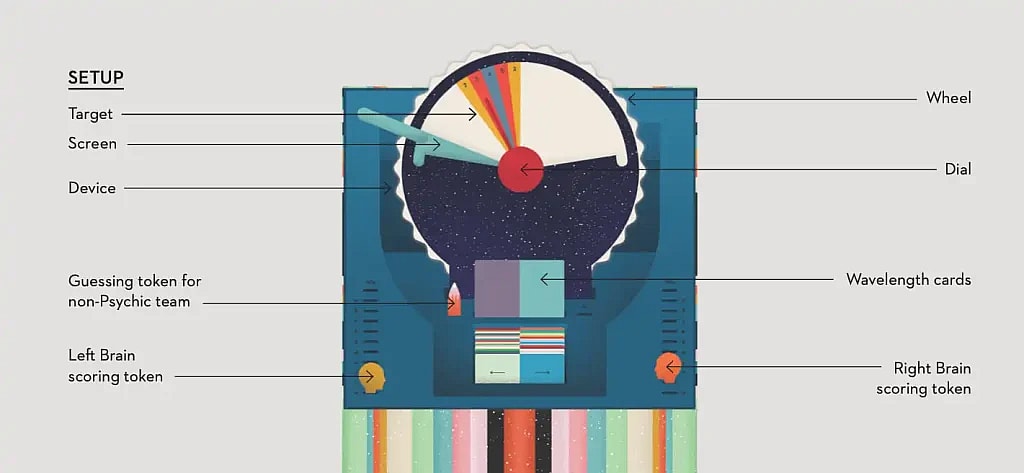
- Wavelength device (dial, screen, and rotating wheel)
- Deck of wavelength cards
- Score markers
- Guessing marker
- Colored point wedges
- Box tray with a slot in the middle of the box
The game is played entirely inside the box—nothing needs to be removed during play.
Setup
- Place the device into the slot in the middle of the box tray.
- Insert the guessing marker and score markers into their designated spaces.
- Divide players into two evenly sized teams.
- Choose a new Psychic for each team for the first round.
- The team going first starts at 0 points; the other team starts at 1 point.
You’re now ready to begin.
Game Overview
Wavelength is played over multiple rounds. Each round consists of four main phases:
- Psychic Phase
- Team Guess Phase
- Left / Right Guess Phase
- Scoring Phase
Teams alternate rounds, switching Psychics each time.
Psychic Phase
The Psychic is the clue-giver for their team.
- Close the screen completely so the target is hidden behind the blue screen.
- Draw a wavelength card from the deck and choose which side to use.
- Place the card in front of the device so both teams can see the spectrum.
- Spin the wheel randomly to determine the target’s location.
- Open the screen fully and view where the center target wedge lies.
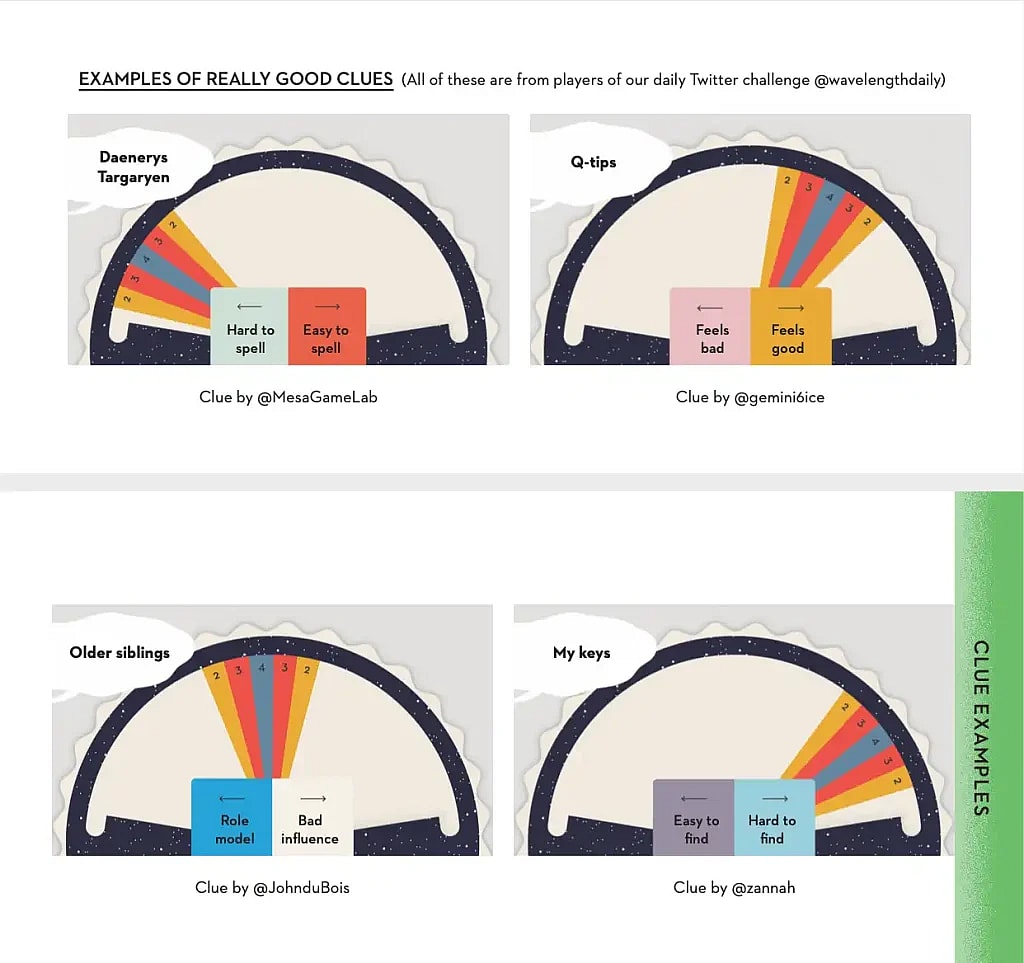
- Give a clue that fits conceptually on the spectrum (for example, hot – cold).
- Close the screen again and rotate the box so it faces your team.
Once the clue is given, the Psychic must remain silent and expressionless.
Team Guess Phase
The Psychic’s team discusses the clue and collectively decides where to rotate the dial.
- Any guesser may turn the dial.
- Discussion is open and unrestricted.
- Avoid using numbers or percentages—use intuitive language instead.
When the team agrees, they finalize the dial’s position.
Left / Right Guess Phase
The opposing team now gets a chance to score.
They must decide whether the center of the target area is to the left or right of the dial.
They place the guessing marker in the appropriate slot next to the wavelength card.
This guess is quick and binary—left or right only.
Scoring Phase
The Psychic opens the screen to reveal the target.
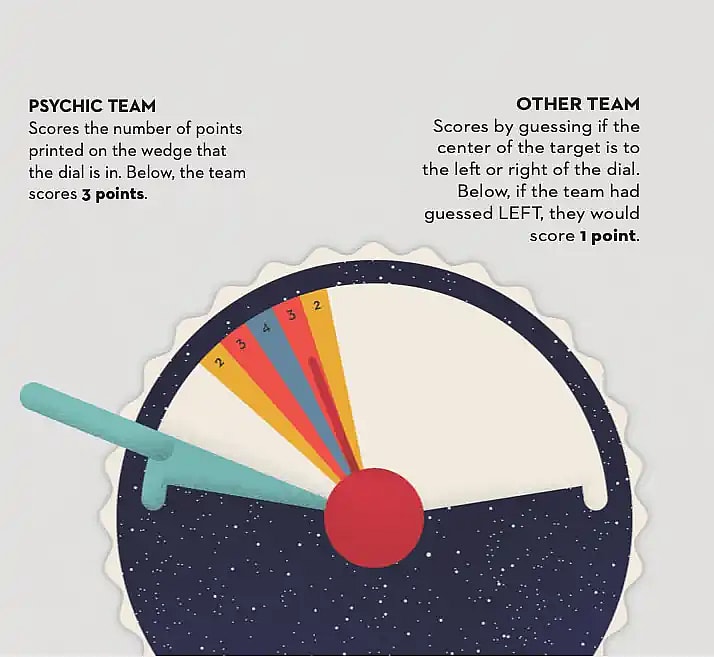
Psychic Team Scoring
- Score points based on which colored wedge the dial landed in (2–4 points).
- If the dial is on an edge, score the higher value.
- A perfect center hit earns maximum points.
Opposing Team Scoring
- Score 1 point if they correctly guessed left or right.
- No points are awarded if the Psychic team hits the exact center.
Move each team’s score markers accordingly to update the team score.
Clue-Giving Guidelines
To keep the game fair and fun:
- Keep clues concise (five words or fewer).
- Avoid modifiers like “very,” “slightly,” or “kind of.”
- Use proper nouns when appropriate.
- Stay strictly on the spectrum shown—no wordplay, puns, or indirect hints.
Strategy Tips
- Think spatially, not literally—where does your idea feel like it belongs?
- Avoid extreme clues unless the target is clearly near an edge.
- Teams should argue ideas openly; disagreement improves accuracy.
- As the Psychic, think about how your team interprets concepts.
- When guessing, aim for the center unless you’re very confident otherwise.
Cooperative Mode (Optional)
In cooperative play, all players form one team.
- Place 7 random wavelength cards in the card slot.
- Skip the left/right guessing phase.
- The game ends when the deck runs out.
- Use the cooperative score chart to evaluate performance, from “Are you sure it’s plugged in?” to “Galaxy brain.”
This mode works especially well with 2–5 players.
End of the Game
The game ends when players reach an agreed score or finish the cooperative deck. The team with the higher score wins, though many groups treat Wavelength as more about discussion than competition.
Frequently Asked Questions
Wavelength works best with 4–12 players but can be enjoyed with as few as 2 using cooperative mode.
No. Once the clue is given, the Psychic must stay silent.
Yes. The Psychic team scores based on accuracy, and the opposing team can score by guessing left or right.
Ignore any visible wedges that are not part of the center target.
Final Thoughts
Wavelength is a rare party game that combines intuition, psychology, and teamwork into a simple but deeply engaging experience. Whether played competitively or cooperatively, it encourages discussion and reveals how differently people interpret the same ideas. If you enjoy Wavelength, you may also like Just One, another social guessing game built around shared intuition.
You may also like
 Official Murder of a Millionaire Rules
 Official Gaia Project Rules
 Official TOSY Flying Ring Rules
Official Mycelia Rules
Official TOSY Flying Ring Rules
Official Mycelia Rules
 Official TWANGLED Rules
 Official Clue Escape: The World’s Fair Rules
 Official Creature Caravan Rules
 Official Crocodile Dentist Rules
 Official The Lord of The Rings: Duel for Middle-Earth Rules
 Official Chinese Checkers Rules
 Official Pilgrim Rules
 Official The Night Cage Rules