

Last Updated on June 5, 2026 by The Official Game Rules Team
The Horse Race board game is a fast-paced betting and dice game that captures the excitement of the racetrack without requiring any real-world knowledge of horse racing. Whether you’re completely new to the sport or already familiar with how racing and wagering work, this game is easy to learn and quick to play.
At its core, the game blends luck, simple betting mechanics, and light strategy. Much of its appeal comes from the wagering element—players build a shared pot and hope their chosen horses cross the finish line first. Over time, players have developed enhanced variations that introduce more decision-making and strategic depth. This guide covers both the traditional rules and an expanded version that adds drafting, special cards, and greater player control.

This post contains affiliate links. For more information, see our disclosures here.
How to Play Horse Race
Game Design and Components
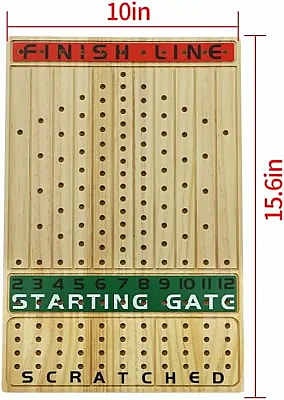
Most Horse Race board games feature a handcrafted wooden track with numbered lanes representing horses (typically 2 through 12). Many boards include a built-in storage box for cards, dice, and chips.
Standard Components
- Wooden race track board
- 11 numbered horses (2–12)
- 2 six-sided dice
- A deck of playing cards
- Poker chips or coins (for betting)
You’ll also need a flat surface and enough space to roll dice comfortably.
Objective of the Game
Win chips by holding cards that match the horse that reaches the finish line first—or by moving the winning horse yourself in the advanced variation.
Standard Rules
Setup
- Place all horses at the starting gate.
- Remove Kings, Aces, and Jokers from the deck.
- Shuffle the remaining 44 cards (2–10, Jacks, Queens).
- Deal the cards evenly among players.
- Decide on betting currency (chips or coins).
- Each player contributes an agreed starting ante into the main pot.
Scratching the Horses
Before the race begins, four horses are removed (scratched).
- The player to the left of the dealer rolls the dice.
- Add the two dice together.
- The total equals the horse that is scratched.
- Move that horse aside—it is out of the race.
- Players discard any matching cards and pay one chip per discarded card into the pot.
- Repeat until four horses have been scratched.
This reduces the field from 11 to 7 horses.
The Race
Players take turns clockwise:
- Roll both dice.
- Add the numbers together.
- Move the matching horse forward one space.
- If the roll matches a scratched horse, the player pays one chip into the pot instead.
Continue until one horse reaches the finish line.
Winning the Race
Players holding cards that match the winning horse split the pot evenly.
You may play:
- A single race (split pot immediately), or
- A series of eight races, tracking wins. After eight rounds, the player with the most wins takes the final accumulated pot.
Ties can be resolved with a final tiebreaker race or by splitting winnings.
Advanced Variation (Enhanced Rules)
Some players felt the original version lacked decision-making and described it as “a game that plays you.” The enhanced version adds drafting, special card powers, escalating antes, and a secondary Jockey Pot.
Revised Deck Construction
Unlike the traditional setup, this variation always includes Kings and Aces. Jokers are added depending on player count. Each player must receive an equal number of cards, and leftover cards are set aside face-down.
Card Roles
- 2–10, Jack (11), Queen (12): Represent horses
- King: Pass a Scratch ante to another player
- Ace: Cancel a Scratch ante
- Joker: Move any horse forward or backward one space
Drafting Phase
- The dealer distributes cards.
- Players choose one card to keep face-down.
- Pass the remaining hand to the left.
- Repeat until all cards are selected.
This drafting phase introduces strategic choices:
- Collect multiple cards of one horse?
- Diversify across many horses?
- Stockpile Aces and Kings to avoid penalties?
Ante and Jockey Pot
Players agree on:
- Base ante (into main race pot)
- Jockey Pot ante (separate pool)
The Jockey Pot goes to the player who moves the winning horse across the finish line—regardless of whether they hold that horse’s card.
Scratching with Escalating Antes
Four horses are scratched before the race.
Each scratch has a position (1st, 2nd, 3rd, 4th).
The ante penalty increases by scratch position:
- 1st scratch: 1× base ante per matching card
- 2nd scratch: 2× base ante
- 3rd scratch: 3× base ante
- 4th scratch: 4× base ante
This builds the pot significantly and shrinks hands before racing begins.
An alternate scratching method rotates the roller and increases penalties if a scratched horse is rolled again.
The Race (Advanced)
Players roll two dice and move the corresponding horse.
If the roll matches a scratched horse:
- Pay the appropriate escalating ante.
Advantage Die
If a player rolls doubles:
- They receive an Advantage Die.
- On a future turn, they roll 3 dice and choose any 2 to add.
- Only one Advantage Die may be used per turn.
This adds tactical flexibility.
Playing Special Cards
After rolling:
- Kings pass a Scratch penalty left or right.
- Aces cancel a passed penalty.
- Jokers move a horse forward or backward one space.
Jokers cannot be played in the same turn as a King or Ace.
Passed penalties double each time they are passed.
End of the Race
When a horse crosses the finish line:
- The mover wins the Jockey Pot.
- Remaining Kings, Aces, Jokers, and unused Advantage Dice must be discarded with penalties:
- Advantage Die: 1×
- King: 2×
- Ace: 3×
- Joker: 4×
- The main pot is divided into shares based on winning horse cards in play.
Leftover chips go to the Jockey Pot winner.
Strategy Tips
1. Draft Intentionally
In small games, focusing on a few horses increases payout potential. In larger groups, diversification reduces risk.
2. Manage Penalty Cards
Kings and Aces help avoid antes—but holding them too long risks costly endgame penalties.
3. Use Jokers Wisely
Jokers can swing close races. Saving them for late-game positioning is often powerful.
4. Watch Probabilities
Some numbers appear more frequently with two dice (7 is most common). However, scratching four horses changes odds dramatically.
Adjust your strategy based on which horses remain.
5. Consider Board Balancing
Some players modify their boards by filling peg holes to create more balanced winning distributions.
FAQ
No. The game requires no prior understanding of real-world racing.
Typically 10–20 minutes per race.
A separate prize awarded to the player who moves the winning horse to the finish line.
Yes. Poker chips or tokens work perfectly.
It adds strategy but remains easy to learn.
For most games: 100 × $1 chips, 100 × $0.50 chips, 300 × $0.25 chips. Larger groups may require more.
Conclusion
The Horse Race board game delivers quick excitement through simple dice rolling and betting mechanics. The traditional version is easy for families and casual players, while the enhanced drafting and card-powered variation introduces meaningful strategic decisions without overcomplicating the experience.
Whether you prefer a straightforward race of chance or a more tactical showdown with escalating stakes and player interaction, this game offers flexibility and plenty of table-side suspense. If you’ve only played the basic version, try the advanced rules to add variety and give players more control over how the race unfolds.
Browse Related Games!
 Official The Night Cage Rules
 Official Mancala Rules
 Official Gaia Project Rules
 Official Guess Who? Rules
 Official The Lord of The Rings: Duel for Middle-Earth Rules
 Official Dixit Rules
 Official Creature Caravan Rules
 Official Pilgrim Rules
 Official TOSY Flying Ring Rules
 Official Mycelia Rules
 Official Aquatica Rules
 Official Battleship Reloaded Rules