

Last Updated on February 26, 2026 by The Official Game Rules Team
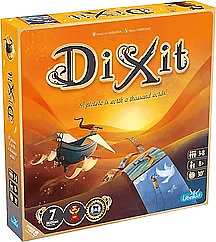
Dixit is a creative storytelling card game where imagination matters more than logic. Using beautifully illustrated image cards, players take turns giving clues (spoken phrases, sounds, or even songs), that hint at one of their cards. The rest of the table responds with images of their own, trying to blend in just enough to confuse others while still earning points.
Dixit works equally well with families, casual players, and creative game nights. Every round tells a miniature story, making Dixit as much a shared experience as it is a competitive game.
This post contains affiliate links. For more information, see our disclosures here.
How to Play Dixit: In-Depth Guide
Components
Inside the box, you’ll find:
- 1 game board with a scoring track
- 84 illustrated image cards
- 36 voting tokens in six different colors, numbered 1 to 6
- 6 wooden rabbit pawns (often called rabbeeples)
Setup
- Each player chooses a wooden rabbit and places it on space 0 of the scoring track.
- Shuffle all 84 image cards.
- Deal 6 cards face down to each player. Keep your hand secret at all times.
- Place the remaining cards face down to form a draw pile.
Voting Tokens by Player Count
- 4 players: each player takes voting tokens numbered 1–4
- 5 players: each player takes voting tokens numbered 1–5
- 6 players: each player takes voting tokens numbered 1–6
Objective of the Game
Score the most points by successfully giving and interpreting clues. Players earn points by guessing the storyteller’s card correctly or by convincing others to vote for their own misleading cards.
Gameplay Overview
The game is played in turns. Each turn consists of:
- Choosing a storyteller
- Giving a clue
- Selecting matching cards
- Voting
- Scoring
- Drawing back up to six cards
The Storyteller Phase
One player acts as the storyteller for the turn.
The storyteller:
- Looks at the six image cards in their hand
- Chooses one card
- Creates a sentence, phrase, sound, or reference inspired by that image
The clue can be:
- One word or multiple words
- A quote, proverb, or movie title
- A sound, short melody, or abstract idea
The storyteller says the clue aloud but does not reveal the chosen card.
For the very first turn of the game, the first player who volunteers a clue becomes the initial storyteller.
Choosing Cards
All other players:
- Review the six cards in their hand
- Choose the one image that best matches the storyteller’s clue
- Hand their selected card face down to the storyteller
The storyteller:
- Collects all submitted cards plus their own
- Shuffles them together
- Places them face up in a row in the center of the table
Cards are numbered from left to right, starting with 1.
Voting Phase
The non-storyteller players now attempt to identify which card belongs to the storyteller.
Each player:
- Secretly selects a voting token matching the number of the card they believe is the storyteller’s
- Places the token face down in front of themselves
Important rules:
- The storyteller does not vote
- You may not vote for your own card
Once everyone has voted, all voting tokens are revealed and placed on the corresponding cards.
Scoring
Points are awarded based on how well the clue was balanced.
If everyone or no one finds the storyteller’s card:
- The storyteller scores 0 points
- All other players score 2 points
If some—but not all—players find the storyteller’s card:
- The storyteller scores 3 points
- Each player who guessed correctly scores 3 points
Bonus Points
- Every non-storyteller player scores 1 point for each vote placed on their own card
Players move their rabbit forward on the scoring track based on the total points earned that turn.
End of Turn
At the end of the turn:
- Each player draws one card to return their hand to six cards
- The storyteller role passes to the player on the left
- Play continues clockwise
End of the Game
The game ends when the final card from the draw pile has been taken. All players finish the current turn, then compare scores.
The player whose rabbit is farthest along the scoring track is the winner.
Strategy Tips for Dixit
- As the storyteller, aim for clues that are neither too obvious nor too obscure
- If everyone guesses your card, you earn nothing
- If no one guesses your card, you still earn nothing
- Pay attention to other players’ thinking styles and reference points
- As a non-storyteller, choose cards that feel plausible but not too perfect
- Earning bonus votes on your card can be just as valuable as guessing correctly
Over time, learning how each player interprets images becomes a key part of winning.
Game Variations
3-Player Variant
- Each player starts with 7 cards instead of 6
- Each non-storyteller submits two cards instead of one
- Five cards total are displayed each round
Scoring change:
- If only one player finds the storyteller’s card, both that player and the storyteller score 4 points instead of 3
Mimes or Music Variant
Instead of speaking, the storyteller may:
- Mime an idea related to the image
- Sing or hum a short tune
All other rules remain the same.
Custom Variants
Players are encouraged to mix variants or invent house rules to suit their group’s creativity and comfort level.
FAQ
Dixit supports 3 to 6 players using the standard rules.
Yes, as long as it is not explicitly descriptive of the image and is shared aloud.
No. Dixit has no objectively correct interpretations—only successful or unsuccessful clues.
It can be either. Dixit works well as a relaxed party game or a light strategy game, depending on the group.
Conclusion
Dixit is a celebration of imagination, interpretation, and shared storytelling. With simple rules, expressive artwork, and endless creative possibilities, every game feels different from the last. Whether you’re crafting the perfect clue or trying to outthink your friends’ logic, Dixit rewards creativity more than convention.
If you enjoy Dixit, you may also like other creative party and storytelling games such as Mysterium, Balderdash, or Apples to Apples—all of which encourage players to think beyond the obvious and enjoy the art of interpretation.
Browse Related Games!
 Official Mancala Rules
 Official Gaia Project Rules
 Official The Lord of The Rings: Duel for Middle-Earth Rules
 Official Pilgrim Rules
 Official Meadow Rules
 Official TOSY Flying Ring Rules
 Official Creature Caravan Rules
 Official Mycelia Rules
 Official Clue Escape: The World’s Fair Rules
 Official Bamboo Rules
 Official Guess Who? Rules
 Official Battleship Reloaded Rules