

Last Updated on March 1, 2026 by The Official Game Rules Team
Jewel Box is a thoughtful tile-placement game where players collect colorful beetles and arrange them into a personal grid. Each beetle family scores points in a different way, so smart placement matters just as much as luck. With simple turns, shared choices, and layered scoring, Jewel Box rewards careful planning and flexible strategy.
Want to learn faster? Checkout the video tutorial for quick and easy gameplay!

This post contains affiliate links. For more information, see our disclosures here.
How to Play Jewel Box
What’s in the Box
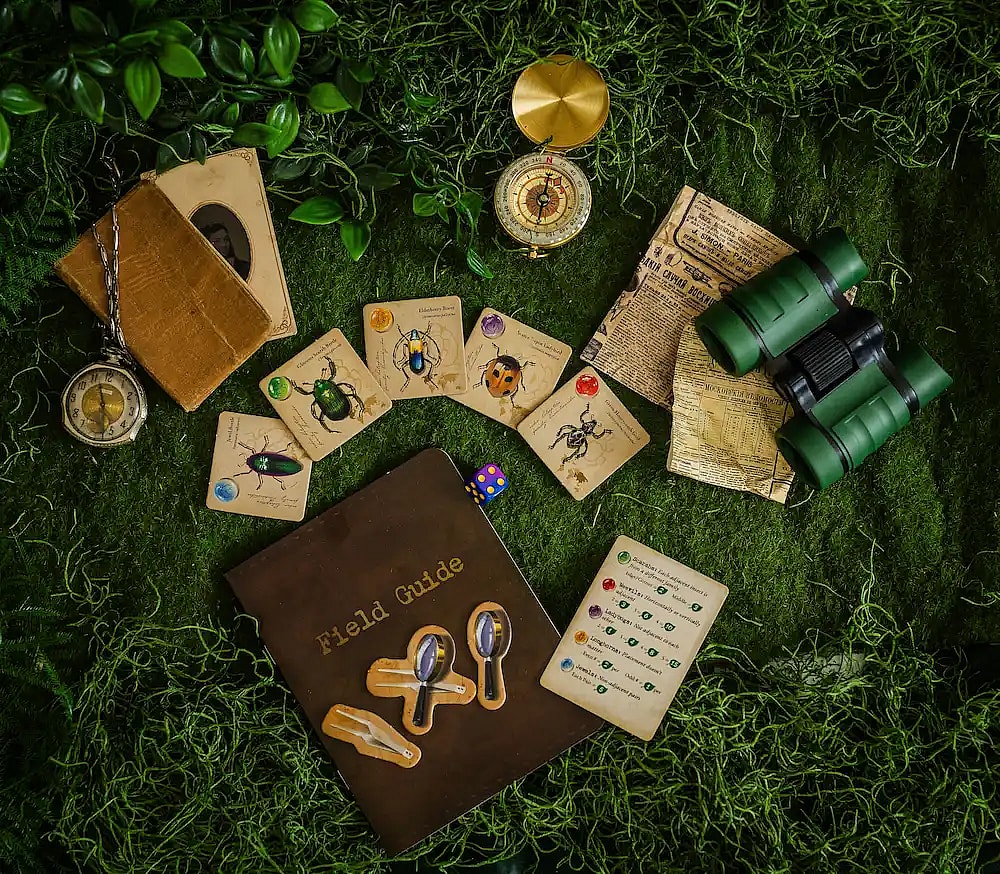
Inside the game box, you’ll find:
- 1 Folding Log Board
Features five numbered slots (1–5) and a special rule for rolling a 6 - 75 Beetle Tiles
- 5 different beetle families
- 15 beetles per family
- 12 Tool Tokens
- 4 Magnifying Glass tokens
- 4 Forceps tokens
- 4 “Either” tokens
- 4 Field Notes cards
- 1 Die
Objective
Your goal is to collect and place 16 beetle tiles into a 4×4 grid, known as your Jewel Box.
You score points (shown with a leaf icon) based on:
- How each beetle family is arranged
- Any unused Tool Tokens at the end of the game
The player with the most total points wins.
Setup
Table Setup
- Place the Log Board in the center of the table.
- Shuffle all 75 Beetle Tiles and place them face down around the Log.
- Randomly draw 5 Beetle Tiles and place one face up in each Log space (1–5).
Player Setup
Each player receives:
- 1 Field Notes card
- 3 Tool Tokens
- 1 Magnifying Glass
- 1 Forceps
- 1 “Either” token
The player who most recently saw a beetle takes the first turn.
Gameplay
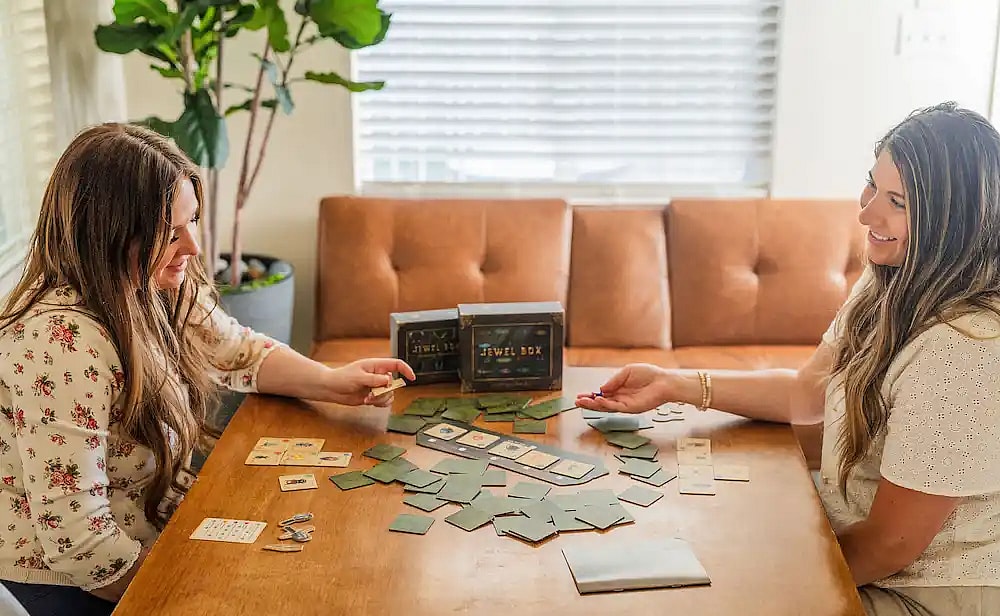
Players take turns clockwise. On your turn, you will collect one beetle and then place it into your Jewel Box.
Collecting a Beetle
- Roll the die.
- Take the beetle from the Log space that matches the number rolled.
- If you roll a 6, you may take any beetle from spaces 1–5.
After taking a beetle, immediately flip a new tile face up to refill the empty Log space.
Placing a Beetle
- The first beetle you collect is placed face up in front of you.
- Every beetle after that must be placed orthogonally adjacent (sides touching, not diagonally) to an existing tile.
- Over time, you will build a 4×4 grid of beetles — your Jewel Box.
Once your beetle is placed, pass the die to the next player.
Tool Tokens
Each player begins with three Tool Tokens. You may use only one Tool Token per turn.
Once used, flip the token to its gray side. Unused tokens are worth 2 bonus points each at the end of the game.
Magnifying Glass
Instead of rolling the die, you may choose any face-up or face-down beetle from the Log.
Forceps
Allows you to swap the positions of two beetles already placed in your Jewel Box.
This may be done before or after collecting a beetle.
“Either” Token
Can be used as either a Magnifying Glass or Forceps token.
End of the Game
The game ends once all players have completed their 4×4 grids (16 beetles).
Players then:
- Score points for each beetle family
- Add 2 points for each unused Tool Token
The player with the highest score wins.
Tiebreaker
- Player with the most unused Tool Tokens wins
- If still tied, the tied players share the victory
Beetle Families and Scoring
Each beetle family scores points in a unique way.
Scarabs (Scarabaeidae)
Scarabs score points individually, but only if all adjacent beetles are from different families.
- Corner or edge placement: 2 points
- Center placement: 3 points
- Any adjacent beetle of the same family cancels the score
Weevils (Curculionidae)
Weevils score points in straight lines, vertically or horizontally.
- 2 connected Weevils: 3 points
- 3 connected Weevils: 6 points
- 4 connected Weevils: 10 points
Diagonal or broken connections do not count.
Ladybugs (Coccinellidae)
Ladybugs score best when kept apart.
- Adjacent Ladybugs cancel each other out
- Count only Ladybugs not touching another Ladybug
Scoring per set:
- 2 Ladybugs: 1 point
- 3 Ladybugs: 4 points
- 4 Ladybugs: 8 points
- 5 Ladybugs: 15 points
If you collect more than five, start a new set.
Longhorns (Cerambycidae)
Longhorns score based on whether the total number is even or odd.
- Even number: 2 points per Longhorn
- Odd number: 1 point per Longhorn
Placement does not matter.
Jewels (Buprestidae)
Jewels score in pairs, but clusters are risky.
- Each non-overlapping adjacent pair: 5 points
- Groups of three or more cancel out and score nothing
Two-Player Variant
For a longer two-player game:
- Build a 5×5 grid (25 beetles)
- All other rules remain the same
Solo Variant
In solo play:
- Build a 5×5 grid
- After each turn, discard one beetle from the Log before refilling it
Compare your final score to the chart:
- 63+ – Master Entomologist
- 57–62 – Pro Entomologist
- 50–56 – Amateur Entomologist
Tips for New Players
- Don’t rush to use Tool Tokens — unused ones are valuable points
- Plan your grid early so you don’t block scoring opportunities later
- Watch what beetles opponents are collecting to anticipate Log choices
Strategy Guide
- Scarabs reward careful spacing — build them later when your grid is stable
- Ladybugs require discipline; one bad placement can undo a whole set
- Forceps tokens are strongest in the late game when grids are crowded
- Aim for even Longhorn totals, especially if you’re collecting many
Frequently Asked Questions
No. Orientation doesn’t matter unless adjacency rules apply.
No, only one Tool Token may be used each turn.
Yes, every unused Tool Token is worth 2 points.
No. Beetles must touch by sides, not corners.
Conclusion
Jewel Box blends luck, planning, and tactical choices into a compact but rewarding experience. With multiple scoring paths and shared decision spaces, every turn presents meaningful options. Whether played competitively, cooperatively, or solo, Jewel Box offers a satisfying puzzle that rewards smart placement and thoughtful timing.
Video Tutorial
Browse Related Games!
 Official Gaia Project Rules
 Official Rush Hour Traffic Jam Rules
 Official Bamboo Rules
 Official The Lord of The Rings: Duel for Middle-Earth Rules
 Official Panda Royale Rules
Official Magnetic Chess Game with Stones Rules
Official Panda Royale Rules
Official Magnetic Chess Game with Stones Rules
 Official The Night Cage Rules
 Official Pilgrim Rules
 Official Mancala Rules
Official Mycelia Rules
Official Mancala Rules
Official Mycelia Rules
 Official Santorini Rules
 Official TOSY Flying Ring Rules