

Last Updated on March 10, 2026 by The Official Game Rules Team
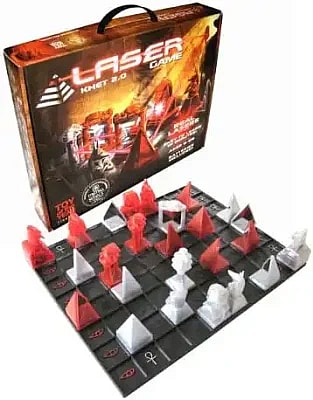
Khet 2.0 is a unique strategy game that blends elements of chess with lasers and mirrors. Instead of capturing pieces through traditional movement, players win by firing a laser across the board and striking their opponent’s Pharaoh. The laser beam reflects off mirrored pieces, creating surprising angles and clever tactical opportunities.
Although the game might look complex at first, the rules are actually straightforward. Every piece moves in a similar way, and once you understand how the laser interacts with the mirrored surfaces, you’ll be planning strategic shots in no time.
The goal is simple: use mirrors and positioning to direct your laser beam toward the opponent’s Pharaoh while protecting your own.
This post contains affiliate links. For more information, see our disclosures here.
How to Play Khet 2.0
Game Pieces
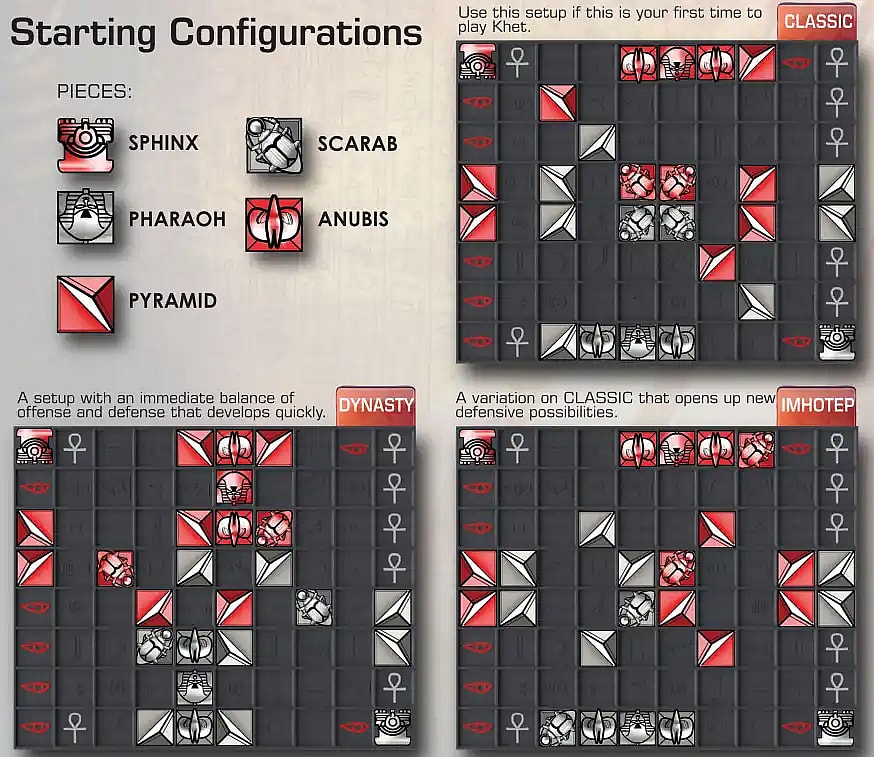
Khet features five main types of pieces, each with a specific purpose in the laser battlefield:
- Pharaoh – Your most important piece. If it gets hit by the laser, you lose.
- Pyramid – Reflects laser beams using its mirrored sides.
- Scarab – A special piece that can swap positions with certain other pieces.
- Anubis – A defensive piece that can block lasers from the front.
- Sphinx – Holds the laser emitter and fires the beam.
Each player controls a set of pieces and a Sphinx located in their corner of the board.
Starting the Game
Unlike many classic board games, Khet 2.0 doesn’t have a single fixed starting setup. Instead, the game includes several tested starting configurations that create different tactical experiences.
The most common setups are:
- Classic – Recommended for beginners
- Dynasty – Offers deeper tactical play
- Imhotep – A more advanced configuration
If you’re new to the game, begin with the Classic setup. After you gain experience, try the other arrangements or create your own custom setups.
Silver always takes the first turn, and players alternate turns for the rest of the game.
Objective of the Game
The objective in Khet is to hit your opponent’s Pharaoh with your laser beam.
To do this, players move and rotate mirrored pieces so the laser beam bounces across the board toward the opponent’s Pharaoh. If your own Pharaoh gets hit, you lose immediately.
Turn Structure
On each turn, a player performs one action, then fires their laser.
A player may choose one of the following actions:
- Move one piece
- Rotate one piece
- Rotate the Sphinx (instead of moving a piece)
After completing the action, the player fires the laser.
Once you remove your hand from the piece you moved or rotated, the move is final and the laser must be fired.
Moving Pieces
All pieces in Khet move in the same basic way.
A piece may move one square in any direction, including diagonally.
However, there are some restrictions:
- A piece cannot move into an occupied square.
- A piece cannot both move and rotate on the same turn.
- A piece may rotate only 90 degrees per turn.
Even the Pharaoh can move like this, although doing so can be risky.
Rotating Pieces
Instead of moving a piece, players may rotate it.
Rotating changes the orientation of its mirrors and therefore the direction the laser will reflect.
Pieces may be rotated:
- 90 degrees clockwise
- 90 degrees counterclockwise
You cannot rotate more than once during a turn.
Rotating the Sphinx
Each player controls a Sphinx, which contains the laser.
The Sphinx does not move around the board, but it can rotate.
On your turn, instead of moving a piece, you may rotate the Sphinx so the laser points:
- Down the first row, or
- Down the first column
After rotating the Sphinx, you must immediately fire the laser.
Board Restrictions
Certain squares on the board are restricted to one color.
- Red pieces cannot enter squares marked with a silver Ankh symbol.
- Silver pieces cannot enter squares marked with a red Eye of Horus.
These restricted spaces are usually located along the edges of the board.
The Scarab’s Special Ability
The Scarab is a unique piece with special movement.
Instead of capturing, the Scarab can swap places with certain adjacent pieces.
A Scarab can exchange positions with:
- A Pyramid
- An Anubis
This swap can happen regardless of color.
However, Scarabs cannot swap with Pharaohs or other Scarabs.
When swapping positions, neither piece rotates.
Firing the Laser
At the end of every turn, the player presses the Sphinx button to fire the laser.
The beam travels across the board in straight lines along rows and columns. When it hits a mirrored surface, it reflects exactly 90 degrees, either left or right depending on the mirror’s orientation.
Players are not allowed to test laser paths before completing their move.
The laser fires once per turn.
What Happens When the Laser Hits a Piece
Different pieces react differently when struck by the laser.
Pyramid
If the laser hits the non-mirrored side of a Pyramid, that piece is destroyed and removed from the board.
If the beam hits a mirrored side, it reflects.
Anubis
The front shield of an Anubis blocks the laser.
If the beam hits the front, nothing happens and the turn ends.
If the laser hits the side or back, the Anubis is destroyed.
Scarab
Scarabs have mirrors on both sides.
The laser always reflects off a Scarab, so it cannot be destroyed.
Pharaoh
If a laser beam hits a Pharaoh, the game ends immediately.
The player whose Pharaoh was struck loses the game.
Even worse, if you accidentally hit your own Pharaoh, you lose.
Draw Rule
If the same exact board position appears three times during a game, the next player may declare a draw.
The repeated position must include:
- The same pieces
- In the same squares
- Facing the same directions
Video Tutorial
Strategy Tips
Think About the Laser Path
Before moving any piece, trace where the laser will travel after it fires. A small rotation can dramatically change the path of the beam.
Protect Your Pharaoh
Keep defensive pieces like Anubis positioned so the Pharaoh isn’t directly exposed to laser shots.
Use Scarabs Creatively
Scarabs are excellent for disrupting your opponent’s defenses. Swapping positions with key pieces can suddenly open laser paths.
Rotate Instead of Moving
Sometimes rotating a piece is more powerful than moving it. A well-placed mirror can redirect the laser across half the board.
Watch for Self-Hits
Because the laser fires after every turn, careless moves can cause your own beam to strike your Pharaoh.
Always double-check before firing.
FAQ
Most games last 15–30 minutes, depending on player experience and the starting configuration.
Khet is designed for two players.
No. The Sphinx cannot be eliminated and always remains on its starting corner square.
No. Players must complete their move before firing the laser.
Yes. The Pharaoh moves like any other piece, but doing so can be risky.
No. The laser continues until it hits a piece or leaves the board.
Conclusion
Khet 2.0 delivers a fast-paced strategy experience that combines traditional board game tactics with the excitement of laser reflections. With simple movement rules and deep tactical possibilities, every move can dramatically change the battlefield.
As you gain experience, you’ll learn to predict complex laser paths, set traps for your opponent, and design creative starting layouts. Whether you enjoy chess-style thinking or innovative board game mechanics, Khet offers a unique challenge that rewards clever planning and careful positioning.
Browse Related Games!
 Official Gaia Project Rules
 Official The Lord of The Rings: Duel for Middle-Earth Rules
 Official Magnetic Chess Game with Stones Rules
 Official The Night Cage Rules
 Official Bamboo Rules
 Official Mancala Rules
 Official Santorini Rules
 Official Root Rules
 Official Rajas of The Ganges Rules
 Official Panda Royale Rules
Official Mycelia Rules
Official Panda Royale Rules
Official Mycelia Rules
 Official Dungeons, Dice & Danger Rules