

Last Updated on May 8, 2026 by The Official Game Rules Team
Mexican Train Dominoes is a popular domino variant focused on strategy, timing, and a bit of luck. Players compete to be the first to play all their dominoes by building personal and shared “trains” that connect to a central hub, known as the station. Simple to learn but deeply strategic, it’s a favorite for family nights and competitive gatherings alike.

This post contains affiliate links. For more information, see our disclosures here.
How to Play Mexican Train Dominoes
Objective of the Game
The goal of Mexican Train Dominoes is to be the first player to play all your dominoes and score the lowest total points over several rounds. Players build their own personal train while also being able to play on the shared Mexican Train, which belongs to everyone.
More of a visual learner? Checkout our Video Tutorial!
What You Need
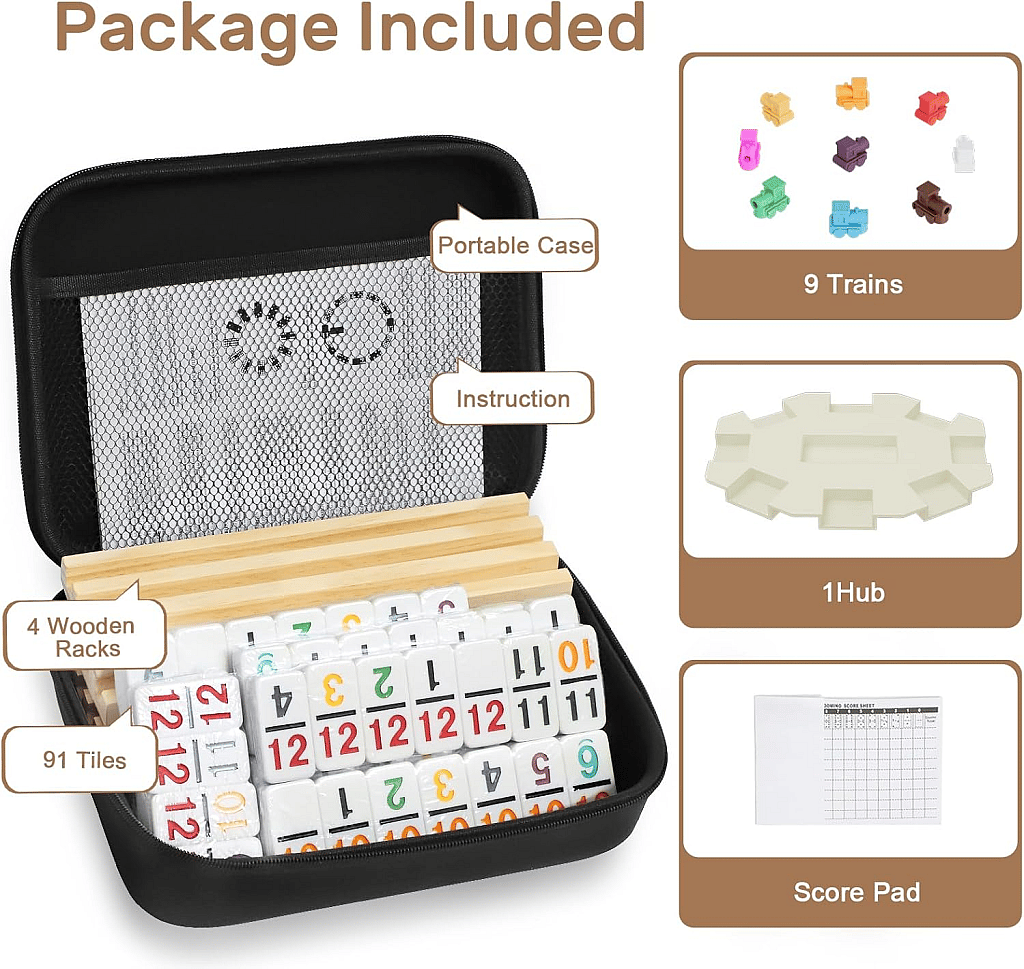
- 1 Double-12 Domino Set (91 tiles)
- Markers for each player (quarters, coins, or tokens)
- A flat playing surface large enough for multiple trains
Setup
- Shuffle and draw: Turn all dominoes facedown and mix them.
- Each player draws one tile. The player with the highest double starts and sets the station number (the engine).
- Return all tiles facedown and shuffle again.
- Each player then draws:
- 2–4 players: 15 tiles
- 5–6 players: 12 tiles
- 7–8 players: 11 tiles
- Stand your dominoes upright so opponents can’t see them.
- Place the remaining tiles in the boneyard, the draw pile.
Overview
Play moves clockwise around the table. The starting player places their highest double in the center as the station tile (for example, a double-12 starts the game at 12).
Each player builds their personal train from that number. If a player can’t start their train, they draw one tile from the boneyard. If they still can’t play, they mark their train with a marker, meaning other players can now play on it.
Gameplay
1. Starting the Game
The first player lays down their double to start the station.
If no one has a double, continue clockwise with players drawing one tile from the boneyard until someone does.
Once the station is set, each player begins building their train by matching the number shown on the station tile.
2. Making Moves
On each turn, a player may:
- Play one domino on their own train, or
- Play on the Mexican Train (a shared public train), or
- Play on another player’s train if it’s marked with a token.
If you can’t make a move, draw one tile from the boneyard:
- If the tile can be played, play it immediately.
- If not, keep it and place or leave a marker on your train.
3. Playing Doubles
A double (like 6–6 or 12–12) gives you another turn, but it must be closed before the game can continue.
To close a double, another tile matching the double’s number must be played on it.
If you can’t close your double:
- Draw one tile from the boneyard.
- If still unable to close it, play passes clockwise until the double is closed.
Exceptions:
- The double is the last of its number.
- It’s the final tile in the game.
- It was played to remove a marker from your train.
4. The Mexican Train
The Mexican Train is a shared line that anyone can play on, as long as it matches the station number.
It can be started at any time after the first round of turns.

5. Ending a Round
A round ends when:
- A player plays their last tile, or
- No one can make a move.
Players then total the pips (dots) on their remaining dominoes. The player who went out scores 0 points, and all others add their remaining pips to their total score.
Scoring and Winning
- Each player’s score equals the total pips left in their hand.
- The player who runs out of tiles earns zero points.
- After three rounds, the player with the lowest total score wins the game.
Strategy and Tips
1. Manage Your Hand Early
Play your highest tiles early in the game to reduce your potential end-game penalty.
Keep an eye on which numbers are being played—this helps you anticipate when certain tiles may become unusable.
2. Use the Mexican Train Wisely
Playing on the Mexican Train is useful when your own train is blocked, but it also opens up opportunities for others. Only play there when it helps you more than your opponents.
3. Plan Around Doubles
Use doubles to your advantage—they grant extra turns—but ensure you can close them. Leaving an open double can stall the game and hurt your position.
4. Track Opponents’ Trains
Markers indicate vulnerable trains. Watch for when your opponents’ trains are open and take advantage of those opportunities to limit their options.
5. Save Flexible Tiles
Keep tiles that connect common numbers (like 6–4 or 8–7) for later rounds. They can help you adapt when options become limited.
6. Keep the Boneyard in Mind
The fewer tiles left in the boneyard, the higher the risk of being unable to play. Try to end the round before you’re forced to draw multiple tiles.
Video Tutorial
FAQ – Mexican Train Dominoes Rules
What happens if the boneyard is empty?
If the boneyard runs out and you can’t play, simply pass your turn and mark your train.
No, players may only play on one train per turn, unless they’ve played a double.
No, it’s optional. You may play on any eligible train, including your own or another player’s open train.
You can remove your marker only when you successfully play on your own train.
If there’s a tie, the tied players share the victory—or play an extra round to break it.
Typically, three rounds make a complete game, but some groups play up to 13 rounds—one for each double tile.
Yes, there are many popular variations of Mexican Train Dominoes that alter the initial setup, the rules for playing doubles, and the way turns proceed, such as the “Fast Game” or “Branching Doubles” (similar to Chickenfoot).

Conclusion
Understanding the Mexican Train Dominoes rules is just the start. The real fun comes from developing clever strategies, predicting opponents’ moves, and timing your plays perfectly. Whether you’re a beginner learning how to play Mexican Train or a seasoned player refining your tactics, this game offers endless replayability and excitement.
Browse Related Games!
 Official Doozy Dice Rules
 Official Magnetic Chess Game with Stones Rules
 Official Gaia Project Rules
 Official Root Rules
 Official The Lord of The Rings: Duel for Middle-Earth Rules
 Official Block Dominoes Rules
 Official The Night Cage Rules
 Official Jinx Rules
 Official Panda Royale Rules
 Official Santorini Rules
 Official Bamboo Rules
 Official Mouse Trap Rules