

Last Updated on October 14, 2025 by The Official Game Rules Team
Qwirkle is an abstract strategy game for 2 to 4 players, where the objective is to score the most points by creating lines of tiles that share a common attribute: either color or shape. Here’s how to play:

This post contains affiliate links. For more information, see our disclosures here.
How to Play Qwirkle
Overview
Number of players: 2–4
Playing time: 30–60 min.
Components
- 108 tiles (three of each of 36 unique combinations of six colors and six shapes)
- 1 draw bag
- 1 instruction booklet
Objective
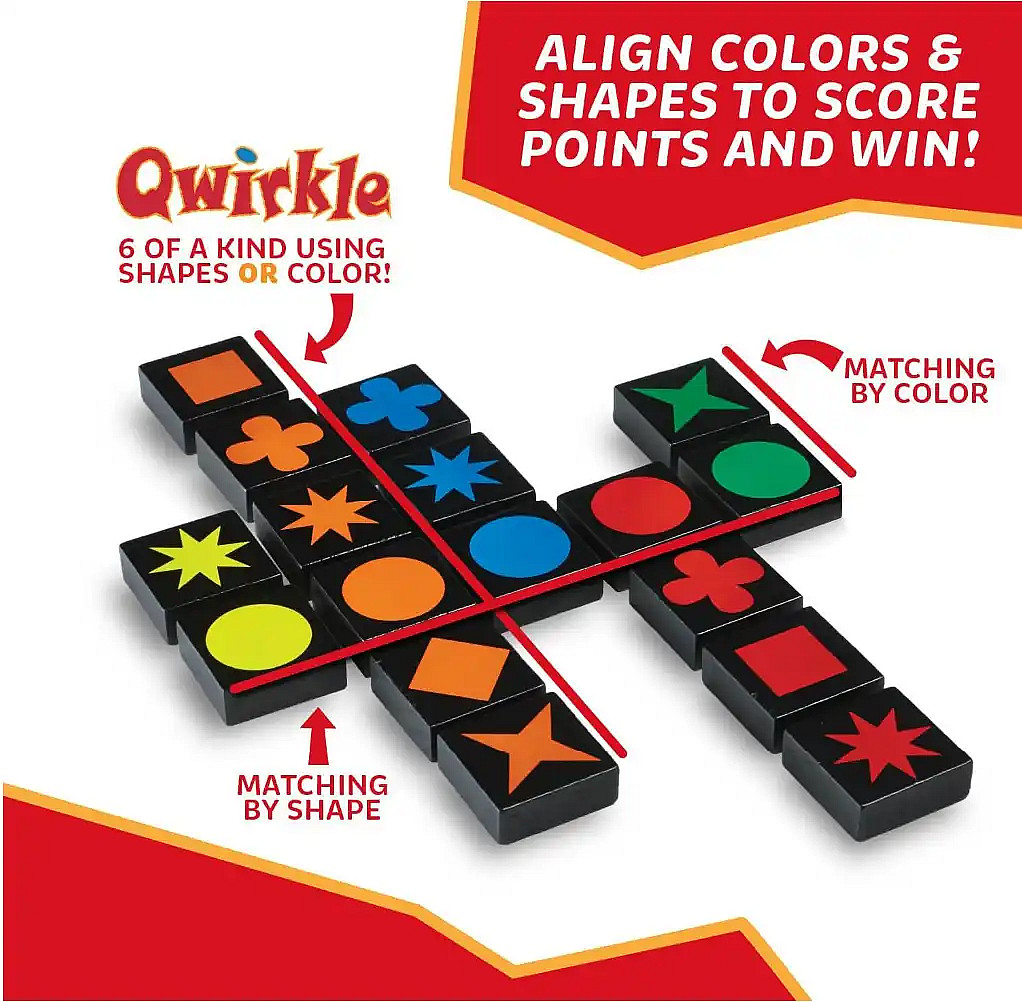
In Qwirkle, the goal is to strategically build lines of tiles that share one characteristic—either color or shape—to score the most points. Players aim to create lines, extend existing ones, and earn bonus points by completing full sets called Qwirkles.
Setup
Use paper and pencil to keep track of each player’s score. Place all 108 tiles in the bag and mix them thoroughly. Each player draws six tiles and keeps them hidden from other players. These tiles form your hand.
Starting the Game
Each player looks for the largest group of tiles in their hand that share one characteristic (either color or shape, but not both). The player who can play the most matching tiles starts the game by placing those tiles in a single line of squares in the center of the table.
If multiple players can play the same number of tiles, the oldest player among them begins. The starting player scores one point per tile played, and play continues clockwise.
How to Play
On your turn, you must take one of the following actions:
- Add tiles to the grid:
- Play one or more tiles from your hand, all sharing one attribute (either color or shape).
- Tiles you play must be placed in the same line, but they don’t need to be adjacent.
- You can place tiles to create or extend one or more lines, as long as all tiles in each line share the same characteristic.
- Draw new tiles from the bag until you have six in your hand.
- Trade tiles:
- You may exchange some or all of your tiles instead of playing.
- Set aside the tiles you wish to trade, draw replacements from the bag, then return your discarded tiles to the bag and mix them in.
- If you cannot play to the grid, you must trade on your turn.
Adding to the Grid
All tiles must connect to the existing grid, forming lines either vertically or horizontally. Each line of squares must meet these conditions:
- A line of shapes must contain tiles of all the same shape but in different colors.
- A line of colors must contain tiles of all the same color but in different shapes.
- No line may contain duplicate tiles.
Example:
- A line of blue tiles could contain one blue star, one blue diamond, and one blue circle.
- A line of circle shapes could include one red circle, one green circle, and one orange circle.
Some spaces on the grid will become blocked as play progresses, creating opportunities for strategic placement.
Scoring
You score points every time you add tiles to the grid.
- Score 1 point per tile in every line you create or extend.
- When you complete a line of six tiles (each sharing one characteristic with no duplicates), you form a Qwirkle and earn 6 bonus points.
- Each Qwirkle scores at least 12 points—six for the tiles themselves and six for the bonus.
- A single tile can score in two different lines at once if it contributes to both a color line and a shape line.
Example:
If you place a tile that completes both a red line and a circle line, you score points for both lines.
Ending the Game
Play continues until no more tiles remain in the bag and a player uses all the tiles in their hand. That player scores an additional 6-point bonus for going out.
The game then ends immediately. Each player totals their points, and the one with the highest overall score wins.
Strategy Tips
- Try to place tiles so that they contribute to multiple lines at once—this can earn you double points in a single turn.
- Watch your opponents and avoid setting them up for easy Qwirkles.
- Count tiles that have been played. If you’re waiting for a specific color or shape, check whether it’s still available in the bag before holding out for it.
- In the end of your turn, always replenish your hand and think ahead to block high-value plays by your opponents.
Example of Play
- Anna starts by playing three red star tiles that share the same color. She scores 3 points.
- Chris plays three square tiles in a red line, creating both a red line and a square line, scoring 6 points total.
- Sally adds one blue circle, forming a blue line and a circle line for 4 points.
- Dave plays two green tiles that create three new lines (a clover line, a diamond line, and a green line), earning 8 points.
As the game continues, each turn builds upon previous lines, with players scoring for every line of squares they extend and earning bonus points for completing Qwirkles.
Variations
- Shorter Version: For a quicker game, remove one set of each tile (play with two copies of each instead of three).
- Team Play: With four players, form two partnerships and combine your scores.
- Solo Practice: Qwirkle can also be played solo as a puzzle—try to create as many Qwirkles as possible with a single draw of tiles.
Qwirkle FAQs
The main objective of Qwirkle is to score the most points by creating lines of squares that share one characteristic—either color or shape. Players earn points for each tile placed, and extra points for completing full lines called Qwirkles.
You win by having the highest total score at the end of the game. Once all tiles have been played, players add up their scores, including any bonus points for being the first to play all their tiles.
Each line of squares must share a single characteristic—either all the same color or all the same shape—with no repeats of that characteristic within the same line.
Your turn ends after placing your tiles, scoring for all the lines you’ve completed or extended, and drawing new tiles to bring your hand back to six.
When a line reaches six tiles that all share one characteristic, it forms a Qwirkle. This earns you bonus points, and that line cannot be extended any further.
Completing a Qwirkle (a line of six tiles) gives you a 6-point bonus on top of your normal score for that line. You also earn an additional 6-point bonus at the end of the game if you’re the first to play all your tiles.
Yes. You can earn points for several lines at once if your tile placement connects tiles both horizontally and vertically, as long as each line follows the matching characteristic rule.
Final Thoughts
Qwirkle combines strategic thinking with simple rules, making it enjoyable for all ages. Every line of squares you build depends on recognizing shared characteristics while planning for future turns. The end of your turn isn’t just about scoring—it’s about setting traps and opportunities for bonus points later. By focusing on completing lines and aiming for the end of a line bonus, you can outthink your opponents and secure victory. The player who best balances strategy, foresight, and tile management will claim the win when the game reaches its end.
Browse Related Games!
 Official Magnetic Chess Game with Stones Rules
 Official Root Rules
 Official Lost Ruins of Arnak Rules
 Official Gaia Project Rules
 Official The Lord of The Rings: Duel for Middle-Earth Rules
 Official Zombicide Rules
 Official Panda Royale Rules
Official Axis and Allies 1942 Rules
Official Panda Royale Rules
Official Axis and Allies 1942 Rules
 Official Bamboo Rules
 Official The Night Cage Rules
 Official Rajas of The Ganges Rules
Official Star Wars: Rebellion Rules
Official Rajas of The Ganges Rules
Official Star Wars: Rebellion Rules