

Last Updated on October 8, 2025 by The Official Game Rules Team
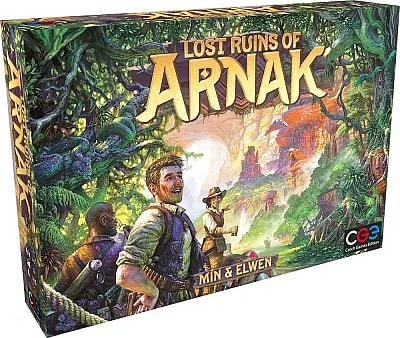
Embark on a thrilling archaeological expedition in Lost Ruins of Arnak, where strategy, resource management, and deck-building combine in a race to uncover an ancient civilization’s secrets. Players explore mysterious sites, face powerful guardians, and advance their research to achieve the highest score. Here’s a complete breakdown of the rules and how to play:
This post contains affiliate links. For more information, see our disclosures here.
How to Play Lost Ruins of Arnak
Overview
2–4 Players | 30–120 Minutes | Ages 12+
Objective of the Game
In Lost Ruins of Arnak, players take on the role of explorers on a remote island, searching for lost knowledge and valuable artifacts. Over the course of five rounds, you’ll send archaeologists to new locations, discover temples, acquire useful cards, and uncover idols.
The player with the most victory points at the end of the game — from research progress, artifacts, idols, guardians defeated, and other achievements — wins.
Components
- 1 Double-sided Game Board (for 2-player and 3–4-player games)
- 110 Cards, including:
- 40 Item cards (blue backs)
- 35 Artifact cards (red backs)
- 16 Fear cards
- 5 Starting decks (8 cards each)
- 5 Reference cards
- 16 Archaeologists (4 per player)
- 27 Guardian Tiles
- 12 Site Tiles (Level 1 and Level 2)
- 16 Idol Tiles
- 10 Research Track Bonus Tiles
- 15 Assistant Tiles
- 1 Staff Marker
- Player Tokens (magnifying glass and journal for each color)
- Resources:
- Gold Coins
- Compasses
- Tablets
- Arrowheads
- Jewels
- 1 Moon Staff (round tracker)
- 1 Temple Tile (Research Track Top)
- 1 Solo Opponent Board (for solo mode)
- 1 Rulebook
Setup
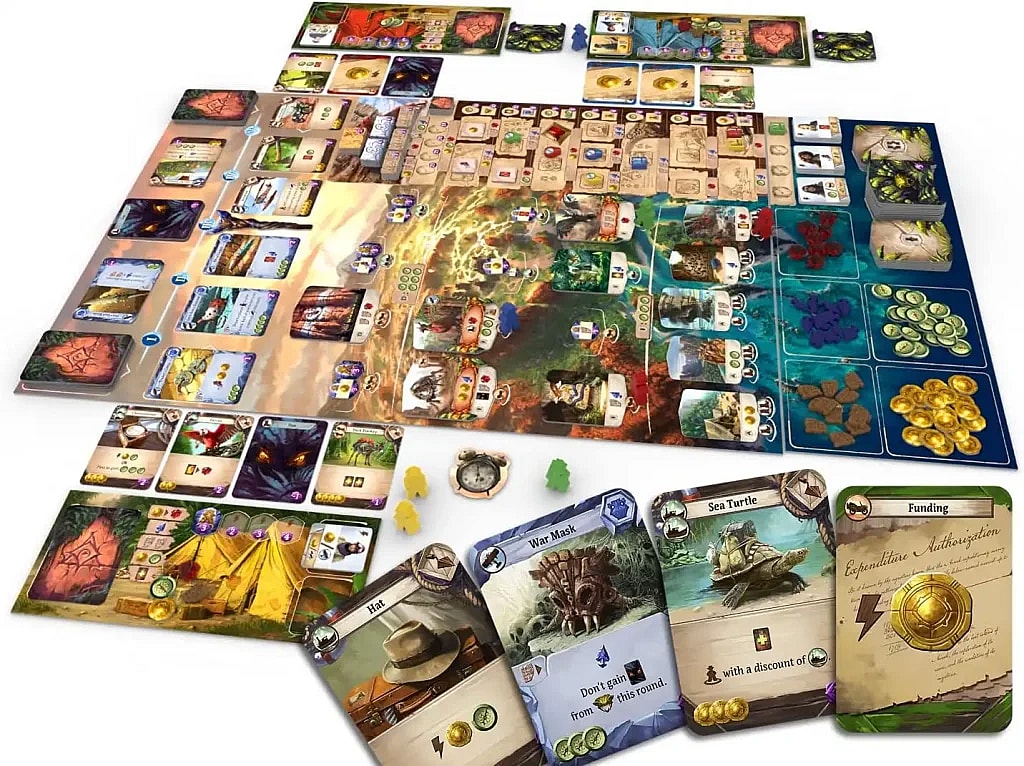
- Place the Main Board in the center of the table. Use the correct side based on your player count.
- Prepare the Cards:
- Separate Items (blue) and Artifacts (red).
- Shuffle each deck and place them face-down on their respective spaces at the top of the board.
- Reveal one card from each deck and place them on the Card Row. Fill the row from left to right, with the Staff dividing the Item and Artifact cards.
- Place the Fear deck nearby.
- Set the Moon Staff on the leftmost space above the Card Row (Round 1). This will move one space to the right each round, reducing available Item slots and increasing Artifact slots.
- Prepare the Research Track:
- Place the Temple Tile at the top.
- Shuffle the Bonus Tiles and randomly place one on each bonus space.
- Shuffle the Assistants and place them face-up near the board.
- Place Site and Guardian Tiles:
- Shuffle and separate Level 1 and Level 2 Site Tiles.
- Shuffle the Guardian Tiles and place them face-down nearby.
- Prepare the Idol Supply:
- Place Idol Tiles on the unoccupied exploration sites (Level 1 and 2 spaces).
- Each Player Receives:
- 2 Archaeologists (meeples)
- 1 Magnifying Glass and 1 Journal Token (for the research track)
- 4 Fear Cards, 2 Funding Cards, and 2 Exploration Cards (starting deck)
- 2 Gold Coins and 1 Compass
- 1 Player Board with space for their deck, discard pile, and assistants
- Determine the Starting Player.
The last person who traveled to an island begins. Give them the starting player marker. - Draw Starting Hands.
Each player shuffles their deck and draws 5 cards.
Gameplay
The game is played over five rounds, each consisting of three phases:
- Research and Supply Refresh
- Player Turns
- Round End
During their turn, a player performs one main action (and any number of free actions). When all players have passed, the round ends.
Phase 1: Research and Supply Refresh
At the start of each round:
- Move the Moon Staff one space to the right.
- Remove the two cards under the Staff from the Card Row.
- Slide remaining cards to fill the gaps.
- Draw new cards from the Item and Artifact decks to refill the row.
- Each player draws 5 cards into their hand (reshuffling their discard pile if needed).
Phase 2: Player Turns
Players take turns performing one main action plus any free actions available.
Main Actions:
1. Dig at a Site
Send one of your Archaeologists to an unoccupied site (either discovered or undiscovered). Pay the travel cost shown next to the site — by discarding cards or paying resources.
- Base Camp Sites: Free to access (but limited).
- Discovered Sites: Pay the travel icons shown (e.g., Jeep, Boat, Airplane).
- Undiscovered Sites:
- Pay 5 compasses for a Level 1 site, or 8 compasses for a Level 2 site.
- Draw a random Site Tile, place it on the location, and gain its discovery reward immediately.
- Then draw a random Guardian Tile and place it face-up at that site.
When you dig, take the site’s listed reward (e.g., resources or cards). Each site can only hold one Archaeologist at a time.

2. Discover a New Site
When you’re the first to explore an undiscovered location:
- Pay the exploration cost (5 or 8 compasses).
- Reveal a new Site Tile.
- Gain its idol reward (collect the Idol Tile from the space).
- Place a Guardian Tile on the site — you must defeat it later or face a penalty.

3. Buy a Card
Purchase a new Item or Artifact from the Card Row.
- Item Cards: Cost gold (🪙). When bought, place the card at the bottom of your deck.
- Artifact Cards: Cost compasses (🧭). When bought, you immediately play it for its effect, then place it in your discard pile afterward.
Slide the remaining cards and refill the empty space from the correct deck.
4. Play a Card
Use a card from your hand for its action or effect. Many cards provide resources, travel icons, or special bonuses.
Once used, place the card in your discard pile (unless stated otherwise).
5. Research
Spend the required resources (shown on the research track) to move either your magnifying glass or journal token up the track.
- Your magnifying glass must always be ahead of your journal.
- Advancing provides instant bonuses such as assistants, idols, or extra cards.
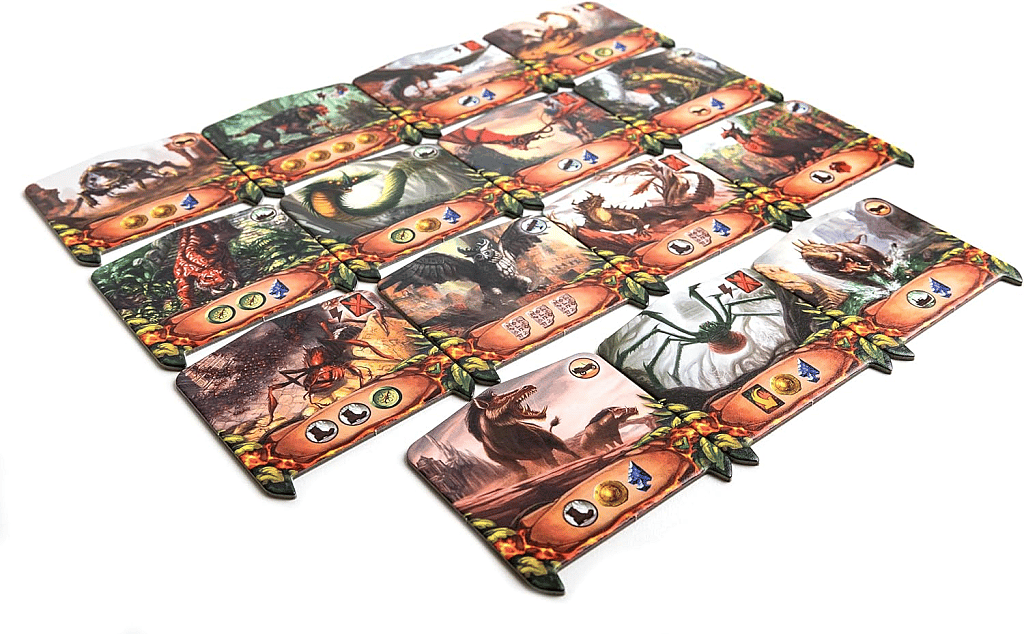
6. Overcome a Guardian
If one of your Archaeologists is on a site with a Guardian, you can defeat it by paying the cost shown on the Guardian Tile (usually resources).
Gain the Guardian as a victory point tile — it’s worth 5 points and may offer a one-time bonus.
7. Pass
When you have no viable actions left, or choose to stop, declare “Pass.” You cannot take further actions this round, but may still perform free actions (e.g., using an assistant or playing a free card).
Free Actions
Free actions can be performed before or after your main action. Examples include:
- Activating assistants
- Playing free-action cards
- Using idol spaces on your player board to gain resources
- Resolving artifact effects that specify “Free Action”
Phase 3: End of Round
After all players have passed:
- Return all Archaeologists to their owners.
- Apply a Fear penalty: For each Archaeologist left on a site with an undefeated Guardian, gain 1 Fear card into your discard pile.
- Reset all used assistants (flip them upright).
- Discard all cards in play (except those that remain active).
- Draw 5 new cards for the next round.
End of the Game
The game ends immediately after the fifth round.
Players then calculate their total score.
Scoring Summary
| Source | Points |
|---|---|
| Research Track (Magnifying Glass & Journal positions) | As indicated |
| Temple Bonuses | As indicated |
| Guardians Defeated | 5 each |
| Idols Collected | 3 each |
| Unused Idol Spaces (on Player Board) | +1–3 each |
| Artifact & Item Cards | Points shown on cards |
| Fear Cards | -1 each |
The player with the highest total wins.
In case of a tie, the player farthest along the research track wins.
Advanced Rules and Strategy Notes
- Timing is key: Explore new sites early to maximize rewards, but remember that compasses are scarce.
- Balance your deck: Removing Fear cards and adding high-value Items/Artifacts improves your draw efficiency.
- Assistant synergy: Advancing on the research track quickly can earn powerful assistants that help generate crucial resources.
- Guardians aren’t just threats: Defeating them grants VP and flexible single-use powers.
- Research vs Exploration: Specializing in one area can be effective, but balanced play often yields more consistent results.
Solo Mode (Against the Rival Expedition)
Lost Ruins of Arnak includes a fully developed solo mode using the Rival Expedition Board.
You will compete against an automated opponent who simulates exploration and research progress.
- Set up the board for two players (you + the rival).
- Use the solo board and deck to determine the rival’s actions each round.
- Each rival turn, draw a card and perform the indicated action (such as exploring, advancing research, or blocking sites).
- The rival never collects resources but earns points for all progress.
After five rounds, compare your score against the rival’s total to determine victory.
Lost Ruins of Arak FAQ
Yes. As soon as you gain an Idol, you may place it on your player board to gain its benefit — or keep it for 3 victory points at the end of the game.
You may not take that action unless you can fully pay its cost. Cards or assistants that reduce costs must be used beforehand.
No, buying a card counts as your main action. You may only buy one card per turn.
You gain one Fear card per Guardian still guarding one of your Archaeologists’ sites at the end of the round.
Items are long-term tools (purchased with gold) and enter your deck for later use. Artifacts are ancient powers (purchased with compasses) and are used immediately when acquired.
No. Each site can hold only one Archaeologist per round.
Conclusion
Lost Ruins of Arnak blends deck-building, worker placement, and resource management into a seamless exploration adventure. Each turn is a puzzle — whether to dig deeper into the jungle, push your research ahead, or unearth forgotten artifacts that could reshape your expedition’s fate.
Master your deck, time your discoveries, and climb the temple’s peak to claim the legacy of the Lost Ruins.
Browse Related Games!
 Official Santorini Rules
 Official House of Danger Rules
 Official Mancala Rules
 Official Gaia Project Rules
 Official The Lord of The Rings: Duel for Middle-Earth Rules
 Official Magnetic Chess Game with Stones Rules
Official Liar’s Dice Rules
Official Magnetic Chess Game with Stones Rules
Official Liar’s Dice Rules
 Official Ticket to Ride Rules
 Official Pilgrim Rules
 Official Cootie Rules
 Official Root Rules
 Official Rajas of The Ganges Rules