

Last Updated on April 18, 2025 by The Official Game Rules Team
Skruuvi is a Finnish card game with historical roots in the Russian card game Vint, later evolving through the 20th century into its modern form. The game is often compared to Whist and Bridge but comes with its own unique set of rules and strategies. This in-depth guide will take you through the essential rules and strategies to master Skruuvi.
This post contains affiliate links. For more information, see our disclosures here.
How to Play Skruuvi
Players, Cards, and Setup
Skruuvi is a four-player game, typically played with two partnerships sitting opposite each other. Players take turns in a clockwise direction.
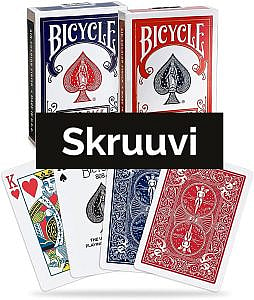
- Deck: A standard 52-card international pack is used, and while not strictly necessary, it’s common to use two decks with different-colored backs for easier identification. The dealer’s opponent shuffles the unused deck, and the cards are passed between players accordingly.
- Seating: Players alternate their seats after each set of 8 deals to ensure everyone plays with each other as a partner by the end of the session.
Game Formats
There are multiple formats you can play, including:
- Kitty Game: A variation with a kitty (a set of 4 face-down cards placed in the center of the table), which the highest bidder will claim.
- No-Kitty Game (Kotka): A more straightforward game with no kitty, where players receive 13 cards each, and there are stricter bidding requirements.
- Bolshevik: A game variant where one player plays against the other three players as a team.
For shorter sessions, a 12-deal game is possible, consisting of 4 deals per player pairing, with 2 Kitty Games followed by 2 No-Kitty Games.
Contracts
The game involves three types of contracts:
1. Trumps
- Objective: Win tricks with a specific suit designated as the trump.
- Example: A bid of “5 Diamonds” means that diamonds are the trump suit, and the bidder must win at least 11 tricks (6+5).
2. Grand
- Objective: Win tricks without any trump suit, aiming for the highest number of tricks.
- Example: A bid of “7 Grand” means the player must win all 13 tricks without trump suits.
3. Misère
- Objective: Lose tricks, particularly avoiding winning tricks containing Aces.
- Example: A “6 Misère” bid means the player must win at most 1 trick, and there is a penalty for taking Aces.
4. Auction and Bidding
The auction begins with the dealer and proceeds clockwise. Players must either pass or bid a higher level and denomination than the previous bidder.
- Bids: A bid consists of a level (a number between 1-7) and a denomination (misère, spades, clubs, diamonds, hearts, or grand). To raise a bid, either the level must be increased, or the same level must be bid with a higher denomination.
- Final Bid: If all players pass, the game ends, and an “All-Pass Misère” is played.
Bidding Levels:
- Bids below 5 are used to explore hand strengths and potential trump suits.
- A final bid of 5 or higher must be made in order for a contract to be valid.
Card Exchange
The player who made the highest bid (kitty bidder) will reveal the four kitty cards and add them to their hand. The kitty bidder then selects four cards to pass to their partner, who, in turn, distributes one card to each opponent. After the exchange, each player will have 13 cards.
In a No-Kitty Game, the highest bidder passes four cards face-down to their partner, and no cards are exchanged between opponents.
Extended Bids
After the card exchange, there is an additional period of bidding between the main players (those who bid the kitty). Players continue to raise the bid until four consecutive passes occur. The final bid made by the main players determines the declarer (the player who will play the contract).
Doubles and Redoubles
The opponents of the declarer can choose to double or redouble the contract, which multiplies the score for the contract’s outcome.
- Double: Doubles the score for a successful contract or penalty for a failed contract.
- Redouble: Triples the score for a successful contract or penalty for a failed contract.
Play
The declarer (the player who made the final bid) leads the first trick, and play proceeds clockwise. Players must follow suit if possible. If a player cannot follow suit, they can play any card. The trick is won by:
- The highest trump card, or
- If no trump cards are played, the highest card of the led suit.
Scoring
Scoring differs based on the type of game (Kitty, No-Kitty, Bolshevik) and the type of contract (Trumps, Grand, Misère). Here’s a breakdown of the scoring:
Kitty and Kotka Game Scoring:
- Contract Made (Trump or Grand):
- Level 5: 25 points
- Level 6: 35 points
- Level 7: 50 points
- Contract Made (Misère):
- Level 5: 10 points
- Level 6: 20 points
- Level 7: 35 points
- Overtricks: 2 points each
- Undertricks:
- Trump or Grand:
- First: 5 points
- Subsequent: 5 points
- Misère:
- First: 10 points
- Subsequent: 5 points each
- Trump or Grand:
- Aces in Misère: For each Ace taken, penalty points are added based on the trick number.
Bolshevik Game Scoring:
- Misère: 20 points if successful, with undertricks scored as 15 for the first and 5 for each subsequent undertrick.
- Dictator (All tricks): Scored the same as in normal games.
Conventions and Strategies
Like Bridge, Skruuvi allows players to establish conventions and systems for bidding, such as:
- Honours: Aces, Kings, Queens, Jacks, and 10s. A bid of “1 Grand” or “2 of a suit” might indicate a hand with multiple high cards.
- Preemptive Bids: A bid of “5 or 6 Misère” serves to obstruct the opponents by preventing them from exchanging information.
- Partner’s Hand: Players should exchange signals through the cards they pass during the exchange. The order of cards and the selection of what to pass can convey important information.
Advanced Strategy Tips
- Bidding System: Develop a common bidding system with your partner, such as one where bids of “1 of a suit” indicate a strong hand, or a bid of “3 Grand” signifies a relatively weaker hand.
- Hand Strength: Early low-level bids help communicate your hand strength and potential trump suits to your partner. Pay attention to these signals and interpret them correctly.
- Managing Aces in Misère: In a Misère contract, it’s crucial to avoid winning tricks containing Aces, as each Ace carries a significant penalty. Keep track of the suits that have Aces, and try to void those suits when possible.
Conclusion
Skruuvi is a deeply strategic game, with players needing to balance bidding, card exchange, and tactical play to win. Whether playing the more traditional Kitty or the No-Kitty Kotka format, understanding the auction, conventions, and contract types is key to success. The dynamic between partners and the ability to read your opponents will determine who triumphs in this engaging card game.
Browse Related Games!
 Official Five Crowns Rules
 Official Bohnanza Rules
 Official Paco Rules
 Official Casting Shadows Rules
 Official Truc Rules
 Official Twenty-Nine Rules
 Official Where Should We Begin? Rules
 Official Eleusis Rules
 Official Piles Rules
Official Broken Ladder Rules
Official Belote Rules
Official Piles Rules
Official Broken Ladder Rules
Official Belote Rules
 Official Coup Rules