

Last Updated on February 26, 2026 by The Official Game Rules Team
Backgammon is among the oldest board games in widespread use, enjoyed casually by new players and seriously by competitors in backgammon tournaments and other major tournaments worldwide. Whether played as a single game or in match play to a specified number of points, the rules below govern the structure, flow, and scoring of the game.

This post contains affiliate links. For more information, see our disclosures here.
How to Play Backgammon
1. Equipment and Board Layout
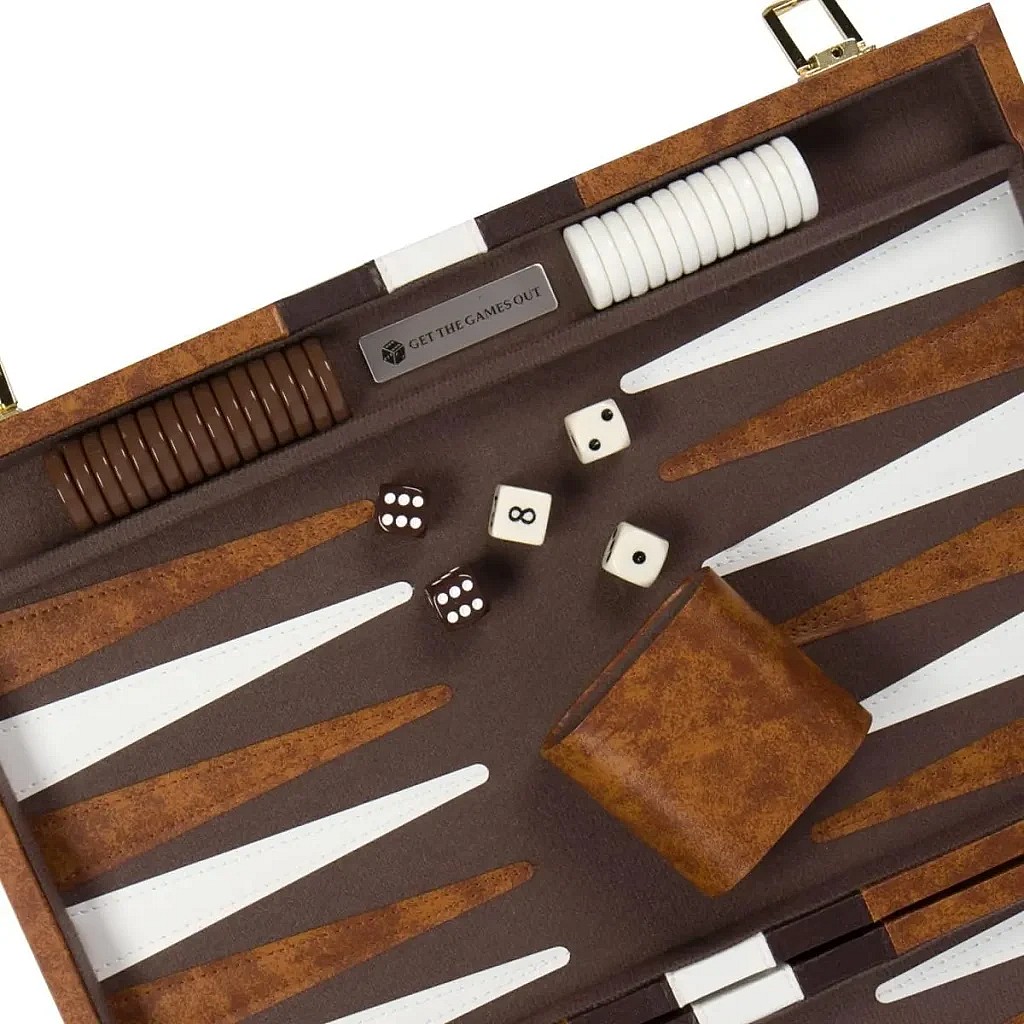
The Board
Backgammon is played on a board consisting of twenty-four narrow triangles called points. These points alternate in color and are grouped into four quadrants, each containing six points.
The four quadrants are:
- One player’s player’s home board
- That player’s outer board
- The opponent’s outer board
- The opponent’s home board
The two halves are separated by a central ridge, known as the bar, which runs through the center of the board.
The playing surface is sometimes described as the surface of the right-hand section of the board and the left-hand section. Each player moves their checkers in opposite directions around the board, beginning from the opponent’s side of the board and progressing toward their own home board.
Game Components
- 15 black checkers (or dark checkers)
- 15 contrasting checkers (often white)
- Two pairs of dice (each player may use their own pair of dice)
- A doubling cube (marked 2, 4, 8, 16, 32, 64)
- A dice cup (commonly used in tournaments)
2. Initial Arrangement of Checkers
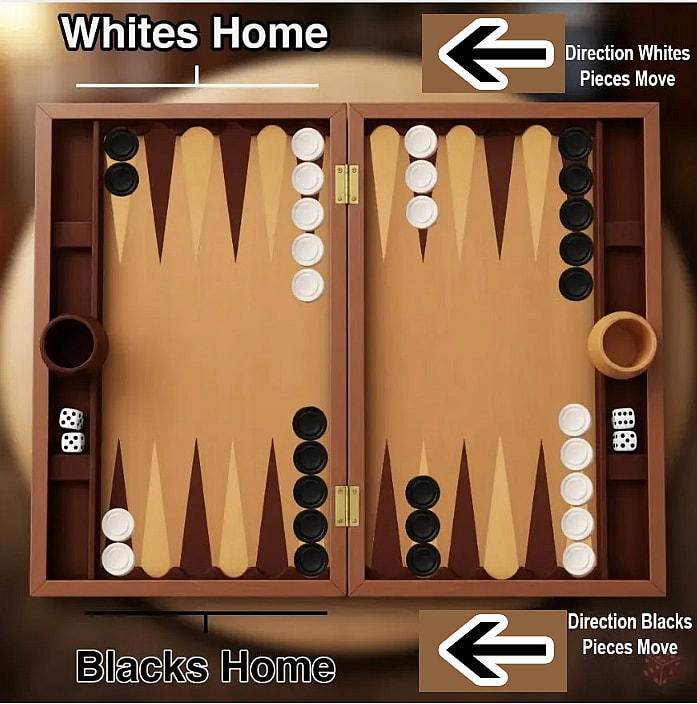
At the beginning of the game, each player places their 15 checkers in the standard initial arrangement of checkers:
- 2 checkers on the player’s twenty-four point
- 5 checkers on the 13-point
- 3 checkers on the 8-point
- 5 checkers on the 6-point
The setup is symmetrical. Each player’s 24-point lies in the opponent’s home board. The direction of movement is from the opponent’s side of the board toward the player’s home board.
3. Object of the Game
The object of the game is to move all of your player’s checkers around the board into your player’s home board, and then remove them from the board through the bear-off process.
The first player to bear off all fifteen checkers wins.
4. Starting Play
Opening Roll
Each player rolls a single die for the first roll. The player with the higher number becomes the first player and uses the numbers of a roll shown on both dice for their opening roll.
If the players roll equal numbers, this results in ties, and both dice are rolled again.
After the opening move, players roll two dice at the start of each own turn, and play proceeds in alternate turns.
5. Movement of the Checkers
General Movement Rules
The movement of the checkers is dictated by the rolled dice. Each die represents a separate move.
- If a player rolls different numbers, they must play both numbers if possible.
- The numbers must be played as two separate moves, either moving two different checkers or a single checker twice.
- In the case of doubles (rolling identical numbers or equal numbers), the player plays the numbers of a double twice — meaning four moves instead of two.
For example:
- Rolling 3 and 5 permits moving one checker 3 points and another 5 points.
- Or a combination of checkers may be moved using both numbers on the same checker (3 + 5), provided each step is a legal move.
Legal Play and Restrictions
A move is legal only if it lands on:
- An open point
- A point occupied by your own checkers
- A point occupied by exactly one of your opponent’s checkers (a blot)
A point occupied by two or more opposing checkers is blocked.
If only one number can be played, the player must play the higher number if possible. If neither number can be played, the player forfeits the turn.
If part of a roll can be played but not all numbers, the player must make the maximum possible legal play. Unused numbers are forfeited.
Order of Movement
If playing the numbers in one order makes a move illegal, but reversing the order makes it legal, the player must choose the order that permits a legal move.
If only one number can be played, and both are possible independently, the higher number must be used.
This obligation ensures full compliance with the following rules of proper play.
6. Hitting and Entering
If a checker lands on a point occupied by a single checker, that opposing checker is hit and placed on the bar.
When an opposing checker lands on the bar, it must re-enter through the opponent’s home board before any other move is made.
Re-entry requires using a die corresponding to an open point in the opposing home board.
If re-entry is not possible, the player forfeits the turn.
This creates strategic interaction and further contact between opposing forces.
7. Bearing Off
The bear-off process begins only when all of a player’s checkers are inside their home board.
A checker may be borne off by rolling the exact number of its point.
If no checker occupies the exact point rolled, the player must move a checker from a higher-numbered point.
If there are no checkers on higher-numbered points, a checker from the highest point occupied may be removed.
If a checker is hit during bear-off, it must re-enter and return to the home board before bearing off resumes.
The game reaches the end of the game when one player removes all checkers.
8. Winning the Game
Single Game
If the losing player has borne off at least one checker, the winner earns 1 point.
Gammon
A gammon occurs if the loser has borne off no checkers. The stake is doubled.
Backgammon
A backgammon occurs if the loser has borne off no checkers and still has:
- A checker on the bar, or
- A checker in the winner’s home board
This counts triple.
9. The Doubling Cube
The doubling cube keeps track of the current stake of the game.
Before rolling, a player may propose a normal double if they believe they hold a sufficient advantage.
The opponent may:
- Accept — becoming the new owner of the cube
- Refuse — forfeiting the game at the previous stakes
After acceptance:
- Only the player in possession of the cube may offer the next double
- The number of redoubles is unlimited
- Each double creates new higher stakes
Beavers (Optional Rule)
Under some following optional rules, a player who accepts a double may immediately redouble (called beavers) while retaining cube ownership.
Jacoby Rule (Optional)
The jacoby rule applies in money play: gammons and backgammons count at double or triple value only if the cube has been turned.
10. Match Play and the Crawford Rule
In match play, players compete to reach an agreed stake (for example, first to 7 points).
When one player reaches one point short of victory, the next game is the crawford game.
Under the crawford rule:
- The doubling cube may not be used in that game.
- After the crawford game, doubling resumes.
11. Additional Clarifications
- Dice must land flat; cocked dice must be re-rolled.
- Dice must be rolled together.
- A die that lands outside the board must be rerolled.
- Players may not change moves after picking up the dice.
- A move is completed once dice are lifted.
12. Strategy
Though the rules are structured, backgammons are strategically complex.
Basic principles include:
- Building strong points in your home board
- Creating primes to block opposing forces
- Targeting blots
- Managing active checkers effectively
- Understanding pip count (total pips, or total distance remaining)
Strong basic strategy involves balancing safety and aggression throughout the course of the game.
Conclusion
Backgammon blends chance and strategy through precise movement rules, doubling dynamics, and scoring variations. From the opening roll to the end of the game, each decision — whether making a legal move, offering a double, or initiating the bear-off process — shapes the outcome.
Mastering these detailed rules ensures correct play in casual games, money play, and competitive match environments alike.
Browse Related Games!
 Official Mancala Rules
 Official Gaia Project Rules
 Official The Lord of The Rings: Duel for Middle-Earth Rules
 Official Panda Royale Rules
 Official Magnetic Chess Game with Stones Rules
 Official Root Rules
 Official The Night Cage Rules
 Official TOSY Flying Ring Rules
 Official Pilgrim Rules
 Official Santorini Rules
Official Minute of Fun Rules
Official Santorini Rules
Official Minute of Fun Rules
 Official Bamboo Rules