

Last Updated on February 26, 2026 by The Official Game Rules Team
1–4 Players | 60–90 Minutes | Ages 10+
In Meadow, players become explorers of the natural world, competing to observe and collect beautiful scenes of wildlife, landscapes, and discoveries. Each turn, you’ll collect and play cards to build a tableau that represents your journey through nature. Your goal is to strategically balance collecting new cards, fulfilling goals, and placing them efficiently to earn the most victory points by the end of the game.

This post contains affiliate links. For more information, see our disclosures here.
How to Play Meadow (Complete Rules Guide)
We’ve done our best to compile and summarize the rules so they are easy to follow, however if you have any questions or are confused, please refer to the official rulebook at the top of the page.
Game Components
- 1 Main Game Board
- 2 Two-Sided Campfire Boards (used depending on player count)
- 2 Campfire Block Tokens
- 4 Foldable Deck Holders
- 184 Cards Total:
- 45 North (N) Deck Cards
- 45 West (W) Deck Cards
- 45 South (S) Deck Cards
- 45 East (E) Deck Cards
- 4 Two-Sided Starting Ground Cards
- 11 Basic Goal Tokens
- 1 Goal Token for Envelope U (Big Encounters)
- 20 Path Tokens (5 in each of 4 player colors)
- 12 Bonus Tokens (3 per color)
- 28 Road Tokens
- 1 Round Marker
- 1 First Player Token
- 4 Color Markers
- 5 Expansion Envelopes (6 cards each)
- 1 Solo Play Game Token
Game Setup
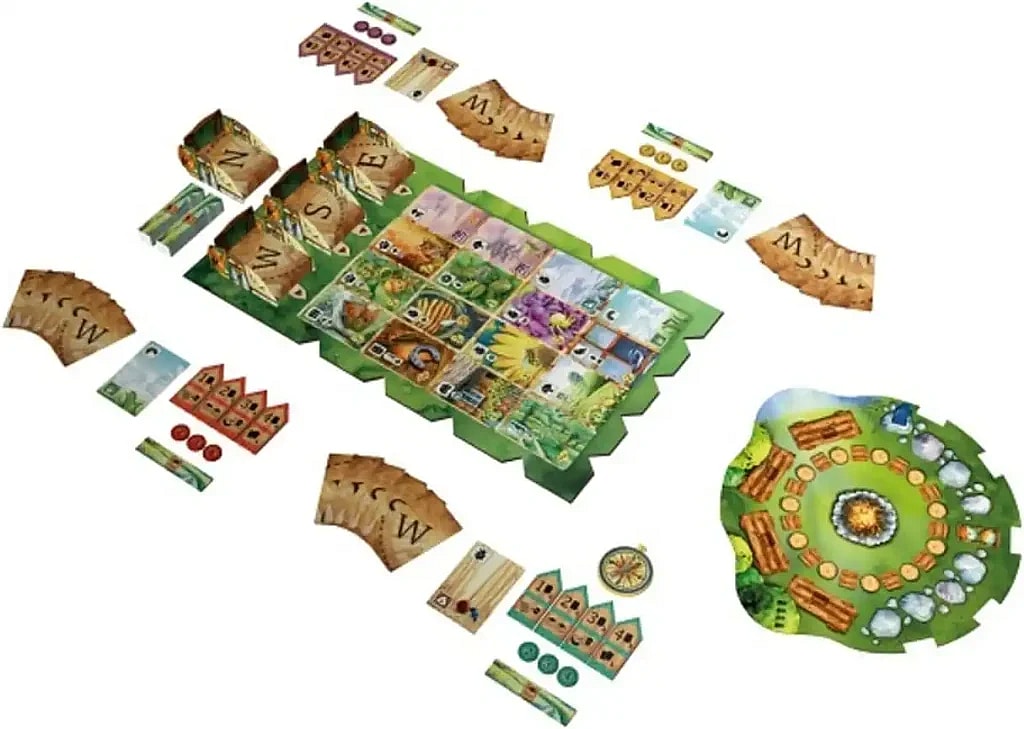
Board Setup
- Place the main board in the center of the table.
- Keep the road tokens and round marker nearby and within reach.
- Insert 3 of the 4 deck holders into the designated slots on the main board and set the remaining deck holder next to the board.
- Separate the cards by deck back (N, S, E, W), shuffle each, and place them into their respective holders.
- Starting Decks: At the beginning of the game, use the West (W), South (S), and East (E) decks.
- Later in the game, the South (S) deck will be replaced by the North (N) deck.
- Choose the correct campfire board for your player count (2, 3, or 4 players). Place it beside the main board with the side showing the correct number of players. Return the unused board to the box.
- Fill every space on the board with face-up cards from the corresponding decks:
- The left column has 4 W cards, and the next two columns each have 4 S cards.
- Shuffle all Goal Tokens, then place one face-up on each square goal space on the campfire board. Return any extras to the box (a 4-player game uses all 11).
- Place the round marker on the first rock of the round tracker.
- Depending on player count:
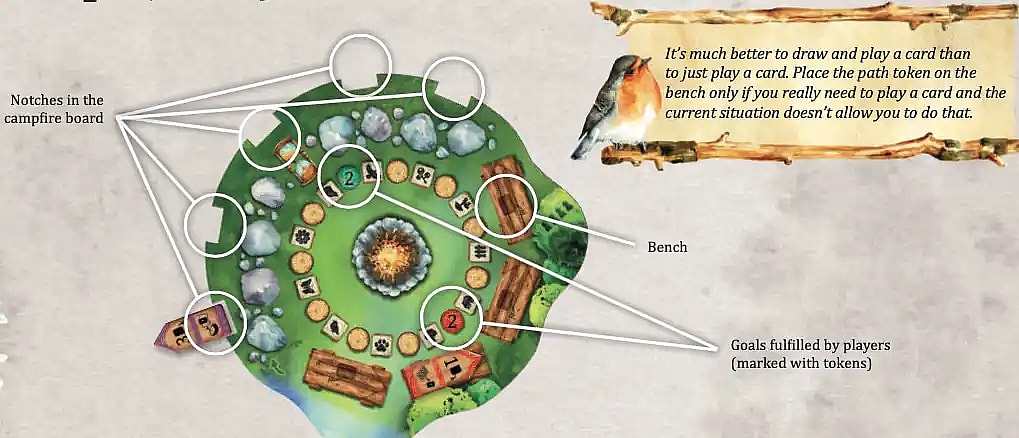
- 2 Players: Block 2 campfire notches.
- 3 Players: Block 1 campfire notch.
- 4 Players: No notches are blocked.
- The player most recently stung by a bee receives the First Player Token and will start the game.
Player Setup
Each player chooses a color and takes:
- 5 Path Tokens (return the “?” token to the box in a 4-player game)
- 3 Bonus Tokens
- 1 Road Token (road symbol face-up)
- 1 Two-Sided Starting Ground Card
Starting Hands
Each player begins with 5 cards, chosen as follows:
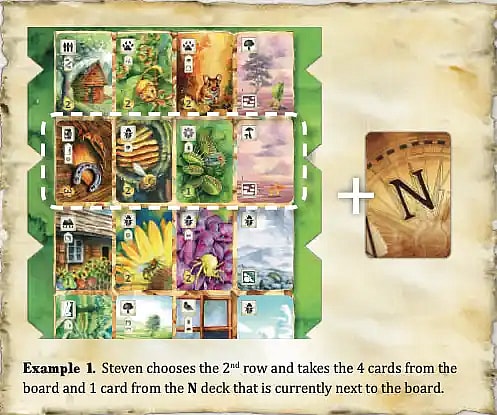
- Starting with the player to the right of the first player and moving counterclockwise, each player selects a row from the main board and takes all 4 cards from that row.
- Each player then draws 1 card from the N deck (the unused deck at the start).
- Refill the empty spaces on the main board from the appropriate decks after each player’s selection.
Beginner Setup Tip: For your first game, deal each player a random hand instead:
- 1 W card
- 2 S cards
- 1 E card
- 1 N card
Finally, each player places their Starting Ground Card (any side up) in their Meadow area as their first card.
Game Structure
Game Length
- 2 or 3 Players: 6 Rounds
- 4 Players: 8 Rounds
(Each stone on the campfire board represents one round.)
Players take turns clockwise, performing one action per turn until all Path Tokens have been used.
Player Turn
On your turn, place one Path Token in an unused notch on either:
- The Main Board, to draw and play cards, or
- The Campfire Board, to take a special action and optionally fulfill a goal.
Once placed, your token remains there until the end of the round.
Main Board Actions (Top Action)
When placing a Path Token on the main board:
- Count the number of spaces in the direction your token points (1–4, or your choice with the “?” token).
- Take the card at that distance and refill the empty spot from the same deck.
- You may now play one card from your hand into your Meadow or Surroundings area.
Playing Cards
Card Placement
Cards are played in one of two areas:
- Meadow Area: Vertically oriented Ground and Observation cards.
- Surroundings Area: Horizontally oriented Landscape and Discovery cards.
Once placed, cards cannot be moved for the rest of the game.

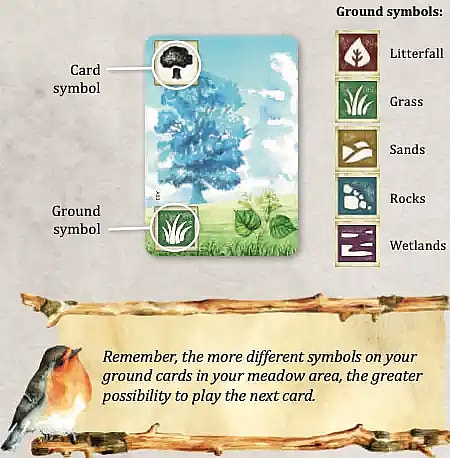
Ground Cards
- Represent natural habitats and ecosystems.
- Form the foundation of your meadow and display key symbols used for playing future cards.
- Place new ground cards to the left or right of your existing ones (up to 10 total).
- Bottom symbols must remain visible at all times.
Observation Cards
- Represent flora, fauna, and human creations observed in nature.
- Can be placed on top of a ground card or another observation card if requirements are met (symbols visible in your play area).
- May have 1 or more required symbols.
- Arrows on a card mean it must be played adjacent to a column containing that symbol.
If you’re missing a symbol, you can discard 2 cards from your hand to ignore one missing requirement, but at least one required symbol must still be met.

Landscape Cards
- Represent broad environments (mountains, forests, rivers).
- Require a Road Token to play.
- When played, flip the Road Token to show its used side.
- Some may require additional symbols, which can still be used for future cards.

Discovery Cards
- Represent items or souvenirs found during your trek.
- Played on top of a Landscape Card, covering the road symbol.
- May also require additional symbols, which remain usable afterward.
- As with other cards, you can discard 2 cards to ignore one requirement symbol (but not the road symbol).
![An illustrated gameplay example from the game Meadow shows a card being played onto another card. A watercolor card featuring a horseshoe, worth 3 victory points and requiring two ground symbols, is shown next to a second card featuring a flowering landscape, worth 2 victory points, which is highlighted with a dashed white line to show the target location. A caption below explains the action: "Example 10. Will found a horseshoe in his travels. This card requires the [landscape/mountain icon] and [flower icon] symbols. In his meadow area, Will has a visible [flower icon] symbol, so he can play this card on a landscape card."](https://officialgamerules.org/cdn-cgi/image/width=494,height=250,fit=crop,quality=90,gravity=auto,sharpen=1,metadata=none,format=auto,onerror=redirect/wp-content/uploads/2025/10/Screen-Shot-2025-10-09-at-1.37.16-PM.webp)
Campfire Board Actions (Bottom Action)
Placing a Path Token on the campfire board allows you to perform a special action and optionally claim a goal.
Special Actions
Depending on the notch used, you may:
- Take any face-up card from the main board (cannot play it this turn).
- Take 2 Road Tokens and add them to your surroundings area (cannot play cards this turn).
- Look at the top 3 cards of one deck, keep 1, and place the others on the bottom in any order (cannot play cards this turn).
- Play up to 2 cards from your hand immediately into your meadow and/or surroundings.
You may also place a Path Token on a Bench Space (symbol: 🪑) to play 1 card immediately.
Goals
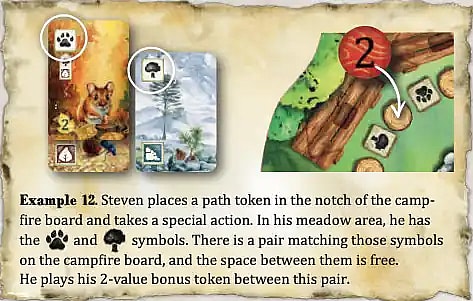
Each pair of goal tokens on the campfire board represents a combination of symbols.
If you have both symbols visible in your meadow, you may place your Bonus Token between them to claim that goal (when placing a Path Token on the campfire board).
Each bonus token’s number (2, 3, 4) equals its victory point value.
You can only claim one goal per turn, even if you qualify for more.
Halfway Point
When the round marker passes the hourglass symbol on the campfire board:
- Discard all cards on the main board.
- Replace the S Deck with the N Deck.
- Refill the board with new cards.
End of the Round
Once all players have used all their Path Tokens:
- Players collect their tokens.
- The First Player Token passes to the next player clockwise.
- Move the Round Marker forward on the tracker.
End of the Game and Scoring
After the final round:
- Count victory points from all played cards and claimed goals.
- Cards in your hand are not worth points.
- Each bonus token scores its printed value.
The player with the most total points wins!
In a tie, the player with more Discovery Cards wins. If still tied, players share victory.
Solo Mode: Playing Against Rover
In solo play, you’ll compete against Rover, an automated opponent.
Setup follows standard rules, with these changes:
- Place the solo play game token and shuffle a pile of path tokens of all other colors.
- Rover does not build a meadow but instead collects cards into a deck.
- Rover is always the first player.
- Each turn, flip a token from Rover’s pile and follow its color and number to take cards automatically.
- Rover never scores bonus tokens.
End of Solo Game
After 6 rounds, compare your score to Rover’s deck total:
- Below 39: A distracted journey.
- 40–49: Fruitful trek.
- 50–59: A memorable expedition.
- 60+: A masterful collection worthy of display.
Strategy Tips
- Diversify your symbols early. The more unique symbols you have, the easier it becomes to play higher-value cards.
- Manage hand size carefully. Discarding cards to bypass requirements can be powerful, but every card is a potential point.
- Watch the campfire goals. Securing goals early prevents opponents from claiming them first.
- Plan your Path Token placements. Blocking key cards or actions can give you a strategic advantage.
- Balance Meadow and Surroundings cards. Both are crucial for symbol synergy and end-game points.
Meadow FAQ
Only if you use the special campfire action that allows you to play up to two cards.
Shuffle its discard pile to form a new deck.
No. At least one required symbol must be present in your meadow.
No, once flipped to their used side, they remain used for the rest of the game.
Only when placing a token on the campfire board—not during main board actions.
Conclusion
To fully grasp the flow of the Meadow game rules, remember that the core of how to play Meadow involves drawing and playing cards by matching ground and requirement symbols, collecting sets of observations, and using campfire actions for bonus scoring. Success in this peaceful nature exploration game ultimately depends on skillfully building your personal meadow tableau and efficiently achieving the various goal conditions throughout the rounds.
Browse Related Games!
 Official Mancala Rules
 Official Gaia Project Rules
 Official Grand Austria Hotel Rules
 Official The Lord of The Rings: Duel for Middle-Earth Rules
 Official Guess Who? Rules
 Official Creature Caravan Rules
 Official TOSY Flying Ring Rules
 Official Mycelia Rules
 Official Aquatica Rules
 Official Battleship Reloaded Rules
 Official Pilgrim Rules
 Official Evenfall Rules