Official Grand Austria Hotel Rules

Last Updated on October 9, 2025 by The Official Game Rules Team

At the dawn of the 20th century, Vienna stood as a cultural and political hub of Europe. Artists, nobles, politicians, and tourists flocked to its grand streets — all under the watchful eye of the Emperor. In Grand Austria Hotel, you step into the role of an ambitious hotelier, striving to transform your modest café into the most prestigious establishment in Vienna.

You’ll attract guests, fulfill their culinary demands, hire staff, prepare luxurious rooms, and curry favor with the Emperor. Balancing service, expansion, and reputation is key to victory.
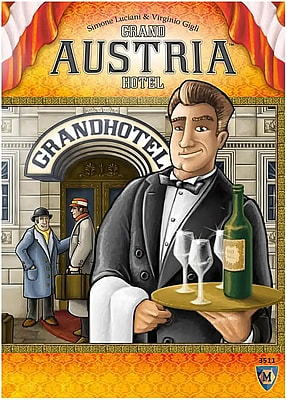
Cover art for the board game Grand Austria Hotel, featuring a smiling waiter in a tuxedo holding a tray with a green bottle of wine and three empty wine glasses, standing in front of the Grandhotel entrance with two guests carrying suitcases.

This post contains affiliate links. For more information, see our disclosures here.

How to Play Grand Austria Hotel


Overview

2–4 Players | 60–120 Minutes | Ages 12+

Components

  • 4 double-sided Hotel Boards
  • 1 Game Board
  • 1 Action Board
  • 9 Turn Order Tiles
  • 48 Staff Cards
  • 56 Guest Cards
  • 12 Politics Cards
  • 4 Overview Cards
  • 84 Room Tiles (28 each of red, yellow, and blue)
  • 120 Dish and Drink Cubes (30 of each: Coffee, Cake, Wine, Strudel)
  • 12 Emperor Tiles
  • 14 Dice
  • 24 Wooden Disks (6 in each player color)
  • 1 Round Marker
  • 1 Dustbin
  • 4 Victory Point Markers
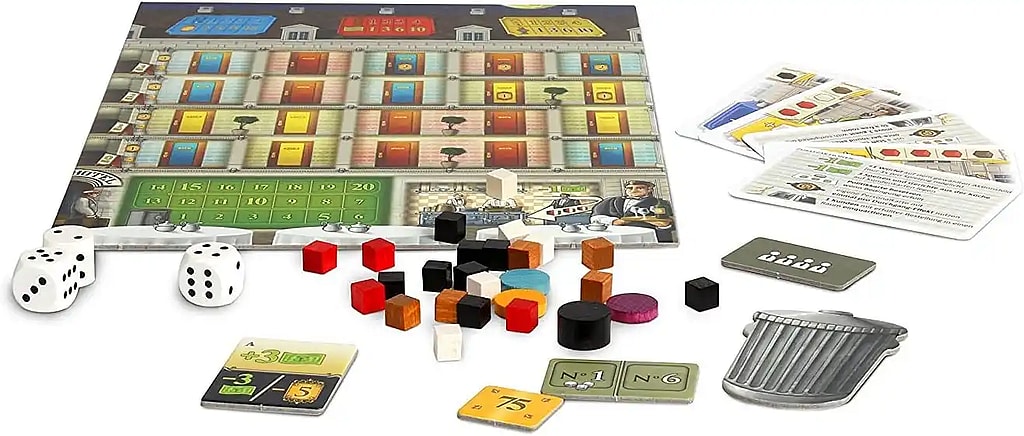
A high-angle photo shows the components of the board game Grand Austria Hotel. The main board depicts a multi-story hotel with colored doors on the upper floor and a green track for a guest seating area below, set above a hotel lobby and restaurant scene. Various components are scattered around the board, including several white six-sided dice, small wooden colored cylinders and cubes (likely customer and resource tokens), several small square and rectangular cardboard tiles displaying numbers and icons (money, action spaces), and a few larger cards with text and symbols (likely objective or staff cards). A gray, garbage-can-shaped token and a small, gray rectangular token with four person symbols are also visible.

Setup

  1. Place the Game Board in the center of the table.
    • Add the Action Board beside it.
    • Sort cubes, tiles, and decks nearby for easy access.
  2. Prepare Cards and Tiles:
    • Shuffle and place the Guest Deck face down. Reveal 5 Guests face up.
    • Shuffle the Staff Deck face down.
    • Choose one Politics Card each from sets A, B, and C, and one Emperor Tile from each group. Place them face up on the board.
    • Sort Room Tiles by color into stacks.
  3. Dice and Turn Order:
    • 2 Players = 10 Dice
    • 3 Players = 12 Dice
    • 4 Players = 14 Dice
    • Use matching Turn Order Tiles for player count.
  4. Player Setup:
    Each player takes:
    • 1 Hotel Board (choose same side for first game).
    • 1 Overview Card.
    • 6 Wooden Disks of their color.
    • Place disks on:
      • Emperor Track “0”
      • Victory Track “0”
      • Money Track “10” (start with 10 Kronen).
    • Take 1 Coffee, 1 Wine, 1 Cake, and 1 Strudel cube for your Kitchen.
    • Draw 6 Staff Cards into your hand.
  5. Determine Start Player:
    Randomly assign Turn Order Tiles “1–X”.
  6. Guest Selection (Reverse Order):
    Starting with the last player and moving counterclockwise, each chooses one face-up Guest and places it in their Café for free. Refill from the Guest Deck after each pick.
  7. Prepare Rooms:
    Each player prepares up to 3 rooms by paying the printed cost, starting from the bottom-left. Rooms must be adjacent.

You are now ready to begin the game.

A close-up shot of the main game board from the board game Grand Austria Hotel, showcasing the various tracks and card placements. The central element is the Emperor Track (the wide track numbered 1 through 13), where the game round marker is currently on space 1. Above this track are three face-up Politics Cards (A, B, and C) showing endgame scoring conditions and immediate rewards. Below the track, five face-up Guest Cards are displayed, each with a required room color (yellow, red, green, yellow, blue), a cost, and an immediate bonus or scoring effect. The perimeter of the board shows the Victory Point Track (numbered 21 down to 80), and decks of face-down cards (Staff and Room/Hotel tiles) are visible on the right side.

Objective

The game is played over 7 rounds. After rounds 3, 5, and 7, an Emperor Scoring occurs. After the final scoring at the end of Round 7, the player with the most Victory Points (VP) wins.

Victory Points are earned by:

  • Fulfilling Guests’ orders
  • Occupying rooms
  • Advancing on the Emperor Track
  • Completing Politics objectives
  • Endgame Staff and resource bonuses

Game Structure

Start of Each Round

The start player rolls all dice and places them on the Action Board according to their number (1–6).


Player Turn Sequence

On your turn, you may:

  1. Take a Guest (optional)
  2. Choose a Die and perform the Action (mandatory)
  3. Perform any number of Additional Actions (optional)

After your turn, play passes to the player with the lowest visible Turn Order number.


1. Take a Guest (Optional)

Choose one of the 5 face-up Guests:

A close-up horizontal row of five face-up Guest Cards from the board game Grand Austria Hotel, as they would appear on the main board. Each card features an illustration of a guest and shows a colored room type required (yellow, red, green, yellow, blue), the type and quantity of food/drink needed to satisfy them (represented by small icons above the colored counter), the victory points they are worth (in the upper right corner), and a reward they grant upon being served (icons on the colored counter). Below each card, a green space displays the monetary cost to take that guest, ranging from 3 krone down to 0 krone.
  • Pay its cost (shown above the slot on the board).
  • Place it into a free Café space.

If all Café spaces are occupied, you cannot take a new Guest.
Slide the remaining Guests right and reveal a new one on the left.


2. Take a Die and Perform the Action

Choose one Action Space that has dice remaining.
The number of dice indicates the strength of the action.
Remove one die after performing it and place it on your Turn Order Tile.

A close-up view of the action board from the board game Grand Austria Hotel. The board is decorated with a luxury hotel lobby theme, featuring a concierge at a central desk. Along the top, there are six action spaces, each corresponding to a different die value (1 through 6), indicated by icons representing the actions players can take (e.g., gaining food/drinks, preparing rooms, hiring staff). Several white, six-sided dice are scattered across the board, with clusters of dice clearly visible on four of the action spaces, demonstrating the dice drafting mechanic of the game.
Action 1 – Take Strudel and/or Cake

For each die, take 1 Strudel or 1 Cake.

  • You cannot take more Cake than Strudel.
Action 2 – Take Wine and/or Coffee

Same as Action 1, but choose between Wine and Coffee.

  • You cannot take more Coffee than Wine.
Action 3 – Prepare Rooms

For each die, you may prepare one Room:

  • Must be adjacent to an existing tile.
  • Pay the printed cost on your board.
  • Room color must match its space.
  • If the space shows VP, gain them immediately.
Action 4 – Advance Tracks

For each die, move 1 space on either the Emperor Track or Money Track (split as desired).

Action 5 – Hire Staff

Play a Staff Card from your hand.

  • Reduce its cost by 1 per die on this space.
  • Pay the remainder in Kronen.
A close-up shot of a hand of five Staff Cards from the board game Grand Austria Hotel. The cards are fanned out and feature illustrations of various hotel personnel, including a chef, a waiter holding flowers, and several men in formal, colorful uniforms. The bottom right corner of the foremost card shows a number and part of a portrait, likely indicating cost and a staff bonus or title, illustrating a key component of the game's strategy. In the blurred background, other game components like blue bowls and part of the main board are visible.
Action 6 – Flexible Action

Pay 1 Krone to perform any other Action (1–5).
Use the number of 6 dice to determine its strength.


3. Additional Actions

You may also perform these anytime during your turn:

  • Once per turn: Pay 1 Krone to add +1 to the chosen Action’s dice count.
  • Pay 1 Krone: Move up to 3 dishes/drinks from Kitchen to Guest cards.
  • Place a Disk on a Politics Card (if you meet its condition).
  • Use a “once-per-round” Staff Card.
  • Move a satisfied Guest to a matching room. Gain VP and their reward, then discard them.
    • Completing all rooms in a group grants an Occupancy Bonus.

Passing

If none of the available actions help, you may pass. After all players have passed or taken both actions, the player with the lowest visible Turn Order number re-rolls all remaining dice (after removing one).

Play continues until all players have taken two actions.

This image combines a rulebook example with a visual representation of the game board. The left side features text explaining a rule for the game Grand Austria Hotel: "Example: It is Andrea’s turn. She desperately needs new rooms to move her guests into. Unfortunately, all dice from Action space 3 are gone. So she passes to wait for the re-roll. After every other player has taken 2 actions, she takes the remaining dice, removes one, and rolls again. She is lucky enough to roll '3' twice. She can now take that action and prepare 2 rooms."

The right side is an illustration of the action board in a post-pass state. The action board, designed like a hotel lobby, has six action spaces along the top. Several white, six-sided dice are scattered across the board, including two showing '3' on the center desk and one showing '6' in the mirror. A small illustration of a trash bin with a die showing '3' is placed between the text and the board, visually representing the die that was removed before the re-roll.

Occupancy Bonuses

Completing all rooms in a group immediately grants:

  • Yellow Rooms: Advance on Emperor Track
  • Blue Rooms: Gain VP
  • Red Rooms: Gain Kronen

The larger the group, the bigger the reward. Each group’s bonus triggers only once.


Politics Cards

Three Politics Cards are in play each game.
When you meet a card’s condition, place one of your disks on it to immediately score the listed Victory Points.
Each player may only claim a card once.

A grid of twelve Politics Cards from the board game Grand Austria Hotel, organized into three rows (A, B, and C), which represent different phases of the game. Each card features an icon and a victory point value (or other reward) and is paired with a clear text description of the requirement needed to score the card.

The cards illustrate conditions related to:

Money/Resources ("You have 20 krones.")

Emperor Track position ("You are on space 10 of the Emperor track or higher.")

Staff Cards played ("You have played at least 6 Staff cards.")

Occupied Rooms on the Hotel board, measured by total number ("You have at least 12 Room tiles on your Hotel board."), rows, columns, groups, or specific colors ("All rooms in at least 2 rows of your Hotel board are occupied.", "All rooms of one color on your Hotel board are occupied.", "You have at least 3 occupied rooms of each color.").

Emperor Scoring

Occurs at the end of rounds 3, 5, and 7:

  1. Each player gains VP equal to the number below their position on the Emperor Track.
  2. Move your marker backward:
    • 3 spaces after Round 3
    • 5 spaces after Round 5
    • 7 spaces after Round 7
  3. Apply the result:
    • Yellow zone (3+): Gain Emperor Tile bonus.
    • Red zone (0): Suffer Emperor Tile penalty.
    • 1–2: No effect.
This image combines a rulebook explanation of game elements with a photograph of the actual components of the board game Grand Austria Hotel.

The left side of the image (taken from a rulebook) displays a grid of six Emperor Tiles—three for phase A and three for phase B—showing the various Bonuses and Penalties associated with the Emperor Scoring track. The bonuses include receiving krones (money), dishes/drinks, drawing and playing Staff cards, or preparing a room for free. Penalties include losing krones or Victory Points, or having to return dishes/drinks or an unoccupied room.

The right side of the image (a photo) shows the game components laid out. This includes the main Hotel Board showing rows of colored rooms and the green guest track, several white dice, various colored wooden tokens (cylinders and cubes for resources and customers), and several cardboard tokens (such as the number '75' VP token and the trash bin token). A small fan of cards is visible in the upper right.
This image combines a rulebook explanation of game elements with a photograph of the actual components of the board game Grand Austria Hotel.

The left side displays a grid of six additional Emperor Tiles—two for phase B and four for phase C—showing the various Bonuses and Penalties associated with the Emperor Scoring track. The bonuses involve drawing and playing Staff cards at no cost, placing and occupying Room tiles for free, or gaining a fixed number of Victory Points or points per Staff card played. Penalties involve returning Staff cards, losing Victory Points, or removing occupied or unoccupied rooms from the player's hotel.

The right side (a photo) shows the main Hotel Board from the game, depicting a multi-story hotel with rows of colored room spaces and a green guest seating track below. Various components are laid out next to it: several large white dice, a collection of wooden tokens (cylinders and cubes in red, black, brown, orange, purple, white, and teal, representing customers and resources), a gray rectangular customer token, a gray trash bin token, various square cardboard tokens (including a +3/-3 Emperor tile and a 75 VP token), and a fan of reference cards or rule summaries.

End of the Round

After each round:

  • Refresh once-per-round Staff Cards.
  • Pass Turn Order Tiles clockwise.
  • Move Round Marker forward one space.

After Round 7, conduct Final Scoring.


Final Scoring

Add together:

  • VP from Staff Cards with endgame bonuses
  • VP for Occupied Rooms
    • Row 1 = 1 VP each
    • Row 2 = 2 VP each
    • Row 3 = 3 VP each
    • Row 4 = 4 VP each
  • VP for leftover Kronen and Dishes/Drinks (1 each)
  • Subtract 5 VP for each Guest still in your Café

The player with the highest score wins.
Ties go to the player with the most remaining Kronen, Dishes, and Drinks.


Introductory Variant

Use the prearranged Staff Card Sets (A–D) for your first game.
Distribute based on player order and shuffle the rest into the deck.


Advanced Variant

For experienced players, draft your starting Staff Cards:

  1. Deal 6 cards to each player.
  2. Choose 1 to keep, pass the rest to the left.
  3. Repeat until all players have 6 chosen cards.

Strategy Tips

  • Balance Guests and Rooms: Avoid clogging your Café with guests you can’t serve; it will cost you points later.
  • Timing Matters: The dice pool shrinks fast — plan actions early to avoid weak choices.
  • Emperor Track is crucial: Falling out of favor hurts; maintain mid-level progress for safety.
  • Diversify Staff: Permanent effects stack beautifully; one-time bonuses can push key turns.
  • Group Bonuses: Complete room sets efficiently — the VP and resource rewards add up fast.
  • Don’t hoard resources: Turn them into actions and fulfilled orders before the round ends.
A very close-up shot of the left and center portion of the action board from the board game Grand Austria Hotel. The image focuses on the first three action spaces, which correspond to die values 1, 2, and 3. A stack of four white, six-sided dice showing the number '1' is visible on the far left action space (for getting food/drinks). The center of the board shows the illustration of the concierge standing behind a desk and a luggage cart holding towels/linen. Two single dice are visible on the right side of the image, one showing a '5' and one showing a '6', resting near the last action spaces. The icons for the corresponding actions are visible along the top.

Grand Austria Hotel FAQ

Can I serve a guest without a matching room available?

o. Guests stay in your Café until a matching room is ready.

What happens if I overfill my Kitchen?

You can store any number of dishes and drinks — there’s no limit.

Can I perform multiple Additional Actions in one turn?

Yes, as long as you have the resources to pay for them.

If I pass, can I act again after dice are re-rolled?

Yes, after re-rolling, you may take new actions until all players have two turns.

What if I land exactly on “0” on the Emperor Track after scoring?

You immediately suffer the penalty from the Emperor Tile.


Overview of Symbols
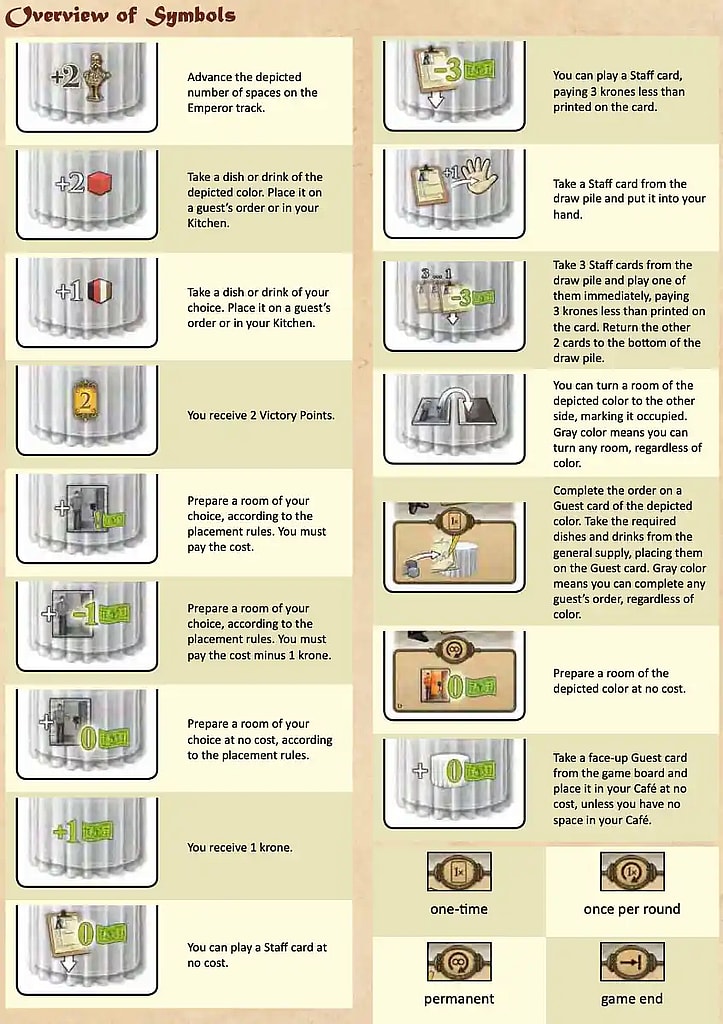
This image is a two-part composition showing the game components of Grand Austria Hotel on the left and a guide to the game's Overview of Symbols on the right.

Left Side (Game Components): A high-angle photo shows the components of the board game Grand Austria Hotel. The main board depicts a multi-story hotel with colored doors on the upper floor and a green track for guest seating below. Various components are scattered around the board, including four white six-sided dice, small wooden colored cylinders and cubes (customer and resource tokens), several small square and rectangular cardboard tiles (like the '+3/-5 Emperor tile' and '75 VP token'), a gray rectangular customer token, and a gray trash bin token. A small fan of reference or Staff cards is visible in the upper right.

Right Side (Symbol Overview): A table-like image, likely from a rulebook, titled "Overview of Symbols," displays over 20 unique icons used in the game, each with a brief text description explaining its effect. These symbols represent common actions and bonuses, such as: advancing on the Emperor Track, taking dishes/drinks (food/wine), gaining Victory Points or krones (money), preparing a room, playing or drawing Staff Cards, and completing a guest order. The bottom also shows icons for different card timing effects: one-time, permanent, once per round, and game end.

Conclusion

The core of how to play Grand Austria Hotel is learning to leverage the dice-drafting mechanism to its fullest. Over seven rounds, you must deftly combine the actions gained from the rolled dice—like gathering food, preparing rooms, and hiring staff—with the strategic placement of guests in your café. Mastering the Grand Austria Hotel rules hinges on the crucial balance: serving guests to occupy rooms and score bonuses, while advancing on the Emperor Track for mid-game victory points. The player who best manages their resources and maximizes their actions to satisfy Vienna’s elite by the final scoring after round seven will be crowned the winner.

Leave a Reply

Scroll to Top