

Last Updated on February 26, 2026 by The Official Game Rules Team
In Sagrada, players compete as stained-glass artists crafting beautiful windows inspired by the famous Sagrada Familia. Using colorful dice to represent glass pieces, you must balance strict placement rules with long-term scoring goals. Over ten rounds, players draft dice, carefully place them into their window patterns, and score points through public and private objectives. When the final round ends, the artist with the most victory points wins.
Number of Players: 1–4 | Play Time: 30-45 min | Ages: 14+

This post contains affiliate links. For more information, see our disclosures here.
How to Play Sagrada
Game Overview
- Players: 1–4
- Rounds: 10
- Core Mechanic: Dice drafting and placement
- Objective: Score the most points through objectives, efficient placement, and smart use of tools
Each die has two traits:
- Color
- Shade (number value; lower numbers are lighter shades)
Dice must be placed according to window restrictions and may never be orthogonally adjacent to a die of the same color or value.
Player Setup
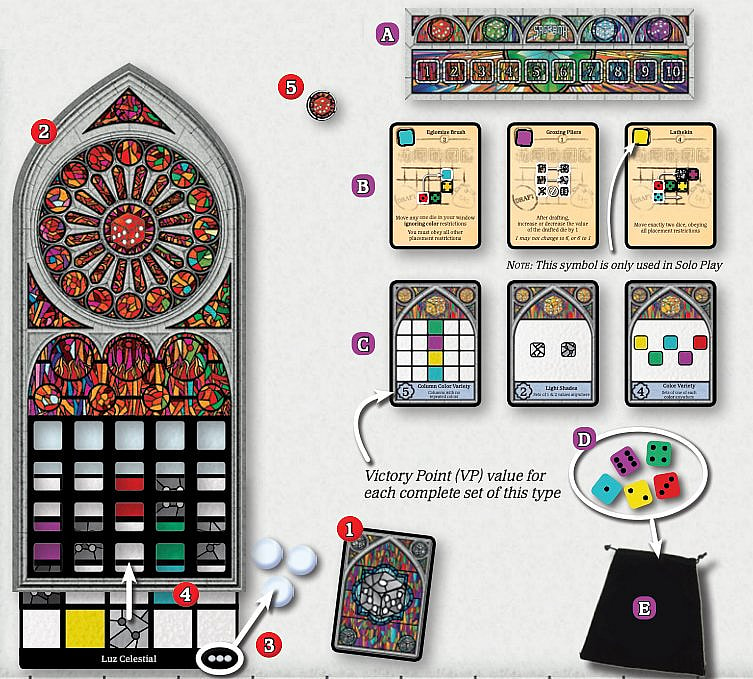
- Shuffle the Private Objective Cards and deal one face down to each player. Keep it secret.
- Give each player:
- 2 random Window Pattern Cards
- 1 Window Frame Player Board
- Each player chooses one window pattern (front or back) to use. The unused card is discarded.
- Window difficulty ranges from 3 (easy) to 6 (hard).
- Take Favor Tokens equal to your window’s difficulty number.
- Slide the chosen window pattern into your player board.
- Place your Score Marker near the Round Track.
Game Setup
- Place the Round Track in the center.
- Shuffle all Tool Cards and place 3 face up.
- Shuffle all Public Objective Cards and place 3 face up.
- Put all 90 dice into the Dice Bag.
- Randomly choose a Start Player and give them the Dice Bag.
Unused cards are returned to the box. Setup is identical for 2, 3, or 4 players.
Gameplay
The game lasts 10 rounds. Each round follows the same structure.
Rolling Dice
The Start Player draws and rolls dice from the Dice Bag:
- 2 players: 5 dice
- 3 players: 7 dice
- 4 players: 9 dice
(Always 2 dice per player, plus 1 extra)
These dice form the Draft Pool.
Taking Turns
Players take turns in clockwise order, starting with the Start Player.
Each player will take two turns per round.
On your turn, you may:
- Draft 1 die from the Draft Pool and place it on your window
- Use 1 Tool Card by spending Favor Tokens
- Do both actions, only one, or pass
After everyone has taken one turn, play reverses direction (counterclockwise) for second turns.
Dice Placement Rules
When placing a die on your window:
- First die must be placed on an edge or corner.
- All other dice must be adjacent (orthogonally or diagonally) to an existing die.
- The die must match the color or value restriction of the space.
- White spaces have no restriction.
- Dice may not be orthogonally adjacent to a die of the same color or value.
Skipping a draft is allowed, but unused dice will reduce scoring opportunities later.
Tool Cards and Favor Tokens
Tool Cards provide powerful, rule-bending abilities.
To use a Tool Card:
- Place Favor Tokens on it:
- 1 token if unused
- 2 tokens if already used
- Resolve the Tool Card effect
Tool Cards become more flexible as windows fill up, but early use is cheaper.
End of the Round
- Any remaining dice are placed on the Round Track for that round.
- Pass the Dice Bag clockwise; the next player becomes the Start Player.
- Begin the next round.
After round 10, proceed to scoring.
End Game Scoring
Players score victory points from:
- Public Objectives (may score each multiple times)
- Private Objective (sum of dice values of the chosen color)
- Unused Favor Tokens (1 point each)
Penalties:
- –1 point for each empty space on your window
Ties are broken by:
- Highest Private Objective score
- Most unused Favor Tokens
- Reverse turn order in the final round
Strategy Guide
- Choose a window pattern that complements public objectives.
- Avoid boxing yourself into corners early.
- Keep flexibility by leaving multiple placement options open.
- Save Favor Tokens for late-game corrections.
- Prioritize completing rows and columns cleanly rather than forcing placements.
Tips for New Players
- Don’t rush to place high-value dice early.
- Diagonal adjacency is often safer than orthogonal.
- Watch opponents’ windows to deny critical dice.
- Leaving spaces open early is fine—unfinished windows at the end are not.
- Tool Cards are strongest when used to fix mistakes, not create them.
Common Dice Placement Mistakes
If a window violates placement rules:
- The player must remove dice of their choice until the window is legal.
- Removed dice are discarded.
- Resulting empty spaces still count as scoring penalties.
Solo Play Rules
In solo mode, you play against a Target Score instead of other players.
Solo Setup Changes
- Favor Tokens are not used.
- Place 2 Public Objectives and 2 Private Objectives face up.
- Choose 1–5 Tool Cards depending on difficulty.
Solo Gameplay Changes
- Each round, roll 4 dice.
- Take two turns per round.
- Tool Cards are paid for using dice from the Draft Pool instead of tokens.
- Each Tool Card may only be used once.
Solo End Game
- The Target Score is the sum of dice values on the Round Track.
- Score normally, choosing one Private Objective.
- Lose 3 points per empty space.
- If your score exceeds the Target Score, you win.
Video Tutorial
Conclusion
Sagrada blends tactical drafting with tight placement rules, rewarding careful planning and adaptability. Whether playing competitively or solo, mastering spacing, timing, and objective balance is key. With practice, your stained-glass masterpiece will score higher and shine brighter every game.
FAQ
Sagrada is designed for between 1-4 players (2 is optimal).
The game always lasts exactly 10 rounds.
Yes, but unused dice move to the Round Track and can hurt scoring.
Yes, diagonal adjacency is permitted and often essential.
Yes, solo mode offers a challenging puzzle-style experience.
Some do, but only in the specific ways described on the card.
Browse Related Games!
 Official Mancala Rules
 Official Gaia Project Rules
 Official My Mine Rules
 Official The Lord of The Rings: Duel for Middle-Earth Rules
 Official Panda Royale Rules
 Official Guess Who? Rules
 Official Pilgrim Rules
 Official Creature Caravan Rules
 Official Root Rules
 Official TOSY Flying Ring Rules
 Official Mycelia Rules
 Official The Night Cage Rules