

Last Updated on March 3, 2026 by The Official Game Rules Team
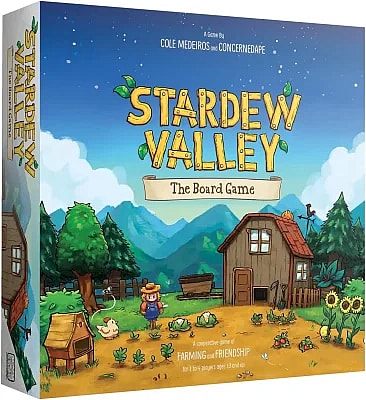
If you enjoy cooperative board games but want something relaxing and non-combative, Stardew Valley: The Board Game is perfect. Unlike games focused on conflict, this experience revolves around farming, fishing, mining, and building friendships in a quiet, charming town. You don’t need prior experience with the video game to enjoy the board game, but fans of Stardew Valley will notice familiar locations, artifacts, and beloved characters that enrich the experience.
To reflect the scope of Stardew Valley, this board game has a lot to it. Don’t let that scare you! There are many ways to customize the game to be the perfect length and challenge level for your needs. This is a complete, comprehensive guide on how to play Stardew Valley and its rules. If you want clarification, check the official pdf rulebook by clicking the button below.
This post contains affiliate links. For more information, see our disclosures here.
How to Play Stardew Valley
TABLE OF CONTENTS
- Objective
- Setup
- Game Phases
- Actions
- Variants
- Strategy
- Quick Rules Reference
- Video Tutorial
- Symbol Reference Sheet
Objective of Stardew Valley
Winning the game requires two main objectives:
- Complete Grandpa’s Goals: There are four revealed goal cards at the start of the game. These may include growing specific crops like parsnips, fishing particular types of fish, or collecting certain resources.
- Restore the Community Center: Six rooms in the Community Center each have Bundles that need to be completed. Each bundle requires donating a certain combination of minerals, crops, fish, and other resources, scaled to the number of players.
Each bundle begins facedown. To reveal a bundle, spend Heart tokens equal to the number of players. Completing at least one bundle in each of the six rooms restores the Community Center and earns rewards. Rewards may include epic items, additional resources, or access to buildings and tools like the sprinkler.
Because the game is cooperative, all objectives scale based on player count, meaning more pawns must act efficiently together to succeed.
Game Setup
Step 1: Prepare the Board and Components
Place the game board in the center of the table. Keep all dice and animal tokens within reach, as you will roll often. Shuffle the following decks:
- Villager Deck
- Item Deck
- Epic Item Deck
- Event Deck
- Mine Event Deck
- Joja Tiles
Set up the Supply Tray to hold all tiles used in the game, and position two cloth bags beside it:
- Gray bag: Holds Artifact and Mineral tiles
- Blue bag: Holds Fishing tiles, Trash, and Treasure tiles
From the Forageable Tiles, place one Parsnip tile (pink background) on the second slot beneath the Farmhouse illustration. Place it with the normal side up, not the quality side.
Step 2: Forageable and Tree Tiles
Foraging and tree tiles are seasonal. Use only Spring tiles for setup:
- Shuffle Forageable Tiles and place one facedown on each forage spot (11 total).
- Shuffle Tree Tiles and place them leaf-side up on all tree spots.
Remaining tiles are kept for later use in future seasons. Forageable tiles are often sources of fiber, minerals, or other resources, and collecting them efficiently is key to success.
Step 3: Fishing Track
Draw five random Fishing tiles from the blue bag and place them on the Fishing Track at the bottom-left of the board. The Fishing Track will replenish during the game after catching fish or discarding trash tiles.
Legendary fish have special rules: if discarded due to season card effects, they return to the bag instead of being permanently lost.
Step 4: Mine and Map Setup
Stack the Mine Level Deck from Level 1 (top) to Level 12 (bottom). Place faceup on the top-right of the board. Shuffle the Map Deck, draw one card, and place it below the Mine Level Deck. Keep the rest of the cards facedown nearby.
The mine allows players to gather stone, ore, geode, and artifact resources while navigating staircases to lower levels.
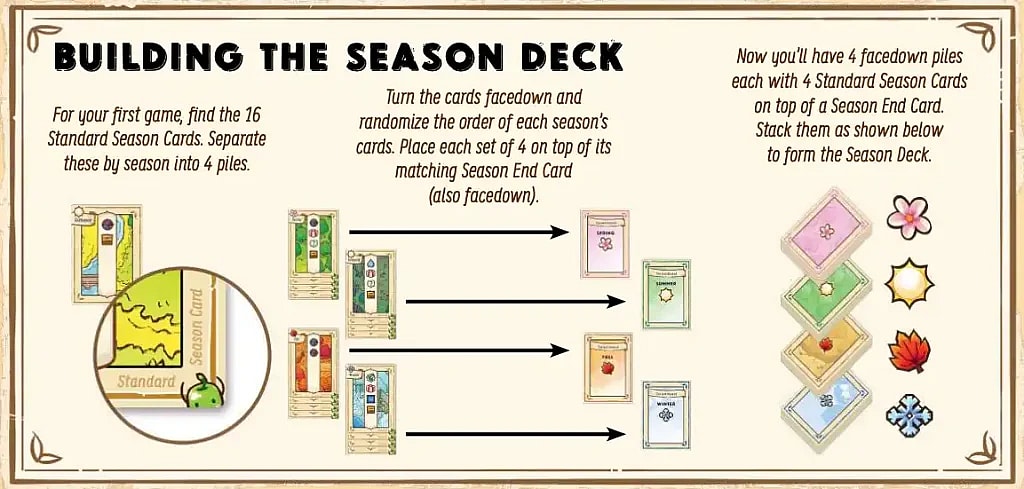
Step 5: Season Deck
The Season Deck determines the flow of the game. Build it as follows:
- Use 16 Standard Season Cards (four per season).
- Shuffle each season and place it on top of its Season End card.
- Stack decks in this order: Winter (bottom), Fall, Summer, Spring (top).
Experienced players can create a custom deck by selecting four random season cards per season.
Step 6: Community Center and Goals
For each of the six Community Center rooms, draw a Bundle card facedown. These will be revealed during the game with Heart tokens. Shuffle the Grandpa’s Goals Deck and draw four cards, placing them faceup. These are the objectives players must complete before the Season Deck runs out.

Step 7: Animals and Buildings
Separate Animal tiles into Coop and Barn stacks. Place the corresponding building tiles on top of each stack. Draw two additional building tiles and place them beneath the stacks.
Buildings are shared among players and often unlock actions like buying new animals or producing resources.
Step 8: Player Setup
Each player selects:
- A Player Mat to determine Profession
- A matching pawn
- A Starting Tool Deck, Level 0 on top
The Pet Token indicates the first player, starting with a cat or dog. All players start with three shared gold and place their player pawns on the Farmhouse space.

Round Phases Explained
Each round consists of three main phases:
- Season Phase
- Planning Phase
- Action Phase
Season Phase
The first player draws a season card and resolves the icons top to bottom:
- Quality Crop (Star): Flip a planted crop to the quality side for extra rewards.
- Rain (Water): Shift all crops one space to the right. Crops leaving the farm are harvested.
- Fish Move: Discard two fish from the right of the Fishing Track; refill from the blue bag.
- Gift (Present): Activate Villager gift abilities.
- Pet Wanders (Cat): Pass the Pet Token to the next player.
- Crow (Green or Red): Discard crops below the colored bar.
- Event (Question Mark): Draw an Event Card and resolve effects like event – gain wood or train passing.
- Joja (Joja Cola): Place a Joja tile, creating a water shortage Joja tile or other restrictions.
- Shipping Bin (Box): Trade or sell items if a shipping bin icon is present.
Season End Cards
When drawn, remove all forageable tiles and tree tiles. Replace with tiles from the next season. Each player draws two Profession Upgrade cards and chooses one to keep, discarding the other. This adds strategic depth to upgrades and resource management.
Planning Phase
Players discuss strategy and trade own items. Place pawns on locations for the Action Phase. Efficient item management and timing of first action and last action are key.
Action Phase
On your turn, you may:
- Take two actions at your current location, or
- Take one action, move along connected paths, then take a second action.
Afterward, return your player pawn to the Farmhouse and choose one End of Turn effect.
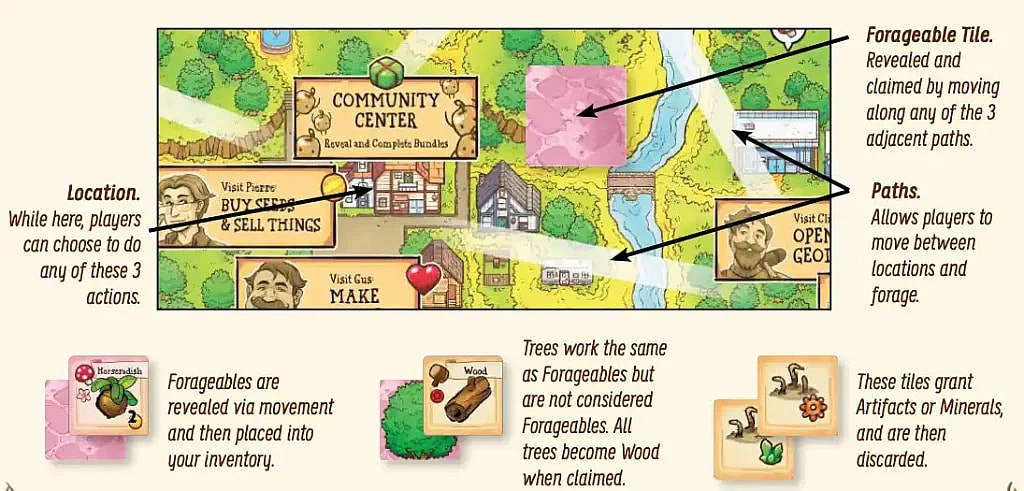
Movement and Foraging
Moving along paths lets you automatically collect one adjacent forageable or tree tile without spending an action.
- Tree Tiles always yield wood.
- Forageable Tiles may reveal fiber, minerals, or artifacts. If the back shows a gear or ore, discard and draw a new tile from the gray bag.
Tip: Plan routes for extra movement to maximize foraging without using actions.
Actions in Detail
Watering Crops
Shift planted crops one space. Crops moving off the board are harvested into your inventory. Using a sprinkler from rewards can reduce the cost of this action.
Collect from Animals
Roll three Animal Dice. Match dice symbols to your animals. Flip animals to happy side via End of Turn effects to increase yields.
Buy Animals
Animals cost gold and buildings like the Coop or Barn. Check animal tokens for the building requirement.
Buy and Plant Seeds
Purchase season-appropriate seeds. Slots under the Ranch show where to plant. You may sell items if a shipping bin icon is active.
Make a Friend
Reveal a Villager card and gift items for heart tokens. Mermaid Pendant allows marriage, placing a Spouse Pawn on the board to act like a specific player.
Reveal and Donate Bundles
Spend Heart tokens to reveal Bundles and donate resources. Rewards include epic items and access to buildings or farm benefits.
Open Geodes
Roll dice for each geode. Collect minerals or artifacts based on the roll. Multiple geodes can be opened sequentially.
Donate to Museum
Place artifacts or minerals in the Museum. Completing a column grants an Epic Item.
Buy Buildings
Visit Robin to buy buildings using wood, stone, and gold. Buildings are shared by all players.
Explore the Mine
Roll dice to gain stone, ore, geode, or encounter monsters. Use staircases to move down levels.
Fishing
Spend a fishing action at the River, Lake, or Ocean. Use dice to catch fish on the Fishing Track. Crab pot fish require Bug Meat instead of dice symbols.
End of Turn Effects
After actions, choose from:
- Build staircases in the mine
- Flip animal tiles to happy side using hearts
- Remove Joja tiles
- Upgrade Starting Tools
Inventory and Trading
Carry two items, two upgrades, six resources, unlimited epic items, and Villagers. Trade common items during the Planning Phase; profession upgrades cannot be traded. Manage discarded tiles wisely to avoid losing resources.
Game Variants
- Seedling: Tutorial, complete four Grandpa’s Goals
- Honest Farmer: Standard, complete four Grandpa’s Goals + six Bundles
- Artisan: No Joja tiles allowed
- Shorter Game: Two season cards per season; complete two Grandpa’s Goals + three Bundles
- Solo Play: Draw three Profession cards per season, keep one
Strategy Tips
- Prioritize Bundles that are easiest to complete early.
- Use End of Turn effects strategically to flip animals, remove Joja tiles, or upgrade tools.
- Collect fiber and minerals early for flexibility in fulfilling Bundles.
- Balance first action and last action to maximize efficiency.
- Plan routes for extra movement to forage tree tiles and forageable tiles simultaneously.
- Upgrade tools like the iron hoe and proficiency axe to save actions.
- Remember fish track replenishment rules when planning fishing.
Quick Rules Reference
QUICK SETUP CHECKLIST
Shuffle Villagers, Joja Tiles, Items, Epic Items, Events and Mine Events. Plant 1 Parsnip.
Place Spring Forageables and Trees on board.
Populate the Fish Track.
Stack Mine Level Cards faceup.
Shuffle Map Cards and reveal 1 faceup.
Build the Season Deck.
Place 6 Community Center Bundles facedown. Reveal 4 of Grandpa’s Goals.
Stack Animal Tiles under Coop and Barn.
Draw 2 random Building Tiles.
Each player chooses a Profession (Player Mat). Each player chooses a Starting Tool.
Give Starting Player the Pet Token.
Players collectively start with 3 Gold.
Draw the first Season Card and begin!
PHASES OF A ROUND
Season Phase: The Starting Player (denoted by the Pet Token) draws and resolves a Season Card. If it’s a Season End Card, remember that you immediately draw the next Season Card after the Season End Card has been resolved.
Planning Phase: Players discuss what they’d like to do, and then each places their pawn on any location. They may freely trade resources and items during this phase.
Action Phase: Beginning with the Starting Player, players move and take actions, following one of the options below:
Action + Action Action + Move + Action
Once a player finishes their turn, they return their pawn to the Farmhouse. They may choose 1 type of End of Turn Effect to trigger as much as they are able. Play then proceeds to the next player until all players have completed their turn, upon which the round ends and a new round begins.
SUMMARY OF ACTIONS
Water Crops: Move all planted crops in your fields 1 space to the right. Crops that leave the track are harvested.
Collect from Animals: Roll the Animal Dice. Each die symbol activates all matching animals, and each animal generates 1 resource each time they are activated.
Buy & Plant Seeds: Spend Gold to plant Crop Tiles in your fields, 1 Gold per crop planted. Place each crop directly into a field matching its watering number. You can only plant crops into empty fields. May also sell resources during this action.
Make a Friend: Draw 1 Villager Card. If you choose to gift them a resource, gain Heart Tokens and keep the card as a friend.
Reveal & Donate to Bundles: Spend Heart Tokens to reveal facedown Bundles, and donate resources to revealed Bundles.
Explore the Mine: Roll 2 Stardew Dice and use them to determine a result on the current Map Card.
Buy Buildings: Spend Gold and resources to build Buildings.
Buy Animals: Spend Gold to buy any animals for which you have the
required Building (Coop or Barn).
Open Geodes: Roll 1 Stardew Die per Geode and consult the Geode Table on the board for your reward.
Donate to Museum: Place Artifacts or Minerals from your inventory into Museum Slots with matching letters.
Go Fishing: May spend Bug Meat to catch Crab Pot Fish, 1 Crab Pot Fish per piece of Bug Meat. Then roll all 3 Stardew Dice and determine if you can catch anything at your location. If not, you may take a Trash Tile. Then refill the Fish Track.
ANSWERS TO COMMON QUESTIONS
• Crops in fields do not wither when the season changes.
• Items and resources cannot be traded during the Action Phase.
• Trash & Fiber are not very useful, but can be discarded at any time.
• The pet only moves when the Season Card triggers it to move.
• “Catch Legendary Fish” Goal: You do not need to keep Legendary Fish. • “Make Friends” Goal: It’s not required for each player to have friends. • Gold and Heart Tokens are communally shared by all players.
• Gold and Heart Tokens are not limited by components.
• When you descend at Mine Level 12, only change the Map Card.
Other Frequently Asked Questions
A: Absolutely. Understanding Grandpa’s Goals, Bundles, and resources is enough to enjoy the game.
A: They provide permanent farm benefits, like sprinklers or enhanced tools, giving strategic advantages.
A: It is removed from the game, freeing up space on the Fishing Track. Legendary fish return to the bag.
Only on Villagers with a blue seashell icon. Place a Spouse Pawn on the board to act like a specific player.
A: Players can carry two items, two upgrades, six resources, unlimited epic items, and all Villagers. Extra items must be discarded.
Common Rule Mistakes
- Forgetting rightmost fish refill rule.
- Trading during Action Phase.
- Ignoring mine depth until too late.
- Forgetting crops do not wither.
- Overproducing beyond inventory capacity.
Video Tutorial
Symbol Reference Sheet

Final Thoughts
Stardew Valley: The Board Game transforms the open-ended experience of Stardew Valley into a structured cooperative challenge. While it retains charm and thematic warmth, it demands efficiency, coordination, and careful long-term planning.
And when your group completes the final bundle just before the last Season card resolves, the victory feels deeply earned,because it was built through teamwork, planning, and smart execution across an entire in-game year.
That tension between cozy theme and tight strategy is what makes this adaptation so satisfying and why mastering the Stardew Valley board game rules truly elevates the experience.
Browse Related Games!
 Official Santorini Rules
 Official Gaia Project Rules
 Official Magnetic Chess Game with Stones Rules
 Official The Lord of The Rings: Duel for Middle-Earth Rules
 Official Mancala Rules
Official Star Wars: Rebellion Rules
Official Mancala Rules
Official Star Wars: Rebellion Rules
 Official Rococo Rules
 Official Grand Austria Hotel Rules
 Official Gnomes at Night Rules
 Official The Night Cage Rules
Official Mycelia Rules
Official The Night Cage Rules
Official Mycelia Rules
 Official Bamboo Rules