

Last Updated on May 23, 2026 by The Official Game Rules Team
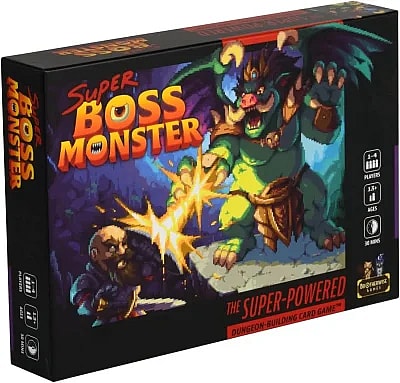
In Super Boss Monster, players become classic video game villains building dangerous side-scrolling dungeons designed to lure heroes to their doom. Instead of playing as brave adventurers, you take the role of an evil Boss creating traps, monster rooms, and deadly combinations to destroy incoming heroes before they survive your dungeon.
The game expands on the original Boss Monster formula by adding:
- A shared town board
- Worker placement mechanics
- Minion actions
- Advanced room upgrades
- More strategic hero control
Every turn, players draft cards, expand their dungeons, cast spells, and manipulate heroes while trying to collect Souls and avoid taking too many Wounds.
Your goal is simple:
- Kill heroes before they escape your dungeon
The first player to collect enough Souls wins the game, but if your dungeon fails and too many heroes survive, you may lose instead.
This post contains affiliate links. For more information, see our disclosures here.
How to Play Super Boss Monster
Super Boss Monster Components
A standard game of Super Boss Monster includes:
- Boss cards
- Room cards
- Hero cards
- Epic hero cards
- Spell cards
- Town board
- Minion pawns
- Counters and tokens
- Treasure markers
Each type of card plays a different role in building your dungeon and controlling the flow of heroes throughout the game.
Objective of the Game
Players earn:
- Souls by killing heroes
- Wounds when heroes survive the dungeon
The main objective is to:
- Collect 10 Souls
before another player does.
However, if you collect:
- 5 Wounds
your Boss is defeated and you are eliminated from the game.
This creates a balance between building aggressive dungeons and protecting yourself from dangerous heroes.
Setting Up the Game
To begin setup:
- Place the Town board in the center
- Shuffle the Room deck
- Shuffle the Spell deck
- Shuffle Hero cards separately from Epic Heroes
- Place Epic Heroes beneath the regular Hero deck
Each player then:
- Receives Boss cards
- Chooses one Boss
- Takes the matching Minion
- Draws starting Room and Spell cards
Players also build:
- Their first room
in front of their Boss.
The player whose Boss has the highest XP value becomes the first player.
Understanding Boss Cards
Your Boss card represents the villain waiting at the end of your dungeon.
Boss cards provide:
- Treasure icons
- Special abilities
- Level Up powers
- Sometimes additional Minion action spaces
Unlike rooms:
- Bosses are not part of the dungeon
- Cannot be destroyed
- Cannot be stunned
- Cannot deal damage directly
Every Boss has a powerful:
- Level Up ability
that activates once your dungeon reaches:
- Five visible rooms
for the first time.
Some Level Up effects trigger once, while others remain active for the rest of the game.
Dungeon Rooms Explained
Rooms form the core of your dungeon.
Each room provides:
- Damage
- Treasure icons
- Special abilities
- Combo effects
Rooms attract heroes based on treasure symbols while damaging them as they travel through the dungeon.
There are two major room types:
- Monster Rooms
- Trap Rooms
Both types also have:
- Advanced versions
that act as upgraded forms of existing rooms.
Ordinary vs Advanced Rooms
Ordinary Rooms
Ordinary rooms may:
- Be built at the end of your dungeon
- Be built over existing rooms
They form the foundation of your dungeon strategy.
Advanced Rooms
Advanced rooms are stronger upgraded rooms.
However, they may only be built:
- Over a room with matching treasure icons
Advanced rooms often provide:
- Higher damage
- Better combos
- Stronger abilities
Building efficient room upgrades is one of the most important parts of high-level play.
Understanding Treasure Icons
Treasure icons determine:
- Which heroes are attracted to your dungeon
The treasure types include:
- Cleric
- Fighter
- Mage
- Thief
- Explorer (expansion content)
The more treasure symbols of a certain type you have, the more likely those heroes will enter your dungeon during the Bait phase.
Balancing treasure types is extremely important because attracting too many strong heroes can become dangerous.
Hero Cards
Heroes appear in the Town every round waiting to be lured into dungeons.
Heroes have:
- Health values
- Treasure preferences
- Sometimes special abilities
Ordinary heroes are silver, while:
- Epic Heroes are gold
Epic heroes appear later in the game and are much more dangerous.
Souls and Wounds
When a hero dies in your dungeon:
- It becomes a Soul
When a hero survives:
- It becomes a Wound
Ordinary heroes count as:
- 1 Soul or 1 Wound
Epic heroes count as:
- 2 Souls or 2 Wounds
Managing this balance is the entire focus of the game.
Turn Structure
Every turn follows several phases:
- Town Phase
- Build Phase
- Minion Phase
- Bait Phase
- Adventure Phase
- Cleanup Phase
Understanding how these phases interact is essential for mastering the game.
Town Phase
During the Town Phase:
- New heroes enter town
- The Market is restocked
- Players place Minions
The Town board includes several locations:
- Temple
- Stadium
- Library
- Hideout
- Tavern
Each location provides unique action spaces and special bonuses.
Using Minions
Each player controls a:
- Minion pawn
Every turn, your Minion may visit:
- One action space
These actions can:
- Draw cards
- Grant treasure icons
- Improve room damage
- Move heroes
- Manipulate dungeons
Only one Minion may occupy each action space at a time.
Choosing where to place your Minion is one of the game’s most strategic decisions.
Landmark Actions
The various Town landmarks offer different bonuses.
Some spaces:
- Add temporary treasure icons to your dungeon
- Allow hero manipulation
- Draw rooms
- Draw spells
- Increase damage
For example:
- The Hideout can boost your last room’s damage by +2 for the turn.
Other spaces let you:
- Send heroes directly into any player’s dungeon
This creates constant player interaction and sabotage opportunities.
Build Phase
During the Build Phase:
- Players may build one room
New rooms are initially played:
- Face down
Then revealed simultaneously at the end of the phase.
Players may:
- Expand their dungeon
- Upgrade rooms
- Trigger “when built” effects
Dungeons may contain:
- Maximum 5 visible rooms
not counting the Boss card.
Leveling Up Your Boss
The first time your dungeon reaches:
- Five visible rooms
your Boss:
- Levels Up
This activates the Boss’s special ability immediately during the Build Phase.
Many Boss abilities completely reshape your strategy for the rest of the game.
Minion Phase
After rooms are built, players resolve:
- Minion actions
This is when Town actions actually occur.
Players may:
- Gain cards
- Add treasure
- Increase damage
- Send heroes to dungeons
Timing matters heavily because:
- Heroes do not leave landmarks until this phase resolves.
Bait Phase
During the Bait Phase:
- Heroes are lured into dungeons
Heroes move toward the dungeon with:
- The most matching treasure symbols
Ties usually cause heroes to remain in town.
Carefully managing treasure icons lets players:
- Control which heroes they attract
- Avoid dangerous matchups
- Steal heroes from opponents
Adventure Phase
Once heroes enter dungeons:
- They move room by room from left to right
Each room immediately deals:
- Its listed damage
If the hero’s Health reaches zero:
- The hero dies
- You gain a Soul
If the hero survives all rooms and reaches your Boss:
- You take a Wound
This phase is where all your planning either succeeds or fails.
Spell Cards
Spell cards represent magical effects and surprise interactions.
Players usually begin with:
- Two spells
Additional spells may be gained through:
- Market actions
- Card effects
Spells may be played during:
- Build Phase
- Adventure Phase
Players may cast:
- Any number of spells per turn
unless restricted by specific effects.
Spell Timing and Priority
Super Boss Monster uses:
- “Last in, first out” timing
This means:
- The most recently played spell resolves first
Players may respond to:
- Other spells
- Room abilities
- Activated effects
This creates chain reactions and counterplay opportunities throughout the game.
+1 Counters
Many cards interact with:
- +1 Counters
These counters:
- Permanently increase room damage
Each counter adds:
- +1 damage
to heroes entering that room.
Counters remain attached to rooms unless:
- Removed
- Covered
- Destroyed
Learning when to stack counters versus spreading damage is an important advanced tactic.
Destroying and Covering Rooms
Rooms may sometimes be:
- Destroyed
- Covered by upgrades
When a room is destroyed:
- It goes to the discard pile
- Rooms slide right to close gaps
If another room was underneath:
- It becomes uncovered again.
Only the top visible room in a stack counts for:
- Treasure
- Damage
- Abilities
Stun and Deactivate Effects
Some effects temporarily disable rooms.
Stunned Rooms
A stunned room:
- Deals no damage this turn
Deactivated Rooms
A deactivated room:
- Loses abilities
- Loses treasure
- Cannot deal damage
- Cannot be destroyed
until reactivated.
These effects can completely disrupt carefully planned dungeon combos.
Winning the Game
The game ends when:
- A player gains 10 Souls
- Or only one Boss remains alive
If multiple players trigger endgame conditions simultaneously:
- Tiebreakers apply
Players with the highest Soul count win.
Super Boss Monster Strategy Tips
Balance Treasure Types
Attracting only one hero type makes your dungeon predictable.
A balanced treasure spread gives better control over incoming heroes.
Upgrade Rooms Efficiently
Advanced rooms are extremely powerful.
Try building upgrade paths early so you can evolve your dungeon later.
Protect Yourself From Wounds
Aggressive strategies are risky if heroes survive.
A few failed turns can quickly eliminate you from the game.
Use Minions Carefully
Minion placement often matters more than card drafting.
Timing hero movement and bonus treasure correctly can swing entire rounds.
Save Spells for Key Moments
Well-timed spells can:
- Kill critical heroes
- Cancel enemy plans
- Protect your dungeon
- Steal victory late in the game
Super Boss Monster FAQ
How many players can play?
Super Boss Monster supports:
- 1–4 players normally
- Up to 6 with expansions
What happens when a hero survives?
That hero becomes a Wound beneath your Boss.
How many rooms can a dungeon have?
A dungeon may have:
- Maximum 5 visible rooms
not including the Boss card.
Can you play multiple spells in one turn?
Yes. Players may cast multiple spells during valid phases.
What are Epic Heroes?
Epic Heroes are stronger late-game heroes worth:
- 2 Souls
- or 2 Wounds
Final Thoughts on Super Boss Monster Rules
Super Boss Monster combines dungeon building, worker placement, drafting, and player interaction into a highly strategic tabletop experience inspired by classic retro video games. Every turn forces players to balance offense, defense, hero management, and long-term dungeon planning.
The game rewards:
- Smart room combos
- Careful treasure control
- Clever spell timing
- Efficient Minion placement
While the rules may seem complex at first, the gameplay becomes incredibly satisfying once players understand how the different phases connect together.
Whether you are creating deadly trap chains, manipulating heroes into rival dungeons, or unleashing powerful Boss abilities, learning the Super Boss Monster rules opens the door to one of the most
Browse Related Games!
 Official Clue Escape: The World’s Fair Rules
 Official Mancala Rules
 Official Gaia Project Rules
 Official Panda Royale Rules
 Official Codenames: Pictures Rules
 Official Castle Panic Rules
 Official Evenfall Rules
 Official House of Danger Rules
 Official TOSY Flying Ring Rules
 Official The Lord of The Rings: Duel for Middle-Earth Rules
 Official Concordia Rules
 Official Herd Mentality Rules